. 2017 Jan 17;8(3):4530-4542.
doi: 10.18632/oncotarget.13889.

Ameloblastoma RNA profiling uncovers a distinct non-coding RNA signature

Affiliations

Ameloblastoma RNA profiling uncovers a distinct non-coding RNA signature

Haleh Davanian et al. Oncotarget. .

Abstract

Ameloblastoma of the jaws remains the top difficult to treat odontogenic tumour and has a high recurrence rate. New evidence suggests that non-coding RNAs (ncRNAs) play a critical role in tumourgenesis and prognosis of cancer. However, ameloblastoma ncRNA expression data is lacking. Here we present the first report of ameloblastoma ncRNA signatures. A total of 95 ameloblastoma cases and a global array transcriptome technology covering > 285.000 full-length transcripts were used in this two-step analysis. The analysis first identified in a test cohort 31 upregulated ameloblastoma-associated ncRNAs accompanied by signalling pathways of cancer, spliceosome, mRNA surveillance and Wnt. Further validation in an independent cohort points out the long non-coding (lncRNAs) and small nucleolar RNA (snoRNAs): LINC340, SNORD116-25, SNORA11, SNORA21, SNORA47 and SNORA65 as a distinct ncRNA signature of ameloblastoma. Importantly, the presence of these ncRNAs was independent of BRAF-V600E and SMO-L412F mutations, histology type or tumour location, but was positively correlated with the tumour size. Taken together, this study shows a systematic investigation of ncRNA expression of ameloblastoma, and illuminates new diagnostic and therapeutic targets for this invasive odontogenic tumour.

Keywords: ameloblastoma; biomarkers; gene expression analysis; ncRNA; transcriptome.


Conflict of interest statement

CONFLICTS OF INTEREST

The authors declare that they have no conflicts of interest.

Figures
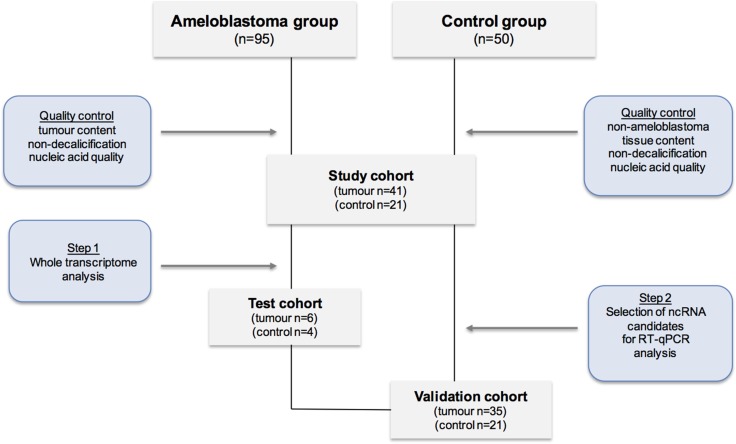
Figure 1
Figure 1. Flowchart describing the study design
Figure 2
Figure 2
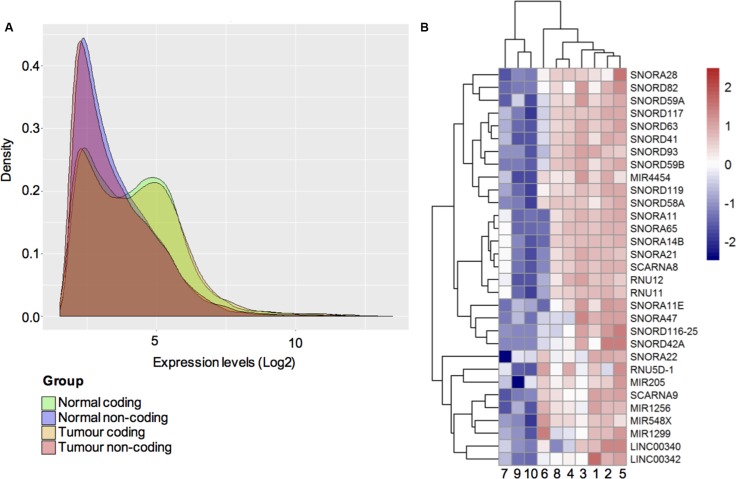
(A) Distribution of gene expression levels. A frequency histogram representing the distribution of expression levels of protein-coding and ncRNA transcripts in ameloblastoma tumours and non-ameloblastoma control tissues. The green peak indicates the expression of protein-coding genes in control tissue, orange peak distribution of coding genes in ameloblastoma, whereas pink peak indicates the expression of ncRNA in ameloblastoma tumours and purple peak the non-ameloblastoma control tissues. (B) Heat map and clustering dendrogram illustrating differential expression of ncRNAs in ameloblastoma and non-ameloblastoma tissue. In total 31 significantly upregulated ncRNAs were expressed in ameloblastoma tumour samples (samples: 1, 2, 3, 4, 5, 6) as compared to non-ameloblastoma control tissue (samples: 7: follicular cyst; 8: Oral lichen planus; 9–10: periradicular granuloma). The colour scale shown illustrates the relative expression level of ncRNAs across all samples. Colours can be interpreted using the scale where red colour represents an expression level > 2.0 in fold change and blue colour represents expression level <−2.0 in fold change. The length of the branch between two samples correspond to degree of similarity between the expressions of ncRNAs.
Figure 3
Figure 3. Uniquely expressed ncRNAs in ameloblastoma tumours
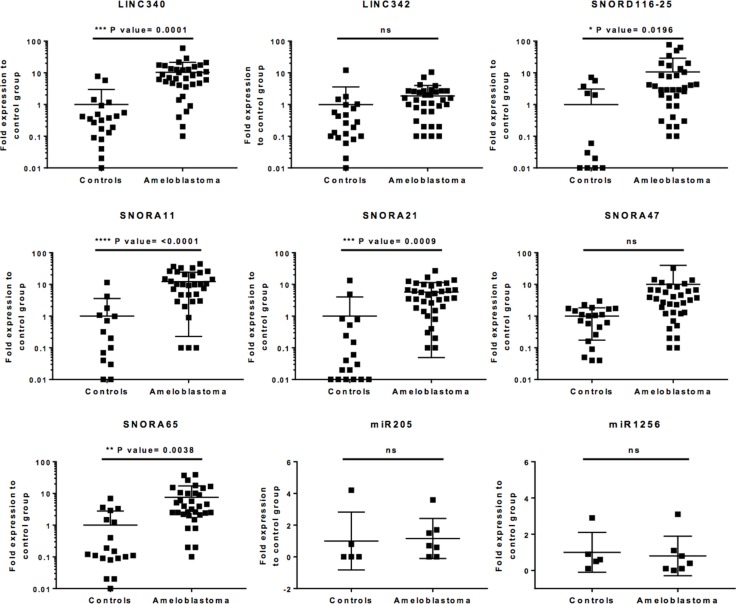
Total RNA-extracted (DNAse treated) from 35 ameloblastoma samples and 21 non-ameloblastoma oral tissues were tested in qPCR using site-specific primers for each ncRNA candidate showing significantly increased relative expression in microarray or high cancer relevance. Dot plots show the individual ncRNA fold expression level of each tumour sample relative to the expression level of control group, including the group mean values, standard deviations and p-values. To normalise the ncRNA expression level, internal controls, GAPDH and RNU48 were used. Unpaired 2-tailed t-tests, was used for statistical comparison between the groups, statistical significance was defined as p-value < 0.05.
Figure 4
Figure 4
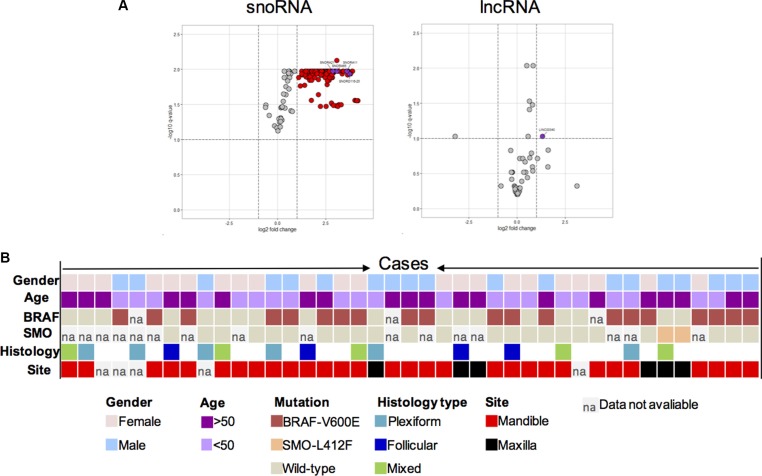
(A) Volcano plots of microarray data for snoRNA (A) and lincRNA (B) on microarray data. The data is plotted as log2 fold change versus the −log10 of the adjusted q-value. Thresholds are shown as dashed lines. ncRNAs that were significantly upregulated and confirmed in the validation cohort are shown as purple dots. ncRNAs that are significantly up-regulated are shown as red dots, as compared with non-tumour control tissues 7, 9, and 10. (B) Mutation frequency, distribution and relationship with pathological features. Information on age, gender, mutation status for the BRAF-V600E and SMO-L412F, histology as well as anatomical site is included below for each case, where each column represents a single case (in total 41). Colours correspond to a patient age, sex, and tumour mutation (BRAF-V600E; SMO-L412F), histology and anatomical site.
Figure 5
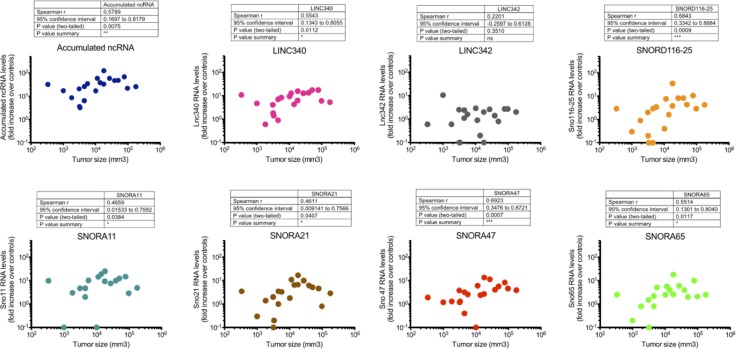
Figure 5. Association between ncRNAs fold expression and tumour size
LINC340, SNORD116-25, SNORA11, SNORA21, SNORA47 and SNORA65 were significantly associated with the tumour size. Spearman non-parametric correlation test, two-tailed, 95% confidence interval was used for statistical comparison. Statistical significance was defined as p-value < 0.05.

References

    1. Sweeney RT, McClary AC, Myers BR, Biscocho J, Neahring L, Kwei KA, Qu K, Gong X, Ng T, Jones CD, Varma S, Odegaard JI, Sugiyama T, et al. Identification of recurrent SMO and BRAF mutations in ameloblastomas. Nat Genet. 2014;46:722–725. - PMC - PubMed
    1. Kaye FJ, Ivey AM, Drane WE, Mendenhall WM, Allan RW. Clinical and radiographic response with combined BRAF-targeted therapy in stage 4 ameloblastoma. J Natl Cancer Inst. 2015;107:378. - PubMed
    1. Stein LD. Human genome: end of the beginning. Nature. 2004;431:915–916. - PubMed
    1. Ponting CP, Belgard TG. Transcribed dark matter: meaning or myth? Hum Mol Genet. 2010;19:R162–168. - PMC - PubMed
    1. Iyer MK, Niknafs YS, Malik R, Singhal U, Sahu A, Hosono Y, Barrette TR, Prensner JR, Evans JR, Zhao S, Poliakov A, Cao X, Dhanasekaran SM, et al. The landscape of long noncoding RNAs in the human transcriptome. Nat Genet. 2015;47:199–208. - PMC - PubMed

Substances