. 2016 Nov 29:10:601.
doi: 10.3389/fnhum.2016.00601. eCollection 2016.

Virtual Embodiment of White People in a Black Virtual Body Leads to a Sustained Reduction in Their Implicit Racial Bias

Affiliations

Virtual Embodiment of White People in a Black Virtual Body Leads to a Sustained Reduction in Their Implicit Racial Bias

Domna Banakou et al. Front Hum Neurosci. .

Abstract

Virtual reality can be used to visually substitute a person's body by a life-sized virtual one. Such embodiment results in a perceptual illusion of body ownership over the virtual body (VB). Previous research has shown that the form of the VB can influence implicit attitudes. In particular, embodying White people in a Black virtual body is associated with an immediate decrease in their implicit racial bias against Black people. We tested whether the reduction in implicit bias lasts for at least 1 week and whether it is enhanced by multiple exposures. Two experiments were carried out with a total of 90 female participants where the virtual body was either Black or White. Participants were required to follow a virtual Tai Chi teacher who was either Asian or European Caucasian. Each participant had 1, 2, or 3 exposures separated by days. Implicit racial bias was measured 1 week before their first exposure and 1 week after their last. The results show that implicit bias decreased more for those with the Black virtual body than the White. There was also some evidence of a general decrease in bias independently of body type for which possible explanations are put forward.

Keywords: Tai Chi; body ownership; implicit association test; racial bias; racism; rubber hand illusion; virtual reality.


Figures
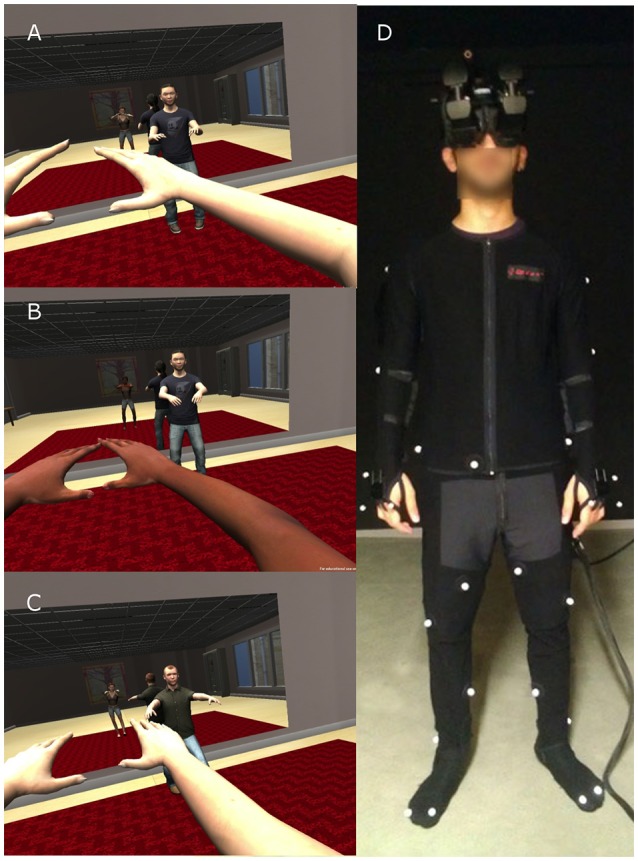
Figure 1
Figure 1
The experimental scenario, with variations in the virtual body of the participant and the teacher. (A) The participant is embodied in a White virtual body and the Teacher is Asian. (B) The participant is in a Black virtual body and the Teacher is Asian. (C) The participant is in a White virtual body and the teacher is European (Experiment 2). (D) The physical apparatus worn by participants—the head-mounted display and the motion capture suit.
Figure 2
Figure 2
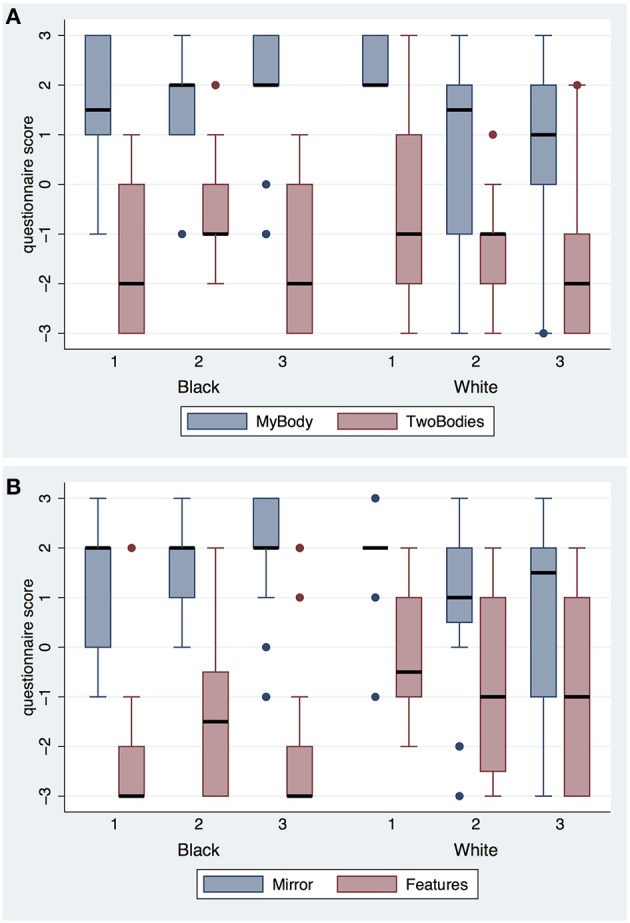
Box plots of body ownership questions by Embodiment and Exposure (A) for MyBody and TwoBodies (B) for Mirror and Features. The thick black horizontal lines are the medians, the boxes are the interquartile ranges, and the whiskers extend to ±1.5 × IQR, or the range. Individual points are outliers.
Figure 3
Figure 3
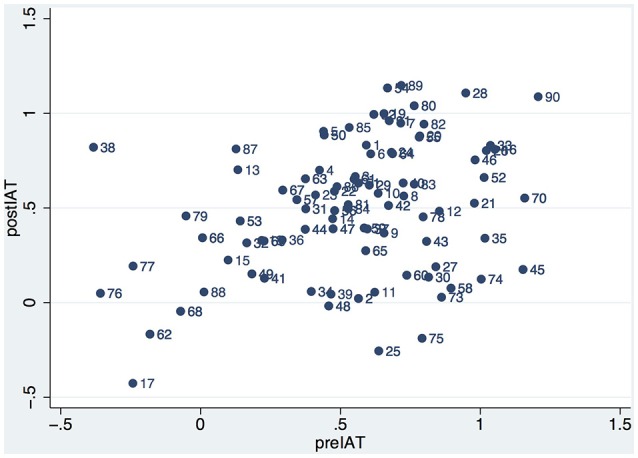
Scatter diagram of postIAT by preIAT for all participants in Experiments 1 and 2.
Figure 4
Figure 4
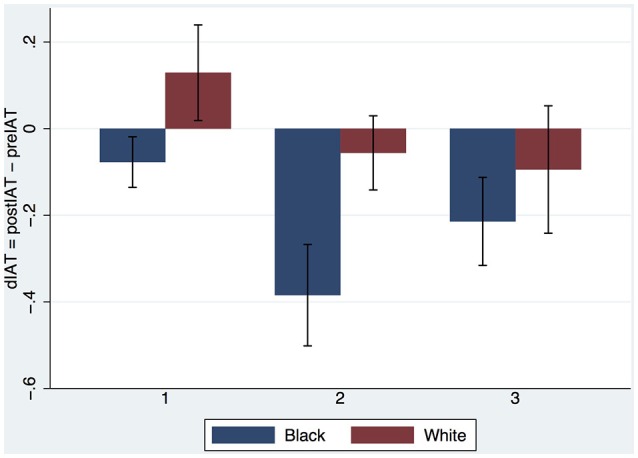
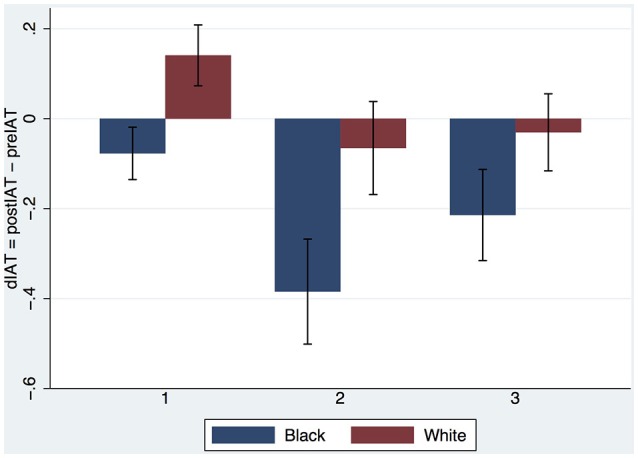
Bar chart (means and standard errors) of dIAT by Embodiment (Black, White) and Exposures (1,2,3), Experiment 1.
Figure 5
Figure 5
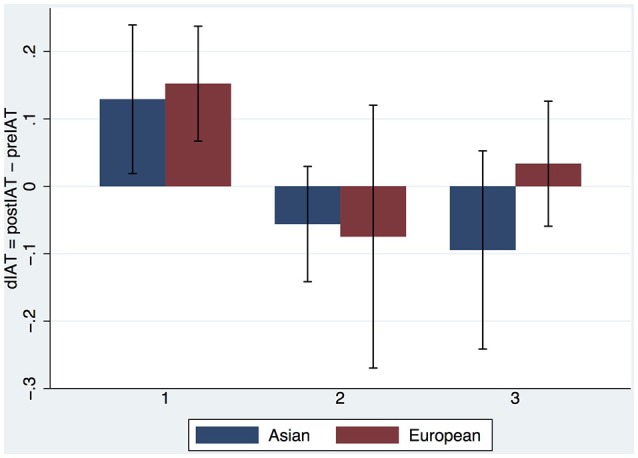
Bar chart showing means and SEs of dIAT by Teacher and Exposures.
Figure 6
Figure 6
Bar chart showing means and SEs of dIAT for all observations (n = 89) by Embodiment and Exposures.

References

    1. Ames D. L., Jenkins A. C., Banaji M. R., Mitchell J. P. (2008). Taking another person's perspective increases self-referential neural processing. Psychol. Sci. 19, 642–644. 10.1111/j.1467-9280.2008.02135.x - DOI - PubMed
    1. Banakou D., Groten R., Slater M. (2013). Illusory ownership of a virtual child body causes overestimation of object sizes and implicit attitude changes. Proc. Natl. Acad. Sci. U.S.A. 110, 12846–12851. 10.1073/pnas.1306779110 - DOI - PMC - PubMed
    1. Banakou D., Slater M. (2014). Body ownership causes illusory self-attribution of speaking and influences subsequent real speaking. Proc. Natl. Acad. Sci. U.S.A. 111, 17678–17683. 10.1073/pnas.1414936111 - DOI - PMC - PubMed
    1. Bem D. J. (1972). Self-perception theory. Adv. Exp. Soc. Psychol. 6, 1–62. 10.1016/S0065-2601(08)60024-6 - DOI
    1. Blanke O., Slater M., Serino A. (2015). Behavioral, neural, and computational principles of bodily self-consciousness. Neuron 88, 145–166. 10.1016/j.neuron.2015.09.029 - DOI - PubMed

LinkOut - more resources