


Nitrogen Source and Rate Management Improve Maize Productivity of Smallholders under Semiarid Climates
- PMID: 27965685
- PMCID: PMC5127845
- DOI: 10.3389/fpls.2016.01773
Nitrogen Source and Rate Management Improve Maize Productivity of Smallholders under Semiarid Climates
Abstract
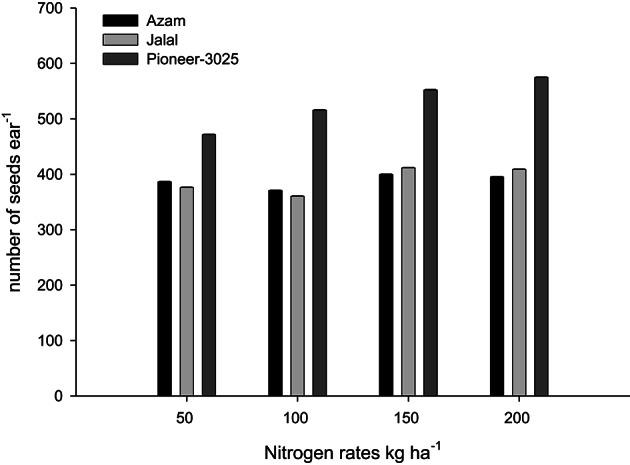
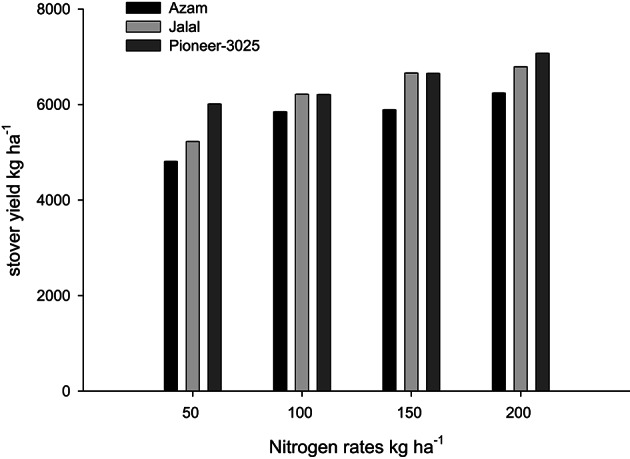
Nitrogen is one of the most important factor affecting maize (Zea mays L.) yield and income of smallholders under semiarid climates. Field experiments were conducted to investigate the impact of different N-fertilizer sources [urea, calcium ammonium nitrate (CAN), and ammonium sulfate (AS)] and rates (50, 100, 150, and 200 kg ha-1) on umber of rows ear-1 (NOR ear-1), number of seeds row-1 (NOS row-1), number of seeds ear-1 (NOS ear-1), number of ears per 100 plants (NOEP 100 plants-1), grain yield plant-1, stover yield (kg ha-1), and shelling percentage (%) of maize genotypes "Local cultivars (Azam and Jalal) vs. hybrid (Pioneer-3025)." The experiment was conducted at the Agronomy Research Farm of the University of Agriculture Peshawar during summers of 2008 (year one) and 2010 (year two). The results revealed that the N treated (rest) plots (the average of all the experimental plots treated with N) had produced higher yield and yield components, and shelling percentage over N-control plots (plots where N was not applied). Application of nitrogen at the higher rate increased yield and yield components in maize (200 > 150 > 100 > 50 kg N ha-1). Application of AS and CAN had more beneficial impact on yield and yield components of maize as compared to urea (AS > CAN > urea). Hybrid maize (P-3025) produced significantly higher yield and yield components as well as higher shelling percentage than the two local cultivars (P-3025 > Jalal = Azam). Application of ammonium sulfate at the rate of 200 kg N ha-1 to hybrid maize was found most beneficial in terms of higher productivity and grower's income in the study area. For the two local cultivars, application of 150 kg N ha-1 was found more beneficial over 120 kg N ha-1 (recommended N rate) in terms of greater productivity and growers income.
Keywords: N levels; N source; Zea mays L.; genotypes; grain yield; shelling percentage; yield components.
Figures




References
-
- Akram M., Ashraf M. Y., Waraich E. A., Hussain M., Hussain N., Mallahi A. R. (2010). Performance of autumn planted maize (Zea mays L.) hybrids at various nitrogen levels under salt affected soils. Soil Environ. 29, 23–32.
-
- Alizade O., Majidi I., Nadian H. A., Mohamadi G. H. N. (2007). Effect of drought stress and nitrogen rates on yield and yield components of corn. Int. J. Agric. Sci. 13, 427–437. 10.4172/2329-9029.1000164 - DOI
-
- Amanullah (2014). Source and rate of nitrogen application influence agronomic N-use efficiency and harvest index in maize (Zea mays L) genotypes. Maydica 59, 80–89.
-
- Amanullah (2016). Rate and timing of nitrogen application influence partial factor productivity and agronomic NUE of maize (Zea mays L) planted at low and high densities on calcareous soil in northwest Pakistan. J. Plant Nutr. 39, 683–690. 10.1080/01904167.2015.1087031 - DOI
-
- Amanullah Almas, L. K., Al-Noaim N. I. (2015a). Nitrogen Rates and Sources Affect Yield and Profitability of Maize in Pakistan. Peshawar: Crop, Forage & Turfgrass Management.
LinkOut - more resources
Full Text Sources
Other Literature Sources
Research Materials
