. 2016 Dec 10;8(12):328.
doi: 10.3390/v8120328.

Serro 2 Virus Highlights the Fundamental Genomic and Biological Features of a Natural Vaccinia Virus Infecting Humans

Affiliations

Serro 2 Virus Highlights the Fundamental Genomic and Biological Features of a Natural Vaccinia Virus Infecting Humans

Giliane de Souza Trindade et al. Viruses. .

Abstract

Vaccinia virus (VACV) has been implicated in infections of dairy cattle and humans, and outbreaks have substantially impacted local economies and public health in Brazil. During a 2005 outbreak, a VACV strain designated Serro 2 virus (S2V) was collected from a 30-year old male milker. Our aim was to phenotypically and genetically characterize this VACV Brazilian isolate. S2V produced small round plaques without associated comets when grown in BSC40 cells. Furthermore, S2V was less virulent than the prototype strain VACV-Western Reserve (WR) in a murine model of intradermal infection, producing a tiny lesion with virtually no surrounding inflammation. The genome of S2V was sequenced by primer walking. The coding region spans 184,572 bp and contains 211 predicted genes. Mutations in envelope genes specifically associated with small plaque phenotypes were not found in S2V; however, other alterations in amino acid sequences within these genes were identified. In addition, some immunomodulatory genes were truncated in S2V. Phylogenetic analysis using immune regulatory-related genes, besides the hemagglutinin gene, segregated the Brazilian viruses into two clusters, grouping the S2V into Brazilian VACV group 1. S2V is the first naturally-circulating human-associated VACV, with a low passage history, to be extensively genetically and phenotypically characterized.

Keywords: genome; outbreak; poxvirus; public health; vaccinia virus; virulence.


Conflict of interest statement

The authors declare no conflict of interest.

Figures
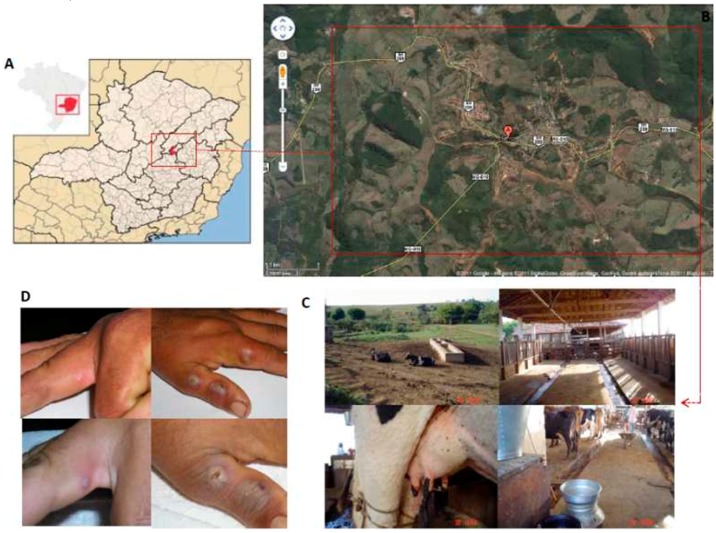
Figure 1
Figure 1
Location of Serro county Bovine Vaccinia (BV) outbreak area. (A) Brazil and Minas Gerais State maps showing Serro County (18°36’ S 43°22’ W) in red; (B) Panoramic view of the outbreak area showing relief topography and vegetation; (C) Typical milking farms landscape and infrastructure. Vaccinia virus (VACV) lesions on a cow udder and teats; (D) Lesion patterns and evolution in a primary VACV zoonosis infection. Vesicle lesion containing liquid from which S2V was isolated; vesicles evolved to pustules and ulcers with focal necrotic tissue. Areas of inflammation can be seen surrounding lesions.
Figure 2
Figure 2
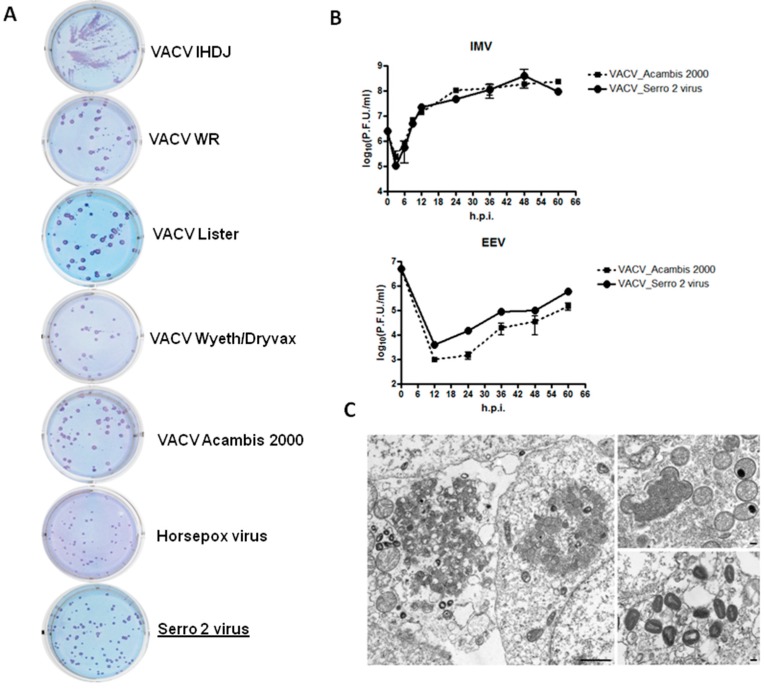
VACV strain Serro 2 virus (S2V) in vitro analysis. (A) Plaque morphology assay in BSC40 cells. For comparison, the assays were performed in parallel with a panel of vaccinia viruses from the Centers for Disease Control and Prevention (CDC) collection. Representative images of two independent experiments are shown; (B) One-step growth curves for S2V and VACV Acambis-2000. Monolayers of BSC40 cells were infected with 5 plaque forming units (PFU)/cell. At the indicated time points, cells were scraped and both cell associated viruses (CAV) and extracellular enveloped viruses (EEV) were collected and subjected to titration on the same cells. The results represent the average of two infected wells; (C) Electron microscopy of S2V-infected BSC40 cells. Typical poxvirus factories (left) contain nascent and intermediate particles, with mature viruses (MVs) within the cytoplasm. Higher magnifications of the particles show nascent (crescent-shaped) and intermediate (round-to-oval) forms within a virus factory (upper right) and MVs are found within the cytoplasm (lower right). Bars, 1 µm (left); 100 nm (upper and lower right).
Figure 3
Figure 3
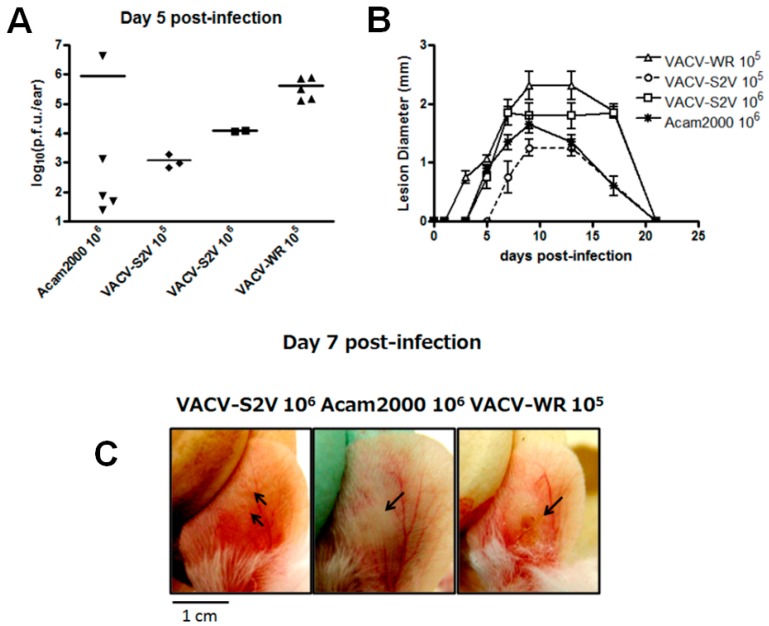
S2V in vivo analysis. In vivo intradermal infection in female BALB/c mice. Groups of five animals were infected with 106 PFU/animal of Acambis-2000 (Acam2000), 105 PFU/animal of Western Reserve (WR), and both 105 and 106 PFU/animal in the case of VACV-S2V. (A) At day 5 post-infection (p.i.), animals were humanely euthanized and ears were removed and processed for viral tritation in BSC40 cells; (B) Lesions diameter (in millimeters) in animals (n = 5) infected with the three VACV strains during 28 days post-infection; (C) Macroscopic examination of lesions in the ears of animals infected with the three VACV strains seven days post-infection. Only the higher dose is shown for VACV-S2V (106 PFU). Note that the lesion caused by VACV-S2V has virtually no surrounding inflammation, in striking contrast with lesions caused by VACV-NYCBH Acambis-2000 and VACV-WR. The photos are representative of the group indicated (n = 5).
Figure 4
Figure 4
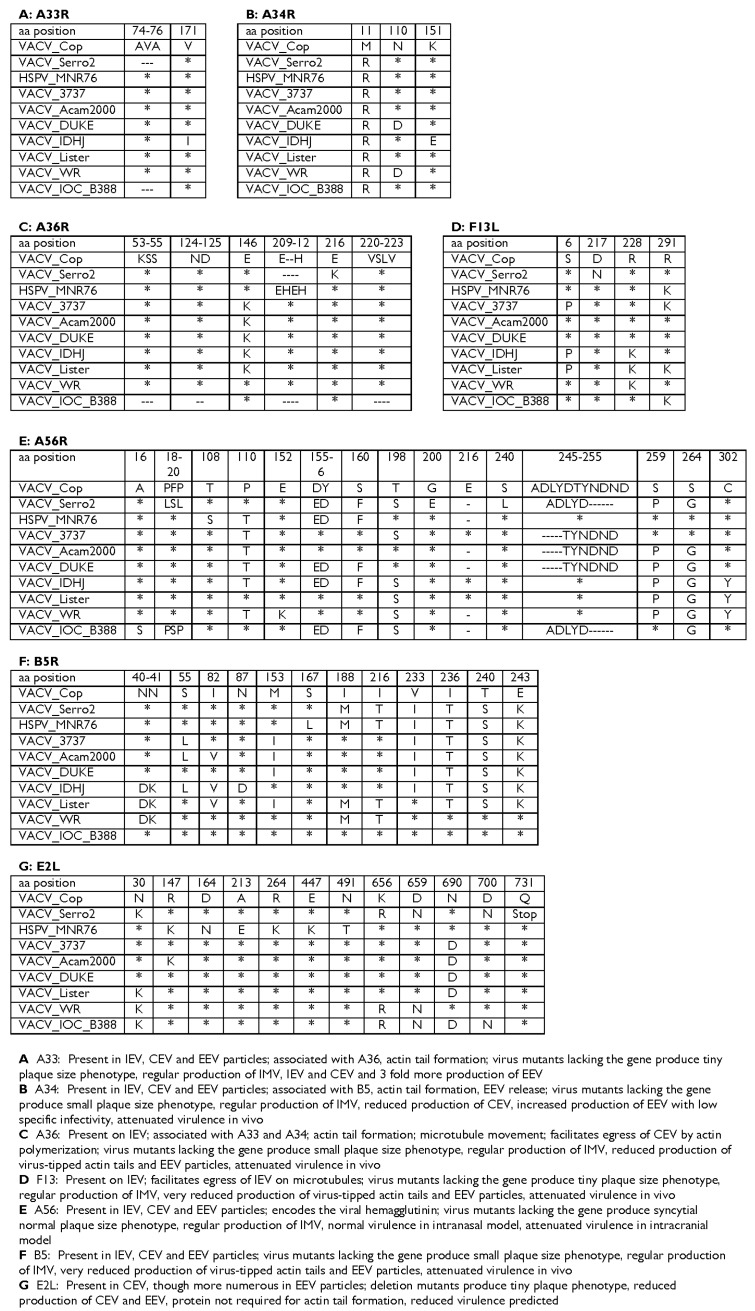
Comparison of amino acid alignments of the EEV genes associated with immune response in VACV strains, horsepox virus (HSPV), and S2V. Vaccinia Copenhagen (VACV-COP) was used as the reference sequence. Numbers at the top of each panel indicate the amino acid position in the VACV-COP protein sequence. The asterisks show conserved amino acids. The dashes show deleted amino acids.
Figure 5
Figure 5
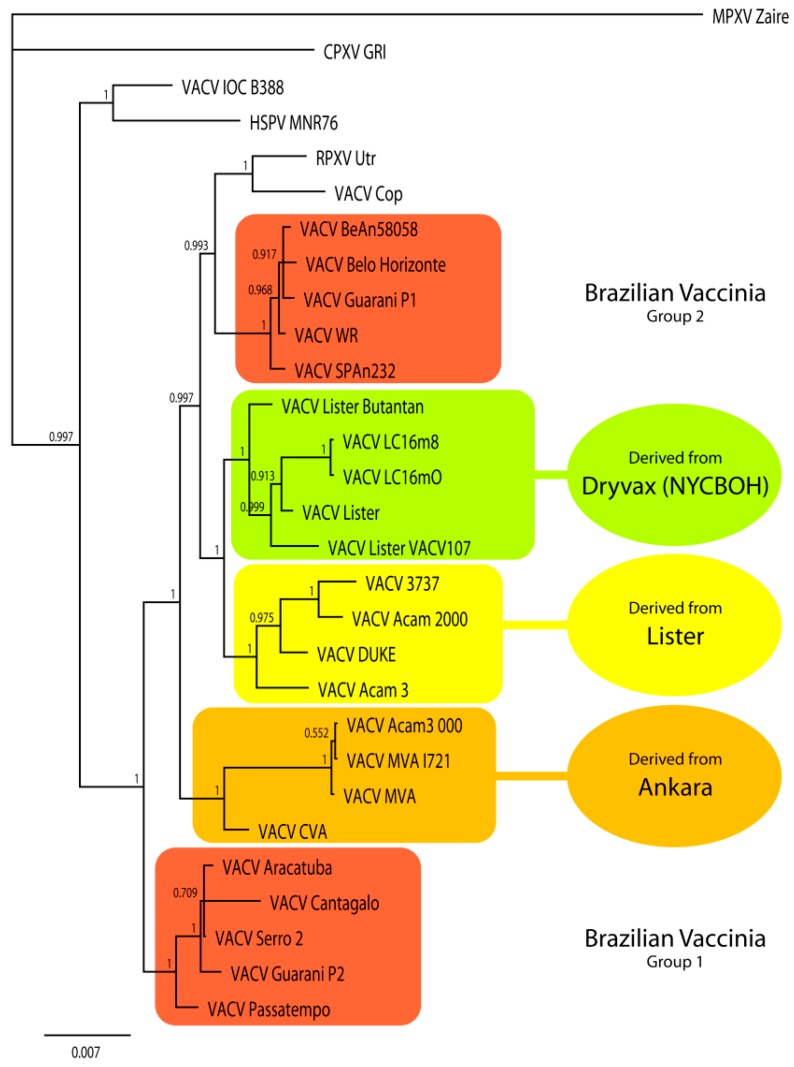
Bayesian phylogram derived from sequences of nine coding regions (B5R, B8R, B19R, C6L, C7L, E3L, K1L, K2L, and K3L) involved in immune modulation plus the A56R gene that encodes the viral hemagglutinin. Posterior probabilities label each node.

References

    1. Fenner F., Henderson D.A., Arita I., Jezek A., Ladnyi I.D. Smallpox and Its Eradication. World Health Organization Press; Geneva, Switzerland: 1988. p. 49.
    1. Smith G.L., Mackett M., Moss B. Recombinant vaccinia viruses as new live vaccines. Biotechnol. Genet. Eng. Rev. 1984;2:383–407. doi: 10.1080/02648725.1984.10647806. - DOI - PubMed
    1. Kirn D.H., Thorne S.H. Targeted and armed oncolytic poxviruses: A novel multi-mechanistic therapeutic class for cancer. Nat. Rev. Cancer. 2009;9:64–71. doi: 10.1038/nrc2545. - DOI - PubMed
    1. Damon I. Fields Virology. Raven Press; New York, NY, USA: 2007. Poxviruses; pp. 2049–2075.
    1. International Committee on Taxonomy of Viruses (ICTV) [(accessed on 1 November 2011)];2009 Available online: http://www.ncbi.nlm.nih.gov/ICTVdb/

Publication types

MeSH terms

Substances

LinkOut - more resources