Percutaneous Nephrolithotomy with Amplatz and Alken Dilators: An Eight-Year Single Tertiary Care Centre Experience
- PMID: 27973459
- PMCID: PMC5179233
- DOI: 10.12659/msm.902163
Percutaneous Nephrolithotomy with Amplatz and Alken Dilators: An Eight-Year Single Tertiary Care Centre Experience
Abstract
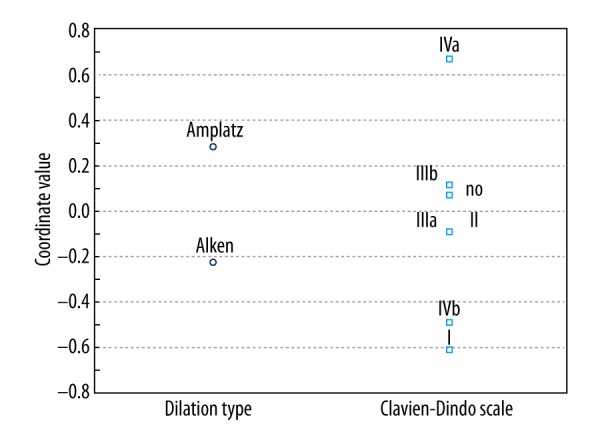
BACKGROUND Percutaneous nephrolithotomy (PNL) is the standard procedure for patients with renal stones over 2 cm in diameter. We analyzed complications after this procedure focusing on two different methods of tract dilation. MATERIAL AND METHODS Between August 2008 and April 2016 222 percutaneous nephrolithotomies were performed in a total of 208 patients. The Group I (n=123) comprised patients where Alken dilatators were used, while Group II (n=99) comprised patients where Amplatz dilators were used. Efficacy was examined based on ultrasound and x-ray examination one month after the procedure. Complications were recorded using Clavien Dindo classification. RESULTS Efficacy was 85.3% and 86.8% in group I and II, respectively (p=0.77). Grade I complications were present in 14.6% and 3%, grade II were present in 9.7% and 8%, grade IIIa were present in 2.4% and 2%, grade IIIb were present in 1.6% and 2%, grade IVa were present in 1.6% and 7%, grade IVb were present in 3.2% and 1% in Group I and Group II, respectively. These differences were statistically significant (p=0.03). CONCLUSIONS Efficacy was comparable between Alken dilator and Amplatz dilator groups. In group I, there were more postoperative fevers >38.5 °C and a higher rate of urosepsis. On the other hand, in group II we observed more pleural injuries. All differences resulted from the type of access to the kidney (inter/infracostal), punctured calyx, and utilization (or not) of access sheath rather than type of dilators itself.
Figures
References
-
- Türk C, Petřík A, Sarica K, et al. EAU guidelines on interventional treatment for urolithiasis. Eur Urol. 2016;69:475–82. - PubMed
-
- Liatsikos EN, Hom D, Dinlenz CZ, et al. Tail stent versus re-entry tube: A randomized comparison after percutaneous stone extraction. Urology. 2002;59:15–19. - PubMed
-
- Basiri A, Ahmadnia H, Moghaddam SM. The efficacy of conventional PCNL and two modifications to standard procedure. J Pak Med Assoc. 2006;56:302–5. - PubMed
-
- Shah HN, Hegde S, Shah JN, et al. A prospective, randomized trial evaluating the safety and efficacy of fibrin sealant in tubeless percutaneous nephrolithotomy. J Urol. 2006;176:2488–92. - PubMed
-
- Noller MW, Baughman SM, Morey AF, et al. Fibrin sealant enables tubeless percutaneous stone surgery. J Urol. 2004;172:166–69. - PubMed
MeSH terms
LinkOut - more resources
Full Text Sources
Miscellaneous