Antimicrobial Stewardship: How the Microbiology Laboratory Can Right the Ship
- PMID: 27974411
- PMCID: PMC5217798
- DOI: 10.1128/CMR.00066-16
Antimicrobial Stewardship: How the Microbiology Laboratory Can Right the Ship
Abstract
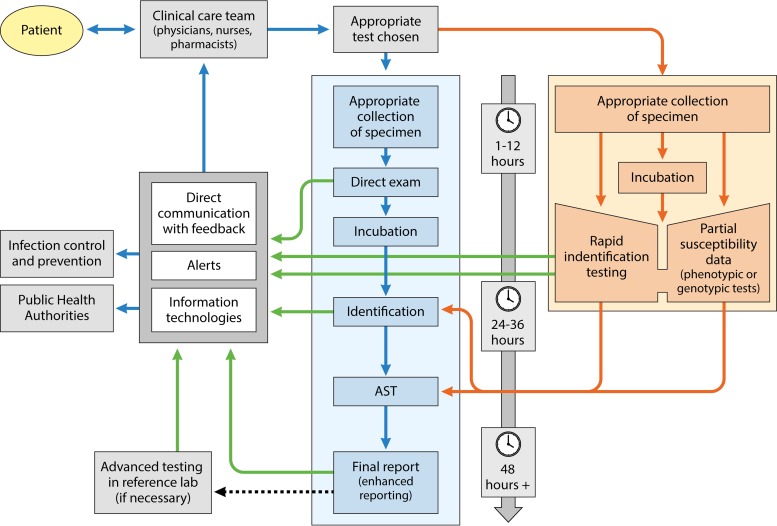
Antimicrobial stewardship is a bundle of integrated interventions employed to optimize the use of antimicrobials in health care settings. While infectious-disease-trained physicians, with clinical pharmacists, are considered the main leaders of antimicrobial stewardship programs, clinical microbiologists can play a key role in these programs. This review is intended to provide a comprehensive discussion of the different components of antimicrobial stewardship in which microbiology laboratories and clinical microbiologists can make significant contributions, including cumulative antimicrobial susceptibility reports, enhanced culture and susceptibility reports, guidance in the preanalytic phase, rapid diagnostic test availability, provider education, and alert and surveillance systems. In reviewing this material, we emphasize how the rapid, and especially the recent, evolution of clinical microbiology has reinforced the importance of clinical microbiologists' collaboration with antimicrobial stewardship programs.
Keywords: antimicrobial stewardship; antimicrobials; microbiologist; optimal use; rapid tests; role; stewardship.
Copyright © 2016 American Society for Microbiology.
Figures



References
-
- Gaynes RP. 2011. Antony van Leeuwenhoek and the birth of microscopy, p 63–77. In Gaynes RP. (ed), Germ theory: medical pioneers in infectious diseases. ASM Press, Washington, DC.
-
- Center for the History of Microbiology/ASM Archives. 2016. Significant events in microbiology 1861-1999. American Society for Microbiology, Washington, DC: https://www.asm.org/index.php/choma2/71-membership/archives/7852-signifi... Accessed 24 June 2016.
-
- McGann P, Snesrud E, Maybank R, Corey B, Ong AC, Clifford R, Hinkle M, Whitman T, Lesho E, Schaecher KE. 2016. Escherichia coli harboring mcr-1 and blaCTX-M on a novel IncF plasmid: first report of mcr-1 in the United States. Antimicrob Agents Chemother 60:4420–4421. doi: 10.1128/AAC.01103-16. - DOI - PMC - PubMed
-
- Centers for Disease Control and Prevention. 2014. Core elements of hospital antibiotic stewardship programs. Centers for Disease Control and Prevention, Atlanta, GA: http://www.cdc.gov/getsmart/healthcare/implementation/core-elements.html. - PMC - PubMed
Publication types
MeSH terms
Substances
LinkOut - more resources
Full Text Sources
Other Literature Sources
Medical