Review
. 2016 Dec 14;81(1):e00036-16.
doi: 10.1128/MMBR.00036-16. Print 2017 Mar.

Bacterial Proteasomes: Mechanistic and Functional Insights

Affiliations
Review

Bacterial Proteasomes: Mechanistic and Functional Insights

Samuel H Becker et al. Microbiol Mol Biol Rev. .

Abstract

Regulated proteolysis is essential for the normal physiology of all organisms. While all eukaryotes and archaea use proteasomes for protein degradation, only certain orders of bacteria have proteasomes, whose functions are likely as diverse as the species that use them. In this review, we discuss the most recent developments in the understanding of how proteins are targeted to proteasomes for degradation, including ATP-dependent and -independent mechanisms, and the roles of proteasome-dependent degradation in protein quality control and the regulation of cellular physiology. Furthermore, we explore newly established functions of proteasome system accessory factors that function independently of proteolysis.

Keywords: proteasome.


Figures

FIG 1
FIG 1
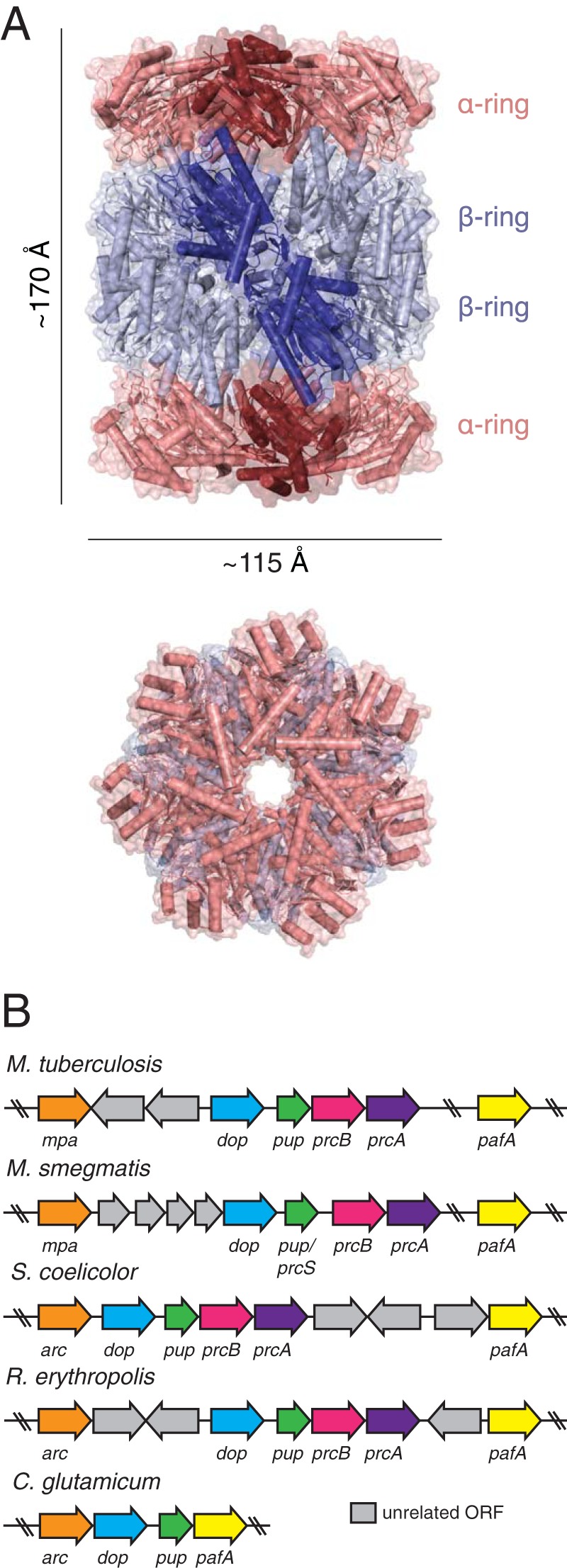
Structure of a bacterial proteasome and proteasome gene loci in select actinobacteria. (A) (Top) Crystal structure of the 20S CP from M. tuberculosis (PDB entry 2FHG). An individual subunit from each ring is shown in a darker tint. (Bottom) Top-down view of the 20S CP. (B) Proteasome gene loci in five representative actinobacterial species. C. glutamicum does not carry prcBA.
FIG 2
FIG 2
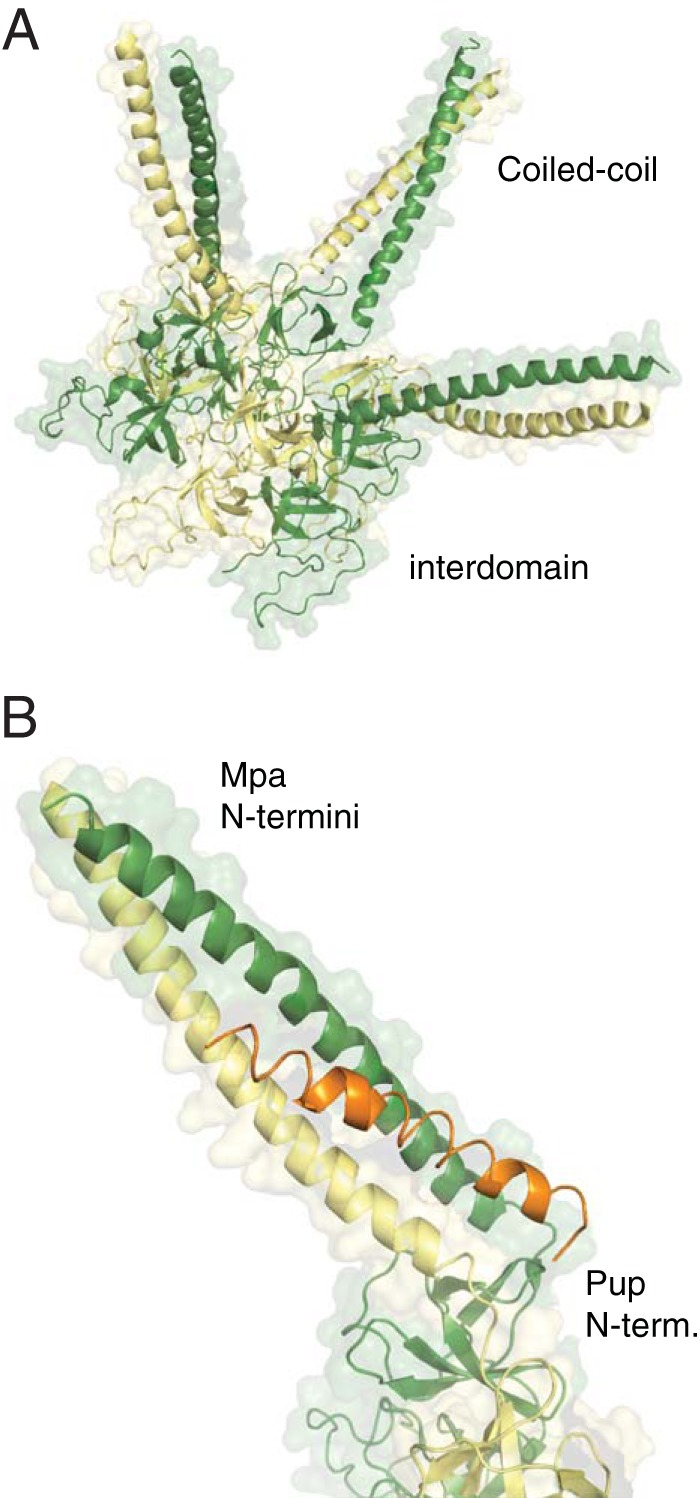
ATP-dependent degradation requires a hexameric chaperone. (A) Crystal structure of a hexamer composed of Mpa1–234 monomers from M. tuberculosis (PDB entry 3M9D). Shading is used to mark individual subunits; two domains of Mpa are indicated. (B) Crystal structure of an Mpa coiled-coil domain (green shades) bound to Pup21–64 (orange), demonstrating binding-induced folding of Pup by Mpa.
FIG 3
FIG 3
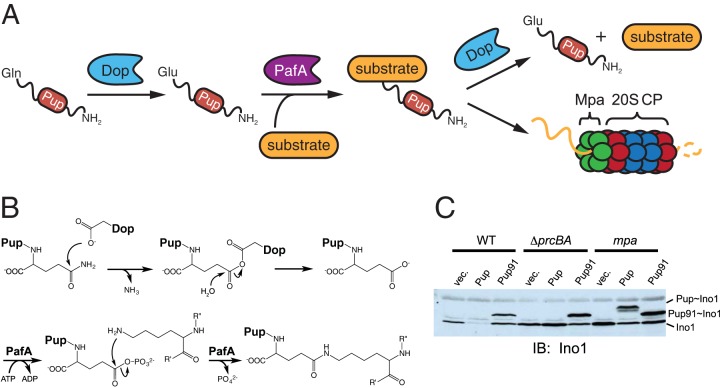
ATP-dependent degradation requires pupylation. (A) From left to right, Pup is deamidated at its C terminus by Dop, producing PupGlu; PafA ligates PupGlu to a substrate; and a pupylated substrate can either be depupylated by Dop or be degraded by the proteasome. (B) Proposed mechanisms of deamidation and pupylation. Starting from top left, the Pup C-terminal Gln is attacked by a nucleophilic Asp in Dop, forming a Pup-Dop intermediate; Pup undergoes a nucleophilic attack by water, activated by Dop, to yield PupGlu; PafA uses ATP to phosphorylate the γ-carboxylate of PupGlu; and nucleophilic attack by a substrate Lys residue results in the covalent linkage of Pup to a substrate. Another mechanism of Pup deamidation has been proposed, in which the Dop Asp residue coordinates a water molecule and nucleophilic attack by this activated water results in deamidation (66). (C) Depupylation of a pupylated substrate in M. smegmatis requires an intact Pup N terminus as well as Mpa. The top labels indicate the M. smegmatis strain background, as follows: WT, wild-type strain; ΔprcBA, deletion mutant lacking the prcBA genes; and mpa, a strain in which the gene has been disrupted with an integrated plasmid. Lanes: vec., empty vector; Pup, overproduced full-length Pup; Pup91, overproduced truncated Pup missing 30 N-terminal amino acids. Immunoblotting (IB) was performed on cell lysates from the indicated strains by using an antibody to M. tuberculosis Ino1 (inositol-1-phosphate synthetase), a known pupylated substrate. Bands corresponding to Ino1 and its Pup or Pup91 conjugate are indicated at the right. (Reprinted from reference with permission from Elsevier.)
FIG 4
FIG 4
PafE/Bpa is an ATP-independent proteasome activator. (Top) Crystal structure of dodecameric PafE/Bpa from M. tuberculosis (PDB entry 5IET). Dashed lines approximate the extended C termini of PafE in contact with the 20S CP α-ring. (Bottom) Top-down view of PafE.
FIG 5
FIG 5
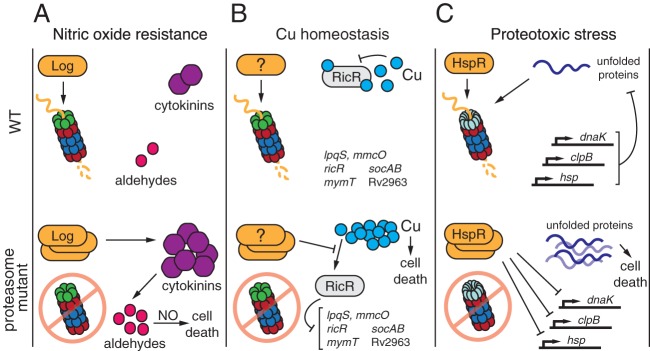
Contributions of proteasomes to the physiology of M. tuberculosis. (A) Proteasomal degradation of the cytokinin synthase Log keeps levels of cytokinins and aldehydes low. Accumulation of Log in a Pup-proteasome mutant causes increased cytokinin production. Cytokinins break down into aldehydes, which cause cytotoxicity in the presence of NO. (B) In wild-type bacteria, the transcriptional repressor RicR binds Cu+, causing its dissociation from promoters controlling the expression of Cu homeostasis genes at five loci on the M. tuberculosis chromosome. In the absence of proteasomal degradation, RicR appears to sense low intracellular Cu levels and binds to DNA, repressing expression of these genes. In the presence of elevated Cu levels, the RicR regulon may not be induced fully in a Pup-proteasome mutant. It is unclear if it is the weak induction of this regulon or another unidentified pathway that results in the hypersensitivity of Pup-proteasome system mutants to Cu. (C) The heat shock-responsive transcriptional repressor HspR, which controls expression of the protein chaperone-encoding genes dnaK, clpB, and hsp, is degraded by the PafE-proteasome. The abundance of misfolded proteins is kept low by DnaK, ClpB, and Hsp, and possibly by direct degradation by the PafE-proteasome. When degradation is disrupted, it is presumed that the failure to degrade HspR causes incomplete derepression of chaperone genes, leading to an accumulation of toxic unfolded proteins. See the text for proteasome-regulated pathways in other bacterial species.

References

    1. Kish-Trier E, Hill CP. 2013. Structural biology of the proteasome. Annu Rev Biophys 42:29–49. doi: 10.1146/annurev-biophys-083012-130417. - DOI - PMC - PubMed
    1. Streich FC Jr, Lima CD. 2014. Structural and functional insights to ubiquitin-like protein conjugation. Annu Rev Biophys 43:357–379. doi: 10.1146/annurev-biophys-051013-022958. - DOI - PMC - PubMed
    1. Forster F, Unverdorben P, Sledz P, Baumeister W. 2013. Unveiling the long-held secrets of the 26S proteasome. Structure 21:1551–1562. doi: 10.1016/j.str.2013.08.010. - DOI - PubMed
    1. Groll M, Bajorek M, Kohler A, Moroder L, Rubin DM, Huber R, Glickman MH, Finley D. 2000. A gated channel into the proteasome core particle. Nat Struct Biol 7:1062–1067. doi: 10.1038/80992. - DOI - PubMed
    1. Rabl J, Smith DM, Yu Y, Chang SC, Goldberg AL, Cheng Y. 2008. Mechanism of gate opening in the 20S proteasome by the proteasomal ATPases. Mol Cell 30:360–368. doi: 10.1016/j.molcel.2008.03.004. - DOI - PMC - PubMed

Publication types

MeSH terms

Substances