. 2016 Dec;13(125):20160800.
doi: 10.1098/rsif.2016.0800.

Uncovering emergent interactions in three-way combinations of stressors

Affiliations

Uncovering emergent interactions in three-way combinations of stressors

Casey Beppler et al. J R Soc Interface. 2016 Dec.

Abstract

Understanding how multiple stressors interact is needed to predict the dynamical outcomes of diverse biological systems, ranging from drug-resistant pathogens that are combated and treated with combination drug therapies to ecosystems impacted by environmental toxicants or disturbances. Nevertheless, extensive studies of higher-order (more than two component) interactions have been lacking. Here, we conduct experiments using 20 three-drug combinations and their effects on the bacterial growth of Escherichia coli We report our measurements of growth rates in single, pairwise and triple-drug combinations. To uncover emergent interactions, we derive a simple framework to calculate expectations for three-way interactions based on the measured impact of each individual stressor and of each pairwise interaction. Using our framework, we find that (i) emergent antagonisms are more common than emergent synergies and (ii) emergent antagonisms are more common and emergent synergies are more rare than would be inferred from measures of net effects that do not disentangle pairwise interactions from three-way interactions.

Keywords: antagonism; antibiotics; drug resistance; higher-order interactions; multiple stressors; synergy.


Figures

Figure 1.
Figure 1.
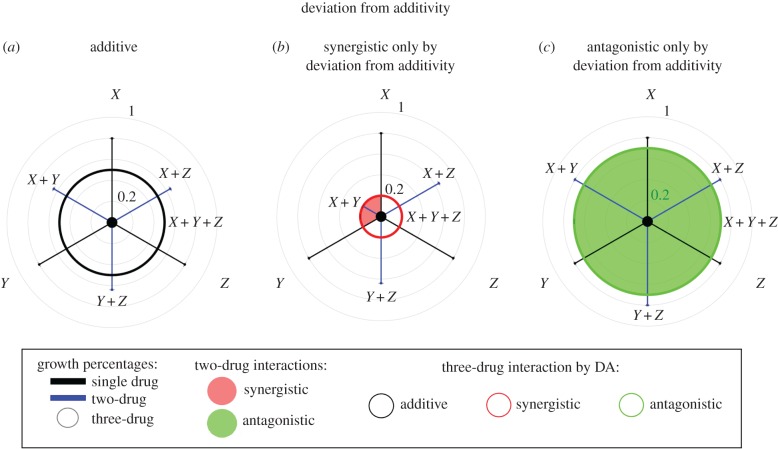
Schematic of triple-drug combination effects according to DA. Relative growth rates for bacteria populations in one-, two- and three-drug combinations are shown as increasing from 0% growth in the centre to 100% growth (no-drug control) at the largest outer circle of the polar graph. Growth rate is shown for single-drug (black bars), two-drug (blue bars with corresponding single-drug treatments adjacent) and triple-drug combinations (radius of inner circle). Shading of the inner circle indicates nature of pairwise interactions (red, synergistic; green, antagonistic; no shading, additive). Outline colouring of inner circle indicates measure of DA (black, additive; red, synergistic; green, antagonistic). Three possible triple-drug combination effects are depicted schematically for theoretical drugs X, Y and Z according to measures of DA. (a) Strictly additive interactions of all pairwise combinations and three-drug combination. (b) Synergy of three drugs according to DA. (c) Antagonistic interaction of three drugs according to DA.
Figure 2.
Figure 2.
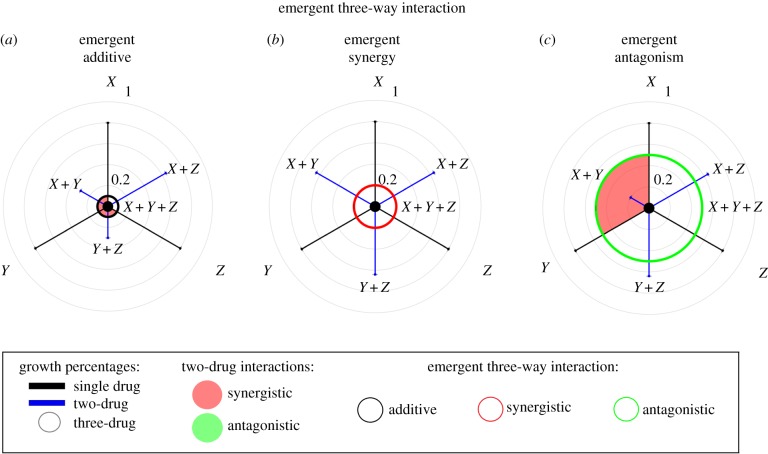
Schematic of triple-drug combination effects according to E3 interactions. Relative growth rates for bacteria populations in one-, two- and three-drug combinations are shown as increasing from 0% growth in the centre to 100% growth (no-drug control) at the largest outer circle of the polar graph. For the E3 interaction measure, the single, two- and triple-drug combination growth rates, as well as pairwise interactions, are shown with the same colour coding as used for the DA measure (figure 1), but with outline colouring of the inner circle indicating measure of E3 (black, additive; red, synergistic; green, antagonistic). Three possible triple-drug combination effects are depicted schematically for theoretical drugs X, Y and Z according to measures of E3. (a) Interactions combine additively according to E3, even though several pairwise interactions are synergistic. (b) Emergent synergy of three drugs according to E3. (c) Emergent antagonism of three drugs according to E3.
Figure 3.
Figure 3.
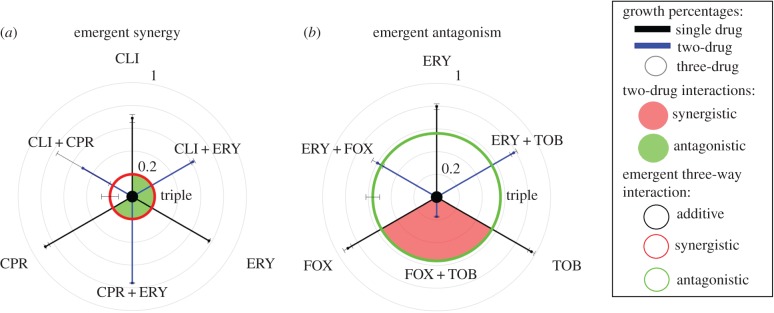
Emergent synergistic and antagonistic interactions in triple antibiotic combinations. Data for triple antibiotic figures are shown according to E3 interaction measures. Figures are presented as described in figures 1 and 2. Data are represented as median ± minimum/maximum. (a) The combination of ciprofloxacin 0.013 µg ml−1 (CPR), clindamycin 31.5 µg ml−1 (CLI) and erythromycin 14 µg ml−1 (ERY) interacts synergistically in three-drug combinations according to both DA and emergent (E3) measures. (b) The combination of ERY 14 µg ml−1, cefoxitin 1.16 µg ml−1 (FOX) and tobramycin 1.3 µg ml−1 (TOB) interacts antagonistically in three-drug combinations according to the E3 measure and additively according to the DA measure. Only data for one concentration of each antibiotic are shown, although each three-drug combination was tested in a minimum of three independent experiments (see Material and methods).
Figure 4.
Figure 4.
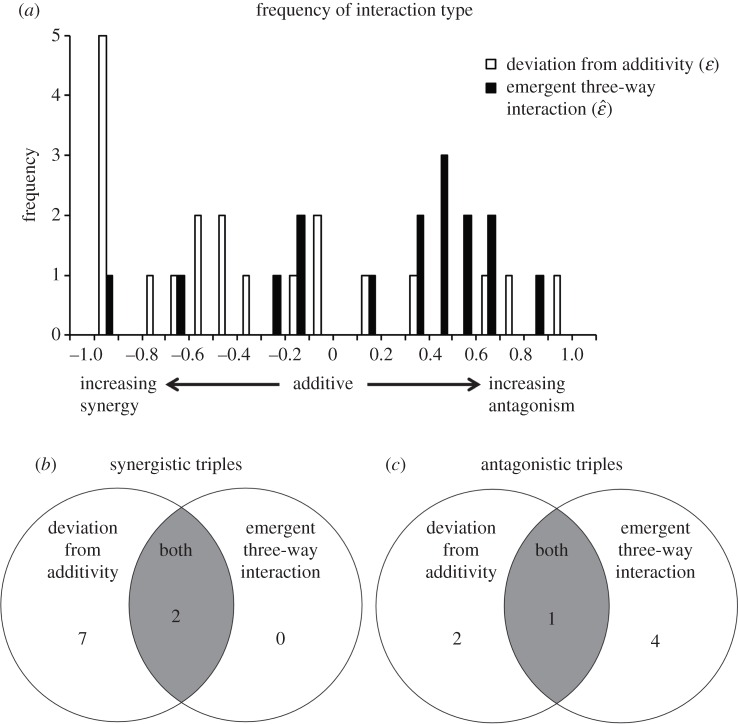
Comparing interaction measures for triple-drug combinations. Comparison of measures of DA and E3 interactions are based on 20 triple-drug combination experiments. Of the 20 combinations, E3 is non-applicable in four cases because of both two-drug and three-drug lethality. Thus, it is impossible to see the effect of the third drug. DA is applicable in all cases because this measure ignores two-drug effects. (a) Overlapping histograms for measures of DA (white bars) and E3 interactions (black bars) with bin size of 0.1. (b) Venn diagram comparing overlap between synergistic three-drug interactions according to measures of DA and E3 interactions. (c) Venn diagram comparing overlap between antagonistic three-drug interactions according to measures of DA and E3 interactions. In both (b) and (c), the shaded area indicates the combinations which are fully synergistic or antagonistic, that is, synergistic in both DA and E3 measurements, or antagonistic in both measurements.

References

    1. Carson R. 1962. Silent spring. Boston, MA: Houghton Mifflin.
    1. Loewe S. 1953. The problem of synergism and antagonism of combined drugs. Arzneimittelforschung 3, 285–290. - PubMed
    1. Bliss CI. 1939. The toxicity of poisons applied jointly. Ann. Appl. Biol. 26, 585–615. ( 10.1111/J.1744-7348.1939.Tb06990.X) - DOI
    1. Yeh PJ, Hegreness MJ, Aiden AP, Kishony R. 2009. Drug interactions and the evolution of antibiotic resistance. Nat. Rev. Microbiol. 7, 460–466. ( 10.1038/nrmicro2133) - DOI - PMC - PubMed
    1. Kalan L, Wright G. 2011. Antibiotic adjuvants: multicomponent anti-infective strategies. Expert Rev. Mol. Med. 13, e5 ( 10.1017/S1462399410001766) - DOI - PubMed

MeSH terms

Substances