


Prognostic role of NF-YA splicing isoforms and Lamin A status in low grade endometrial cancer
- PMID: 27974701
- PMCID: PMC5352372
- DOI: 10.18632/oncotarget.13854
Prognostic role of NF-YA splicing isoforms and Lamin A status in low grade endometrial cancer
Abstract
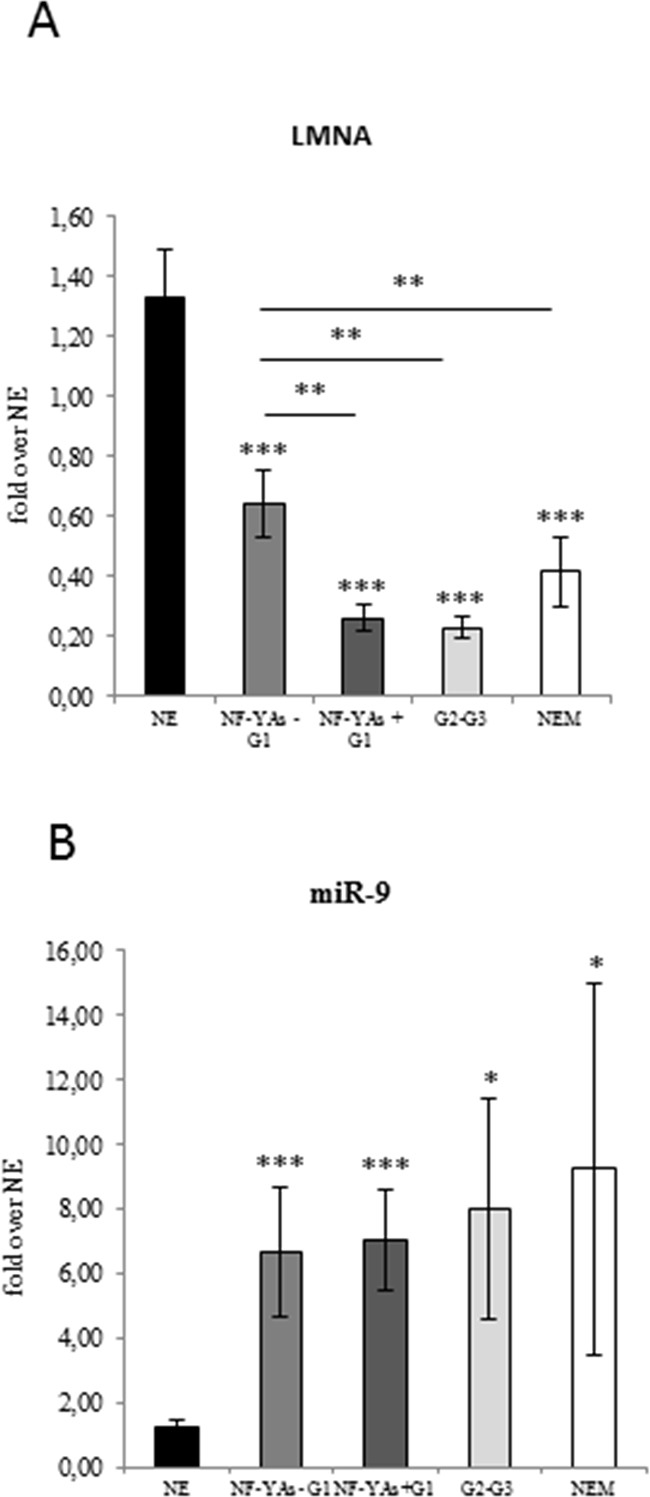
Although most cases of low grade (G1) endometrial cancer (EC) do not behave aggressively, in rare instances, can progress in a highly aggressive manner. In this study we analyzed formalin-fixed, paraffin-embedded (FFPE) EC tissues to find novel clinical and biological features to help diagnosis and treatment of G1 ECs s in order to better stratify patient risk of recurrence. A retrospective cohort of FFPE specimens from patients with EC (n=87) and benign tissue specimens (NE) from patients who underwent a hysterectomy to treat other benign disease (n = 13) were collected. Total RNA and proteins were extracted and analyzed, respectively, by quantitative PCR and western blotting. NF-YAs is expressed and lamin A is down-modulated in all high grade (G2 and G3) ECs. In G1 ECs, NF-YAs expression is heterogeneous being expressed only in a subset of these tumours. Interestingly, the G1 ECs that express NF-YAs display low levels of lamin A similar to those present in G2 and G3 ECs. Of note, this pattern of NF-YAs and lamin A expression correlates with tumor aggressiveness assessed by comparative analysis with estrogen receptor (ER) status and epithelial-mesenchymal transition (EMT) markers thus suggesting its potential role as biomarker of tumour aggressiveness in G1 EC. In all grade ECs, lamin A is strongly downmodulated, being its expression inversely correlated with tumor aggressiveness and its loss of expression. We identified NF-YAs and lamin A expression levels as novel potential biomarkers useful to identify G1 ECs patients with risk of recurrence.
Keywords: NF-Y; endometrial cancer; estrogen receptor; lamin A; miR-200 family.
Conflict of interest statement
The authors report no conflicts of interest. The authors are responsible for the content and writing of the paper.
Figures


References
-
- Amant F, Moerman P, Neven P, Timmerman D, Van Limbergen E, Vergote I. Endometrial cancer. Lancet. 2005;388:491–505. - PubMed
-
- Rose PG. Endometrial carcinoma. N Engl J Med. 1996;9:640–49. - PubMed
-
- Creasman WT. Prognostic significance of hormone receptors in endometrial cancer. Cancer. 1993;4:1467–70. - PubMed
-
- Morrow CP, Bundy BN, Kurman RJ, Creasman WT, Heller P, Homesley HD, Graham JE. Relationship between surgicalpathological risk factors and outcome in clinical stage I and II carcinoma of the endometrium: a Gynecologic Oncology Group study. Gynecol Oncol. 1991. pp. 55–65. - PubMed
-
- Prat J. Prognostic parameters of endometrial carcinoma. Hum Pathol. 2004(6):649–62. - PubMed
MeSH terms
Substances
LinkOut - more resources
Full Text Sources
Other Literature Sources
