


Regional Influence of Cannabinoid CB1 Receptors in the Regulation of Ethanol Self-Administration by Wistar Rats
- PMID: 27974944
- PMCID: PMC5152943
- DOI: 10.2174/1876523800902020077
Regional Influence of Cannabinoid CB1 Receptors in the Regulation of Ethanol Self-Administration by Wistar Rats
Abstract
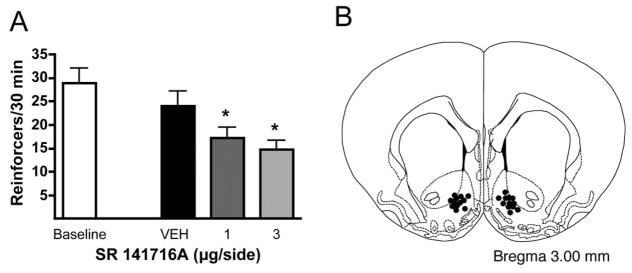
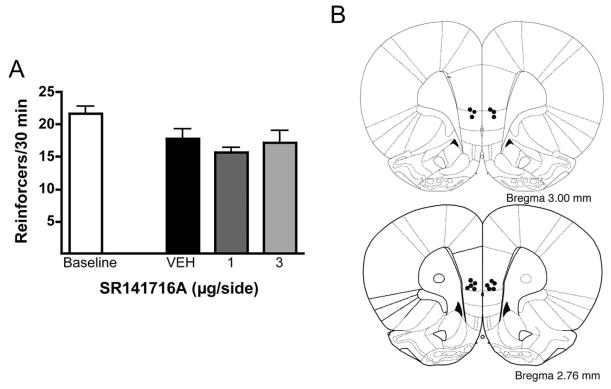
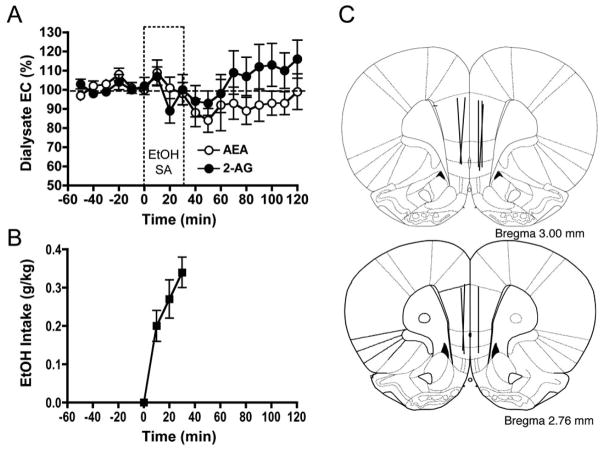
Substantial evidence suggests a facilitatory influence of cannabinoid CB1 receptors in the modulation of ethanol consumption by rodents. Studies performed in rats selectively bred for high alcohol preference point to an involvement of CB1 receptors in the nucleus accumbens (NAC), ventral tegmental area (VTA) and medial prefrontal cortex (mPFC) in the modulation ethanol self-administration. However, the neural mechanisms through which CB1 receptors regulate ethanol intake in out-bred Wistar rats have not been investigated. The present study evaluated alterations in ethanol self-administration induced by localized infusions of the CB1 receptor antagonist SR141716A (0, 1 and 3 μg/side) into the NAC, anterior and posterior VTA and mPFC. Separate groups of Wistar rats were trained to operantly respond for an oral ethanol solution and prepared with bilateral injection cannulae aimed at each brain region. Results revealed significant decreases in ethanol intake following intra-NAC SR141716A administration, consistent with our prior observation of ethanol-induced increases extracellular 2-arachidonoyl glycerol (2-AG) in this brain region. We also observed a significant dose-dependent reduction in ethanol intake following SR141716A administration into the posterior, but not anterior VTA, consistent with evidence of a specific involvement of the posterior VTA in the regulation of ethanol intake. Ethanol consumption was unaltered following intra-mPFC SR141716A administration and ethanol self-administration did not induce robust changes in anandamide or 2-AG levels in mPFC microdialysates. These findings implicate an involvement of CB1 receptors in the NAC and posterior VTA, but not anterior VTA and mPFC in the regulation of ethanol self-administration behavior by outbred Wistar rats.
Conflict of interest statement
The authors listed on this manuscript do not have any potential conflicts of interest related to the subject of this report. Further, each of the authors on this manuscript is supported in full by NIH research grants and have not received, and do not anticipate receiving, any compensation for professional services from any source outside of the NIH.
Figures

References
-
- Ferko AP. Interaction between L-glutamate and ethanol on the central depressant properties of ethanol in mice. Pharmacol Biochem Behav. 1994;47:351–54. - PubMed
-
- Boehm SL, II, Ponomarev I, Blednov YA, Harris RA. From gene to behavior and back again: new perspectives on GABAA receptor subunit selectivity of alcohol actions. Adv Pharmacol. 2006;54:171–203. - PubMed
-
- Rassnick S, Pulvirenti L, Koob GF. Oral ethanol self-administration in rats is reduced by the administration of dopamine and glutamate receptor antagonists into the nucleus accumbens. Psychopharmacology (Berl) 1992;109:92–8. - PubMed
-
- Hyytiä P, Koob GF. GABAA receptor antagonism in the extended amygdala decreases ethanol self-administration in rats. Eur J Pharmacol. 1995;283:151–59. - PubMed
-
- Colombo G, Serra S, Brunetti G, et al. The GABA(B) receptor agonists baclofen and CGP 44532 prevent acquisition of alcohol drinking behaviour in alcohol-preferring rats. Alcohol Alcohol. 2002;37:499–503. - PubMed
Grants and funding
LinkOut - more resources
Full Text Sources