


Highly Efficient Training, Refinement, and Validation of a Knowledge-based Planning Quality-Control System for Radiation Therapy Clinical Trials
- PMID: 27979445
- PMCID: PMC5175211
- DOI: 10.1016/j.ijrobp.2016.10.005
Highly Efficient Training, Refinement, and Validation of a Knowledge-based Planning Quality-Control System for Radiation Therapy Clinical Trials
Abstract
Purpose: To demonstrate an efficient method for training and validation of a knowledge-based planning (KBP) system as a radiation therapy clinical trial plan quality-control system.
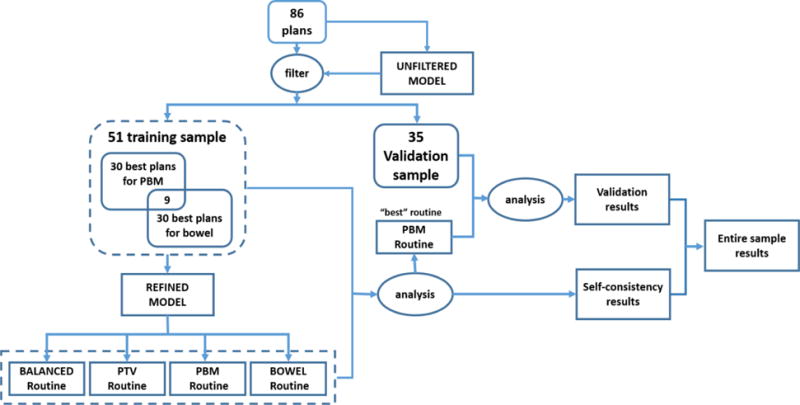
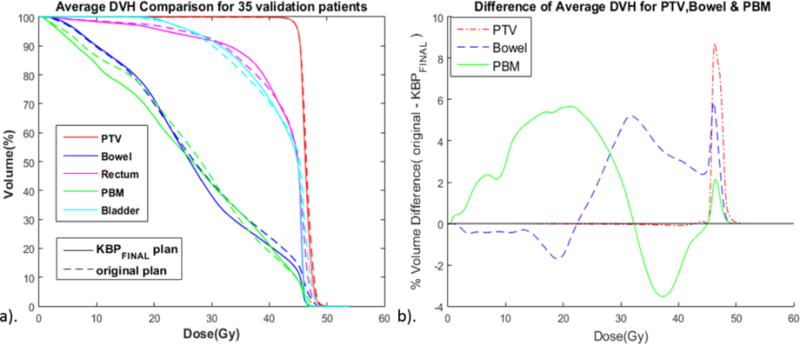
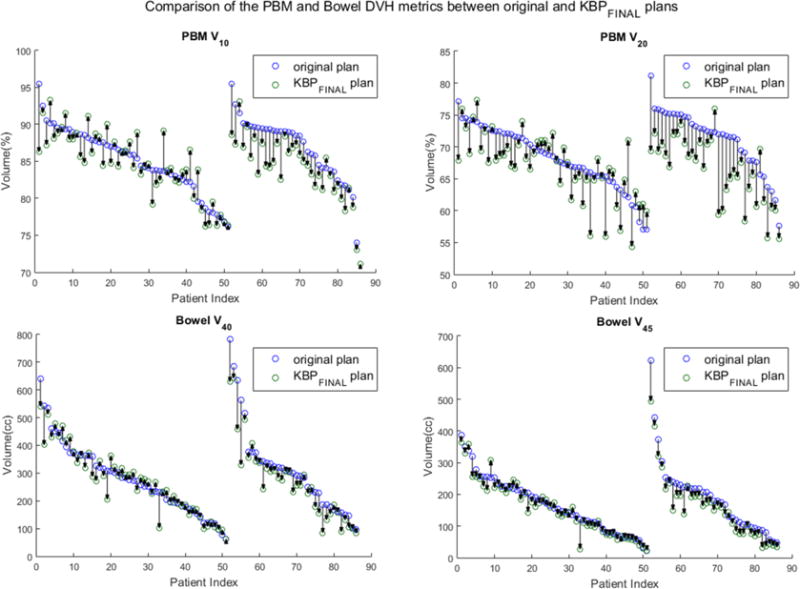
Methods and materials: We analyzed 86 patients with stage IB through IVA cervical cancer treated with intensity modulated radiation therapy at 2 institutions according to the standards of the INTERTECC (International Evaluation of Radiotherapy Technology Effectiveness in Cervical Cancer, National Clinical Trials Network identifier: 01554397) protocol. The protocol used a planning target volume and 2 primary organs at risk: pelvic bone marrow (PBM) and bowel. Secondary organs at risk were rectum and bladder. Initial unfiltered dose-volume histogram (DVH) estimation models were trained using all 86 plans. Refined training sets were created by removing sub-optimal plans from the unfiltered sample, and DVH estimation models… and DVH estimation models were constructed by identifying 30 of 86 plans emphasizing PBM sparing (comparing protocol-specified dosimetric cutpoints V10 (percentage volume of PBM receiving at least 10 Gy dose) and V20 (percentage volume of PBM receiving at least 20 Gy dose) with unfiltered predictions) and another 30 of 86 plans emphasizing bowel sparing (comparing V40 (absolute volume of bowel receiving at least 40 Gy dose) and V45 (absolute volume of bowel receiving at least 45 Gy dose), 9 in common with the PBM set). To obtain deliverable KBP plans, refined models must inform patient-specific optimization objectives and/or priorities (an auto-planning "routine"). Four candidate routines emphasizing different tradeoffs were composed, and a script was developed to automatically re-plan multiple patients with each routine. After selection of the routine that best met protocol objectives in the 51-patient training sample (KBPFINAL), protocol-specific DVH metrics and normal tissue complication probability were compared for original versus KBPFINAL plans across the 35-patient validation set. Paired t tests were used to test differences between planning sets.
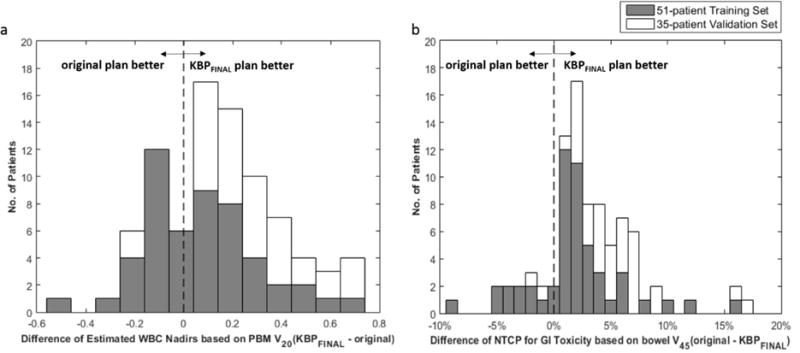
Results: KBPFINAL plans outperformed manual planning across the validation set in all protocol-specific DVH cutpoints. The mean normal tissue complication probability for gastrointestinal toxicity was lower for KBPFINAL versus validation-set plans (48.7% vs 53.8%, P<.001). Similarly, the estimated mean white blood cell count nadir was higher (2.77 vs 2.49 k/mL, P<.001) with KBPFINAL plans, indicating lowered probability of hematologic toxicity.
Conclusions: This work demonstrates that a KBP system can be efficiently trained and refined for use in radiation therapy clinical trials with minimal effort. This patient-specific plan quality control resulted in improvements on protocol-specific dosimetric endpoints.
Copyright © 2016 Elsevier Inc. All rights reserved.
Conflict of interest statement
Dr. Bosch reports personal fees from Augmenix, Inc., other from ASTRO, other from AAPM, outside the submitted work; Dr. Straube reports grants from National Institutes of Health, during the conduct of the study; Dr. Mell reports grants from U.S National Institutes of Health, grants and personal fees from Varian Medical System, during the conduct of the study; Dr. Moore reports grants from National Institute of Health, grants, personal fees and non-financial support from Varian Medical Systems, during the conduct of the study; In addition, Dr. Moore has a patent US Patent 20,120,310,615 licensed to Varian Medical Systems, and a patent THREE-DIMENSIONAL RADIOTHERAPY DOSE DISTRIBUTION PREDICTION pending.
Figures
References
-
- Nelms BE, Robinson G, Markham J, et al. Variation in external beam treatment plan quality: An inter-institutional study of planners and planning systems. Pract Radiat Oncol. 2012;2:296–305. - PubMed
-
- Das IJ, Cheng CW, Chopra KL, et al. Intensity-modulated radiation therapy dose prescription, recording, and delivery: Patterns of variability among institutions and treatment planning systems. J natl cancer inst United States. 2008:300–7. - PubMed
-
- Appenzoller LM, Michalski JM, Thorstad WL, et al. Predicting dose-volume histograms for organs-at-risk in imrt planning. Med Phys. 2012;39:7446–61. - PubMed
-
- Moore KL, Mutic S, Brame RS, et al. Developing predictive dose-volume relationships for a radiotherapy treatment. Book Developing predictive dose-volume relationships for a radiotherapy treatment: Google Patents. 2012 Editor, editorˆeditors.
-
- Moore KL, Brame RS, Low DA, et al. Quantitative metrics for assessing plan quality. Seminars in radiation oncology. 2012;22:62–69. - PubMed
Publication types
MeSH terms
Grants and funding
LinkOut - more resources
Full Text Sources
Other Literature Sources
Medical
Miscellaneous
