


Population-based assessment of prevalence and causes of visual impairment in the state of Telangana, India: a cross-sectional study using the Rapid Assessment of Visual Impairment (RAVI) methodology
- PMID: 27979835
- PMCID: PMC5168693
- DOI: 10.1136/bmjopen-2016-012617
Population-based assessment of prevalence and causes of visual impairment in the state of Telangana, India: a cross-sectional study using the Rapid Assessment of Visual Impairment (RAVI) methodology
Abstract
Objective: To assess the prevalence and causes of visual impairment (VI) among a rural population aged 40 years and older in the state of Telangana in India.
Design: Population-based cross-sectional study.
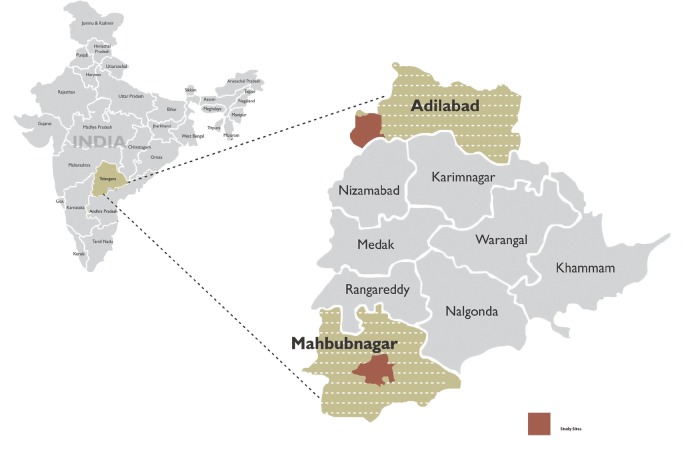
Setting: Districts of Adilabad and Mahbubnagar in south Indian state of Telangana, India.
Participants: A sample of 6150 people was selected using cluster random sampling methodology. A team comprising a trained vision technician and a field worker visited the households and conducted the eye examination. Presenting, pinhole and aided visual acuity were assessed. Anterior segment was examined using a torchlight. Lens was examined using distant direct ophthalmoscopy in a semidark room. In all, 5881 (95.6%) participants were examined from 123 study clusters. Among those examined, 2723 (46.3%) were men, 4824 (82%) had no education, 2974 (50.6%) were from Adilabad district and 1694 (28.8%) of them were using spectacles at the time of eye examination.
Primary outcome measure: VI was defined as presenting visual acuity <6/18 in the better eye and it included moderate VI (<6/18 to 6/60) and blindness (<6/60).
Results: The age-adjusted and gender-adjusted prevalence of VI was 15.0% (95% CI 14.1% to 15.9%). On applying binary logistic regression analysis, VI was associated with older age groups. The odds of having VI were higher among women (OR 1.2; 95% CI 1.0 to 1.4). Having any education (OR 0.4; 95% CI 0.3 to 0.6) and current use of glasses (OR 0.19; 95% CI 0.1 to 0.2) were protective. VI was also higher in Mahbubnagar (OR 1.0 to 1.5) district. Cataract (54.7%) was the leading cause of VI followed by uncorrected refractive errors (38.6%).
Conclusions: VI continues to remain a challenge in rural Telangana. As over 90% of the VI is avoidable, massive eye care programmes are required to address the burden of VI in Telangana.
Keywords: EPIDEMIOLOGY; PRIMARY CARE.
Published by the BMJ Publishing Group Limited. For permission to use (where not already granted under a licence) please go to http://www.bmj.com/company/products-services/rights-and-licensing/.
Conflict of interest statement
Conflicts of Interest: None declared.
Figures
References
-
- WHO. Universal eye health: a global action plan 2014–2019. 2013:28. - PubMed
Publication types
MeSH terms
LinkOut - more resources
Full Text Sources
Medical
