. 2016 Aug 21:5:54-64.
doi: 10.1016/j.ynstr.2016.07.001. eCollection 2016 Dec.

Social defeat stress induces depression-like behavior and alters spine morphology in the hippocampus of adolescent male C57BL/6 mice

Affiliations

Social defeat stress induces depression-like behavior and alters spine morphology in the hippocampus of adolescent male C57BL/6 mice

Sergio D Iñiguez et al. Neurobiol Stress. .

Abstract

Social stress, including bullying during adolescence, is a risk factor for common psychopathologies such as depression. To investigate the neural mechanisms associated with juvenile social stress-induced mood-related endophenotypes, we examined the behavioral, morphological, and biochemical effects of the social defeat stress model of depression on hippocampal dendritic spines within the CA1 stratum radiatum. Adolescent (postnatal day 35) male C57BL/6 mice were subjected to defeat episodes for 10 consecutive days. Twenty-four h later, separate groups of mice were tested on the social interaction and tail suspension tests. Hippocampi were then dissected and Western blots were conducted to quantify protein levels for various markers important for synaptic plasticity including protein kinase M zeta (PKMζ), protein kinase C zeta (PKCζ), the dopamine-1 (D1) receptor, tyrosine hydroxylase (TH), and the dopamine transporter (DAT). Furthermore, we examined the presence of the α-amino-3-hydroxy-5-methyl-4-isoxazolepropionic acid (AMPA)-receptor subunit GluA2 as well as colocalization with the post-synaptic density 95 (PSD95) protein, within different spine subtypes (filopodia, stubby, long-thin, mushroom) using an immunohistochemistry and Golgi-Cox staining technique. The results revealed that social defeat induced a depression-like behavioral profile, as inferred from decreased social interaction levels, increased immobility on the tail suspension test, and decreases in body weight. Whole hippocampal immunoblots revealed decreases in GluA2, with a concomitant increase in DAT and TH levels in the stressed group. Spine morphology analyses further showed that defeated mice displayed a significant decrease in stubby spines, and an increase in long-thin spines within the CA1 stratum radiatum. Further evaluation of GluA2/PSD95 containing-spines demonstrated a decrease of these markers within long-thin and mushroom spine types. Together, these results indicate that juvenile social stress induces GluA2- and dopamine-associated dysregulation in the hippocampus - a neurobiological mechanism potentially underlying the development of mood-related syndromes as a consequence of adolescent bullying.

Keywords: Bullying; CA1; Depression; Dopamine; GluA2; Juvenile; Tail suspension test.


Figures
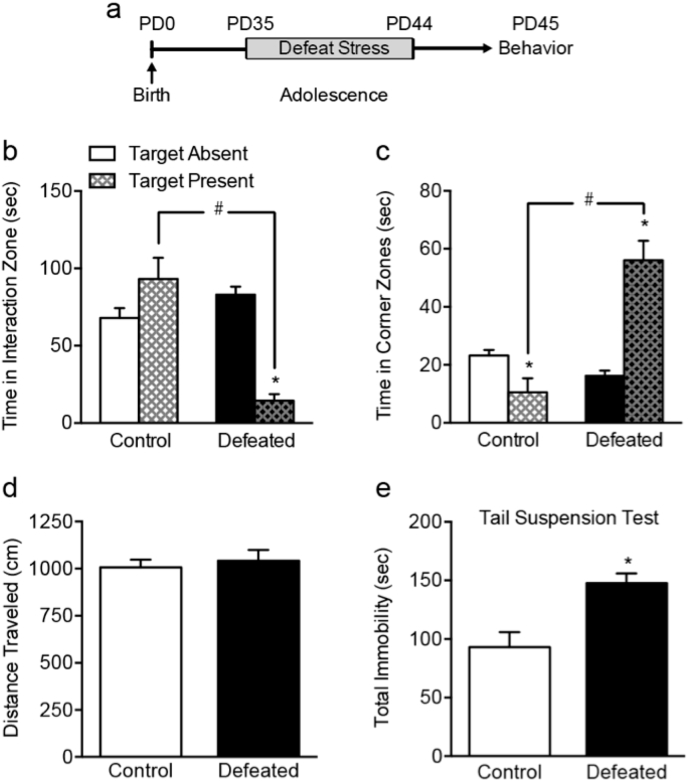
Fig. 1
Fig. 1
Social defeat stress induces a depression-like behavioral response in adolescent C57BL/6 male mice. (a) Timeline of the experimental procedures. Adolescent (postnatal day [PD]) 35 mice were exposed to 10 days of social defeat stress (i.e., PD35-44). Twenty-four h later (PD45), mice were tested on either the social interaction or tail suspension test. (b) Defeated mice spent less time in the interaction zone in the presence, versus the absence, of a social target (p < 0.05, within group comparison), which was significantly less than that of control mice during the target present condition (#p < 0.05, between group comparison). (c) This reduction of social behavior was evident when assessing time in the corner zones, in which defeated mice spent significantly more time in the corners regardless of whether the social target was present (#p < 0.05, between group comparison) or absent (p < 0.05, within group comparison). (d) No differences in total distance traveled between control and defeated mice were observed during the first 2.5 min of the social interaction test (target absent condition). (e) Defeated mice spent more time (sec) immobile in the tail suspension test, when compared to control mice (p < 0.05). Data are presented as mean + SEM.
Fig. 2
Fig. 2
Effects of social defeat stress on body weight in adolescent male C57BL/6 mice. Social defeat (postnatal day 35–44; gray area) reduced overall body weight across days of stress, starting on day 4 of stress exposure (postnatal day 38), when compared to non-stressed controls (n = 24). Body weight remained significantly lower in the defeated group (n = 31) 24 h after the last day of stress exposure (postnatal day 45). Arrow indicates day of behavioral testing and brain tissue collection. *Significantly different when compared to controls (p < 0.05). Data are presented in grams (mean ± SEM).
Fig. 3
Fig. 3
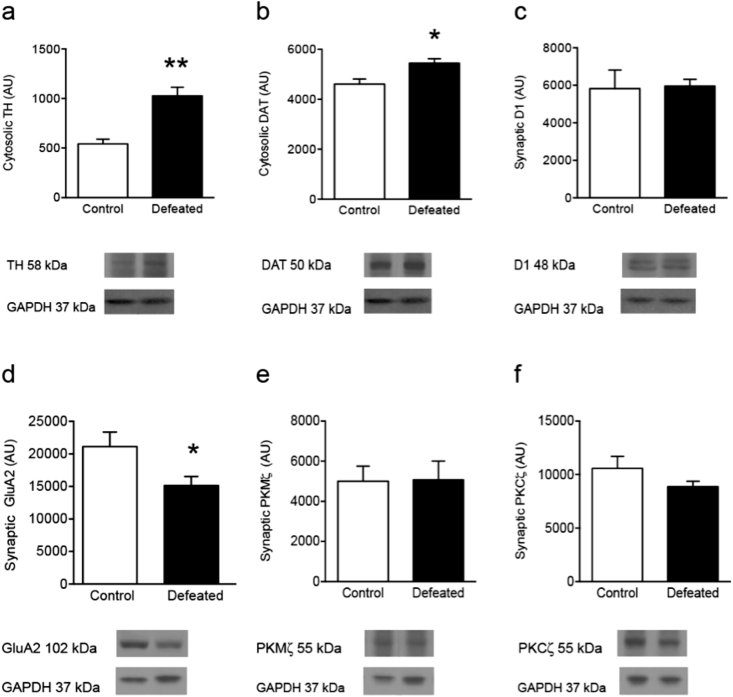
Effects of social defeat stress on hippocampal dopamine- and GluA2-related function in adolescent male C57BL/6 mice. (a) Social defeat stress increased cytosolic tyrosine hydroxylase (TH), when compared to controls (∗∗p < 0.01). (b) Similarly, social defeat stress increased cytosolic dopamine transporter (DAT) levels, when compared to controls (p < 0.05). (c) No differences in synaptic dopamine-1 receptors (D1) were observed between the groups (p > 0.05). (d) Conversely, social defeat stress reduced synaptic GluA2 when compared to controls (p < 0.05). (e–f) No differences in synaptic PKMζ or PKCζ were evident following social defeat stress (p > 0.05). Arbitrary units (AU). Data are presented as ratio of total protein normalized to GAPDH (mean + SEM).
Fig. 4
Fig. 4
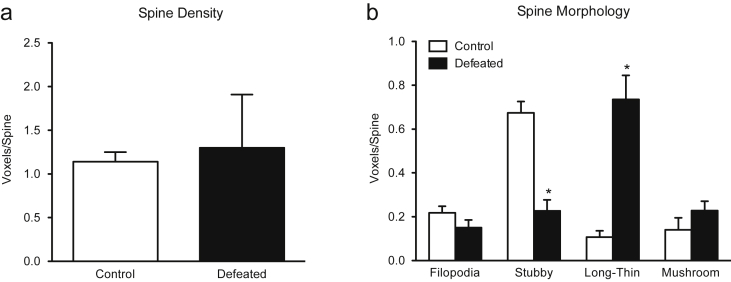
Effects of social defeat stress on spine density and morphology within the CA1 of the adolescent hippocampus in male C57BL/6 mice. (a) Social defeat did not alter overall spine density as a function of stress (p > 0.05). (b) Conversely, when assessing spine morphology, social defeat significantly decreased stubby spines (p < 0.01), and increased long-thin spines (p < 0.01), while having no effect on filopodia (p > 0.05) or mushroom spines (p > 0.05). Data are presented as voxels per micron (mean + SEM).
Fig. 5
Fig. 5
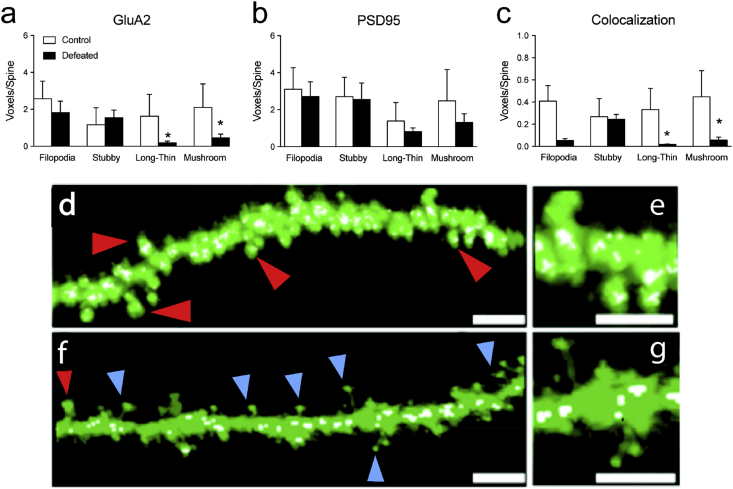
Effects of social stress on GluA2, PSD95, and their colocalization across spine types in the CA1 region of the hippocampus in adolescent C57BL/6 male mice. Social defeat stress decreased (a) GluA2 expression within long-thin and mushroom spines (*p < 0.05). (b) No changes in PSD95 were observed across spine types (p > 0.05) as a function of stress exposure. Conversely, (c) the number of spines expressing the colocalization of GluA2 and PSD95 was reduced in long-thin and mushroom spines (*p < 0.05). Representative images of a dendritic branch from a control (d–e) and socially defeated animal (f–g). Scale bar = 5 μm for d and f; 2.5 μm for e and g. Red arrows indicate stubby spines. Blue arrows indicate long-thin spines. White voxels represent GluA2/PSD95 colocalization. Data are represented as mean voxels per spine (mean + SEM). (For interpretation of the references to colour in this figure legend, the reader is referred to the web version of this article.)

References

    1. Andersen S.L., Teicher M.H. Stress, sensitive periods and maturational events in adolescent depression. Trends Neurosci. 2008;31(4):183–191. - PubMed
    1. Anggono V., Huganir R.L. Regulation of AMPA receptor trafficking and synaptic plasticity. Curr. Opin. Neurobiol. 2012;22(3):461–469. - PMC - PubMed
    1. Araya R., Jiang J., Eisenthal K.B., Yuste R. The spine neck filters membrane potentials. Proc. Natl. Acad. Sci. U. S. A. 2006;103(47):17961–17966. - PMC - PubMed
    1. Avgustinovich D.F., Alekseyenko O.V. [3H]SCH 23390 binding in various brain regions of C57BL/6J mice with repeated experience of victory or social defeat in agonistic interactions. Physiol. Res. 2010;59(3):455–458. - PubMed
    1. Bagot R.C., Parise E.M., Pena C.J., Zhang H.X., Maze I., Chaudhury D., Persaud B., Cachope R., Bolanos-Guzman C.A., Cheer J.F. Ventral hippocampal afferents to the nucleus accumbens regulate susceptibility to depression. Nat. Commun. 2015;6:7062. - PMC - PubMed

LinkOut - more resources