


Targeting the epigenome: Screening bioactive compounds that regulate histone deacetylase activity
- PMID: 27981795
- PMCID: PMC5508980
- DOI: 10.1002/mnfr.201600744
Targeting the epigenome: Screening bioactive compounds that regulate histone deacetylase activity
Abstract
Scope: Nutrigenomics is a rapidly expanding field that elucidates the link between diet-genome interactions. Recent evidence demonstrates that regulation of the epigenome, and in particular inhibition of histone deacetylases (HDACs), impact pathogenetic mechanisms involved in chronic disease. Few studies, to date, have screened libraries of bioactive compounds that act as epigenetic modifiers. This study screened a library of 131 natural compounds to determine bioactive compounds that inhibit Zn-dependent HDAC activity.
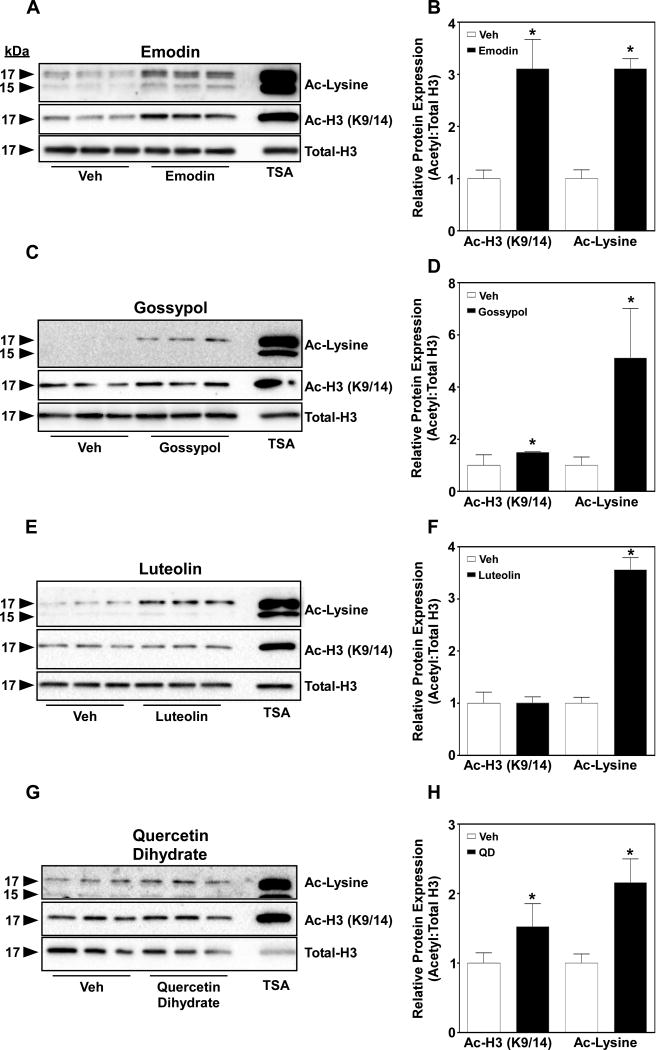
Methods and results: Using class-specific HDAC substrates, we screened 131 natural compounds for HDAC activity in bovine cardiac tissue. From this screen, we identified 18 bioactive compound HDAC inhibitors. Using our class-specific HDAC substrates, we next screened these 18 bioactive compounds against recombinant HDAC proteins. Consistent with inhibition of HDAC activity, these compounds were capable of inhibiting activity of individual HDAC isoforms. Lastly, we report that treatment of H9c2 cardiac myoblasts with bioactive HDAC inhibitors was sufficient to increase lysine acetylation as assessed via immunoblot.
Conclusion: This study provided the first step in identifying multiple bioactive compound HDAC inhibitors. Taken together, this report sets the stage for future exploration of these bioactive compounds as epigenetic regulators to potentially ameliorate chronic disease.
Keywords: Acetylation; Bioactive compounds; Dietary HDAC inhibitors; HDACs; Histone deacetylases.
© 2016 WILEY-VCH Verlag GmbH & Co. KGaA, Weinheim.
Conflict of interest statement
The authors declare no conflicts of interest.
Figures


References
-
- Vahid F, Zand H, Nosrat-Mirshekarlou E, Najafi R, Hekmatdoost A. The role dietary of bioactive compounds on the regulation of histone acetylases and deacetylases: a review. Gene. 2015;562:8–15. - PubMed
-
- Szarc vel Szic K, Ndlovu MN, Haegeman G, Vanden Berghe W. Nature or nurture: let food be your epigenetic medicine in chronic inflammatory disorders. Biochem Pharmacol. 2010;80:1816–1832. - PubMed
-
- Choudhary C, Kumar C, Gnad F, Nielsen ML, et al. Lysine acetylation targets protein complexes and co-regulates major cellular functions. Science. 2009;325:834–840. - PubMed
Publication types
MeSH terms
Substances
Grants and funding
LinkOut - more resources
Full Text Sources
Other Literature Sources
