. 2016 Dec 16;10(12):e0005184.
doi: 10.1371/journal.pntd.0005184. eCollection 2016 Dec.

CystiSim - An Agent-Based Model for Taenia solium Transmission and Control

Affiliations

CystiSim - An Agent-Based Model for Taenia solium Transmission and Control

Uffe Christian Braae et al. PLoS Negl Trop Dis. .

Abstract

Taenia solium taeniosis/cysticercosis was declared eradicable by the International Task Force for Disease Eradication in 1993, but remains a neglected zoonosis. To assist in the attempt to regionally eliminate this parasite, we developed cystiSim, an agent-based model for T. solium transmission and control. The model was developed in R and available as an R package (http://cran.r-project.org/package=cystiSim). cystiSim was adapted to an observed setting using field data from Tanzania, but adaptable to other settings if necessary. The model description adheres to the Overview, Design concepts, and Details (ODD) protocol and consists of two entities-pigs and humans. Pigs acquire cysticercosis through the environment or by direct contact with a tapeworm carrier's faeces. Humans acquire taeniosis from slaughtered pigs proportional to their infection intensity. The model allows for evaluation of three interventions measures or combinations hereof: treatment of humans, treatment of pigs, and pig vaccination, and allows for customary coverage and efficacy settings. cystiSim is the first agent-based transmission model for T. solium and suggests that control using a strategy consisting of an intervention only targeting the porcine host is possible, but that coverage and efficacy must be high if elimination is the ultimate goal. Good coverage of the intervention is important, but can be compensated for by including an additional intervention targeting the human host. cystiSim shows that the scenarios combining interventions in both hosts, mass drug administration to humans, and vaccination and treatment of pigs, have a high probability of success if coverage of 75% can be maintained over at least a four year period. In comparison with an existing mathematical model for T. solium transmission, cystiSim also includes parasite maturation, host immunity, and environmental contamination. Adding these biological parameters to the model resulted in new insights in the potential effect of intervention measures.


Conflict of interest statement

The authors have declared that no competing interests exist.

Figures
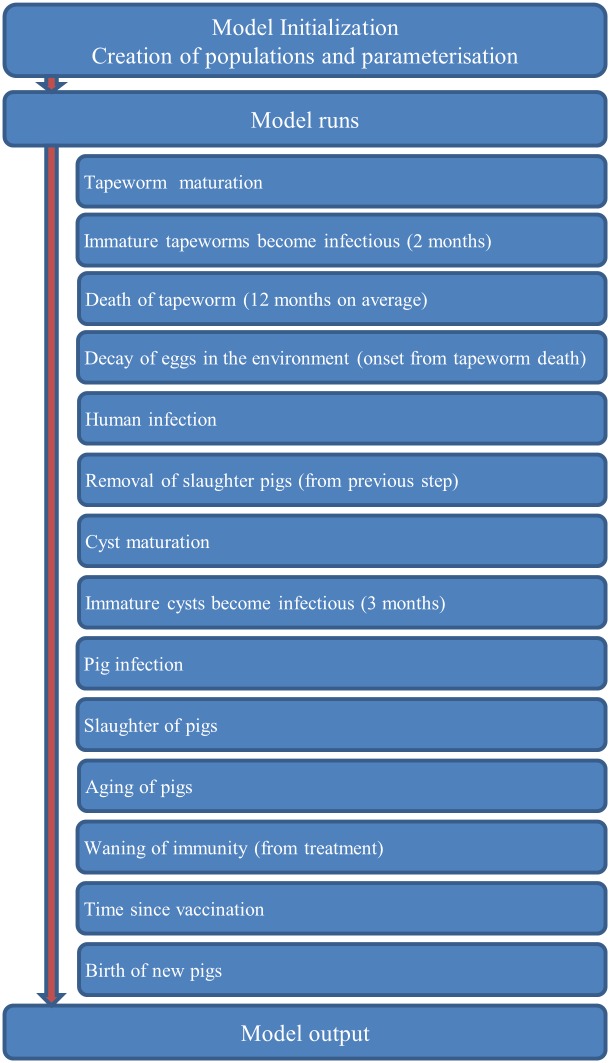
Fig 1
Fig 1. Flow chart of the process overview in cystiSim.
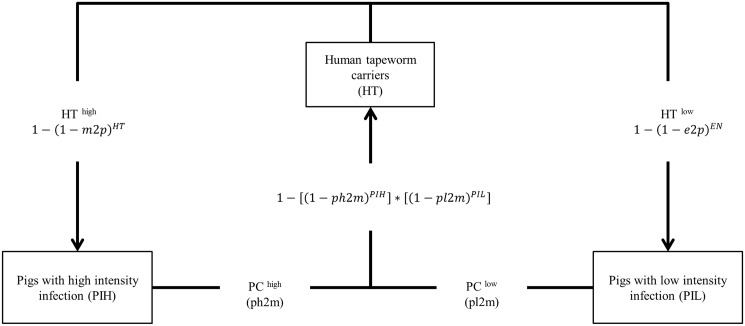
All tapeworm carriers with a mature worm can transmit the parasite to pigs based on direct or indirect transmission (Fig 2). Direct transmission leads to high intensity infections in pigs, a simulation of coprophagia. Denoting the direct transmission probability from humans to pigs as m2p and the number of humans carrying a mature tapeworm as HT, the probability that a susceptible pig gets infected through the direct transmission route is 1 − (1 − m2p)HT Indirect transmission leads to low intensity infections in pigs and constitutes the environmental contamination. Denoting the indirect transmission probability from humans to pigs as e2p and the number of contaminated environments as EN, the probability that a susceptible pig gets infected through the indirect transmission route is 1 − (1 − e2p)EN Pigs do not revert from infectious to non-infectious over time, primarily based on their relative short lifespan, but pigs can go from a low intensity infection to a high intensity infection if they come into contact with a tapeworm carrier (direct transmission). Slaughtered pigs can transmit the infection based on whether they have high infection intensities or low infection intensities. Denoting the transmission probability from heavily and lightly infected pigs to humans as ph2m and pl2m, respectively, and the number of heavily and lightly infected pigs as PIH and PIL, respectively. The probability that a susceptible human gets infected through any route is 1 − [(1 − ph2m)PIH] * [(1 − pl2m)PIL] If deemed appropriate, the infection probability of susceptible humans can be made age-dependent by specifying the intercept and slope of a logistic regression model. Age-dependent susceptibility implicitly covers all factors leading to changes in infection probability within the human host such as change in immunity/resistance, eating habits, and risky behaviour. cystiSim allows for interventions to be tailored in terms of treatment intervals and change of efficacy and coverage for each specific intervention tool implemented. Processes that are implicitly modelled are transmission from pigs to humans influenced by natural death of pigs, natural death of cysts, cooking of pork, and meat inspection, and for transmission from humans to pigs, the use of latrines, sanitation standards, and hygiene levels.
Fig 2
Fig 2. Taenia solium transmission pathway.
Schematic overview of the different transmission pathways of Taenia solium incorporated in cystiSim. Tapeworm carriers (HT) transmit the parasite to pigs based on parameters for direct (1 − (1 − m2p)HT)or indirect (1 − (1 − e2p)EN) transmission where EN denotes the environmental contamination. Direct transmission leads to high intensity infections in pigs (PIH), a simulation of coprophagia. Indirect transmission leads to low intensity infections in pigs (PIL) and constitutes the environmental contamination. Pigs transmit the infection based on two parameters, for high infection intensities (ph2m) or low infection intensities (pl2m).
Fig 3
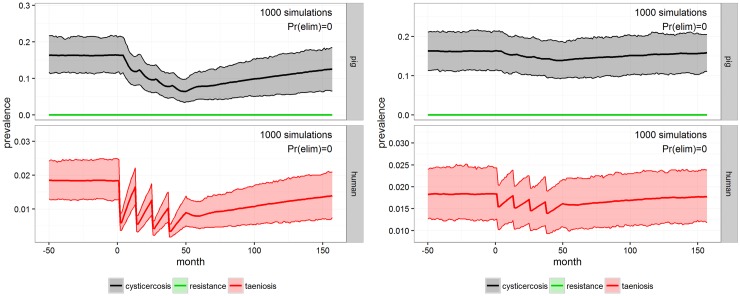
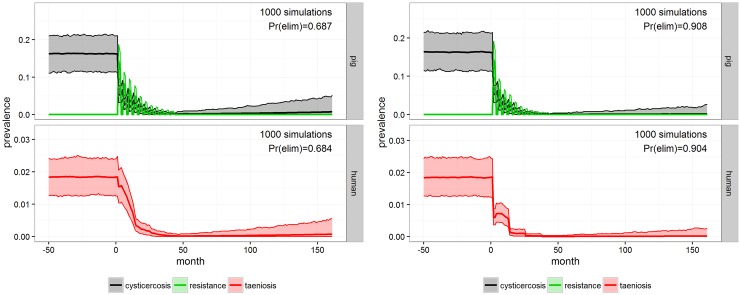
Fig 3. INT-1 and INT-2.
Outcome of the MDA to the whole population with 75% coverage (INT-1, left) and MDA to school-aged children with 90% coverage (INT-2, right) for Mbeya district after 1000 simulations in cystiSim. Efficacy was set at 90% in all of the simulations. The coloured area demarcates the 95% uncertainty intervals for prevalence. The green line illustrates pig resistance towards new infections and Pr(elim) states the predicted probability of elimination occurring in the given scenario.
Fig 4
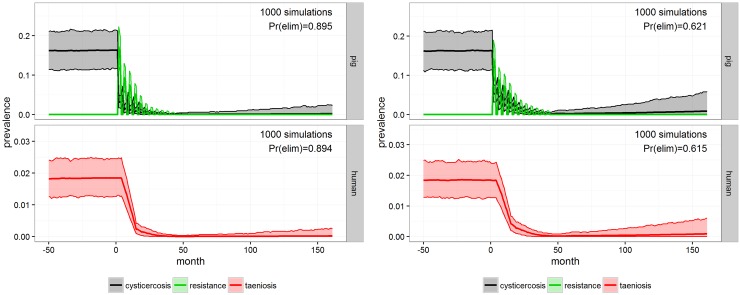
Fig 4. INT-3 and INT-4.
Outcome of the porcine population treatment with 90% coverage (INT-3, left) and 75% coverage (INT-4, right) for Mbeya district after 1000 simulations in cystiSim. Efficacy was set at 90% in all of the simulations. The coloured area demarcates the 95% uncertainty intervals for prevalence. The green line illustrates pig resistance towards new infections and Pr(elim) states the predicted probability of elimination occurring in the given scenario.
Fig 5
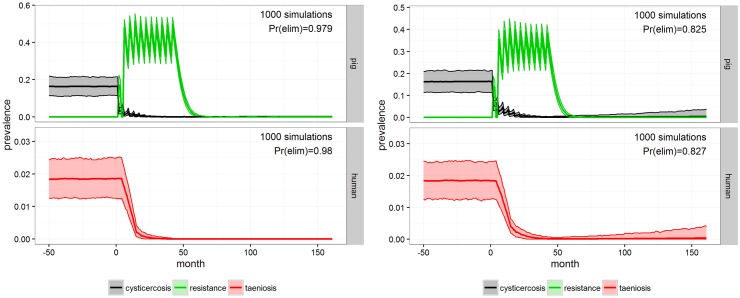
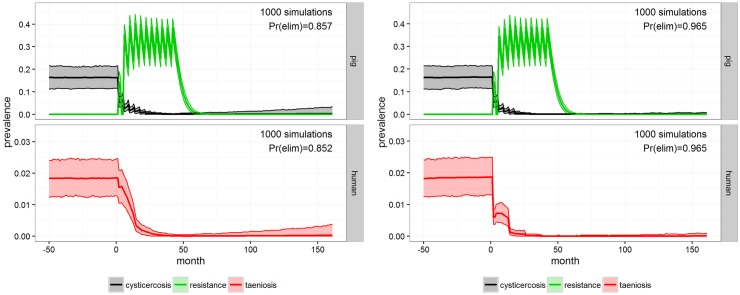
Fig 5. INT-5 and INT-6.
Outcome of anthelmintic treatment and vaccination of the porcine population with 90% coverage (INT-5, left) and 75% coverage (INT-6, right) for Mbeya district after 1000 simulations in cystiSim. Efficacy was set at 90% in all of the simulations. The coloured area demarcates the 95% uncertainty intervals for prevalence. The green line illustrates pig resistance towards new infections and Pr(elim) states the predicted probability of elimination occurring in the given scenario.
Fig 6
Fig 6. INT-7 and INT-8.
Outcome of MDA to school-aged children with 90% coverage in combination with anthelmintic treatment of the porcine population with 75% coverage (INT-7, left) and outcome of INT-8 which consisted of MDA to the whole human population in combination with anthelmintic treatment of the porcine population both with 75% coverage (on the right), for Mbeya district after 1000 simulations in cystiSim. Efficacy was set at 90% in all of the simulations. The coloured area demarcates the 95% uncertainty intervals for prevalence. The green line illustrates pig resistance towards new infections and Pr(elim) states the predicted probability of elimination occurring in the given scenario.
Fig 7
Fig 7. INT-9 and INT-10.
Outcome of MDA to school-aged children with 90% coverage in combination with anthelmintic treatment and vaccination of the porcine population with 75% coverage (INT-9, left) and outcome of INT-10 which consisted of MDA to the whole human population in combination with anthelmintic treatment and vaccination of the porcine population both with 75% coverage (on the right), for Mbeya district after 1000 simulations in cystiSim. Efficacy was set at 90% in all of the simulations. The coloured area demarcates the 95% uncertainty intervals for prevalence. The green line illustrates pig resistance towards new infections and Pr(elim) states the predicted probability of elimination occurring in the given scenario.

References

    1. Garcia HH, Gonzalez AE, Evans CAW, Gilman RH, Cysticercosis Working Grp P (2003) Taenia solium cysticercosis. Lancet 362: 547–556. 10.1016/S0140-6736(03)14117-7 - DOI - PMC - PubMed
    1. Braae UC, Saarnak CF, Mukaratirwa S, Devleesschauwer B, Magnussen P, et al. (2015) Taenia solium taeniosis/cysticercosis and the co-distribution with schistosomiasis in Africa. Parasit Vectors 8: 323 10.1186/s13071-015-0938-7 - DOI - PMC - PubMed
    1. Rajshekhar V, Joshi DD, Doanh NQ, van De N, Xiaonong Z (2003) Taenia solium taeniosis/cysticercosis in Asia: epidemiology, impact and issues. Acta Trop 87: 53–60. - PubMed
    1. Komba EV, Kimbi EC, Ngowi HA, Kimera SI, Mlangwa JE, et al. (2013) Prevalence of porcine cysticercosis and associated risk factors in smallholder pig production systems in Mbeya region, southern highlands of Tanzania. Vet Parasitol 198: 284–291. 10.1016/j.vetpar.2013.09.020 - DOI - PubMed
    1. Braae UC, Harrison W, Lekule F, Magnussen P, Johansen MV (2015) Feedstuff and poor latrines may put pigs at risk of cysticercosis—A case-control study. Vet Parasitol 214: 187–191. 10.1016/j.vetpar.2015.08.009 - DOI - PubMed

Publication types

LinkOut - more resources