


Cell therapy for the degenerating intervertebral disc
- PMID: 27986604
- PMCID: PMC5776755
- DOI: 10.1016/j.trsl.2016.11.008
Cell therapy for the degenerating intervertebral disc
Abstract
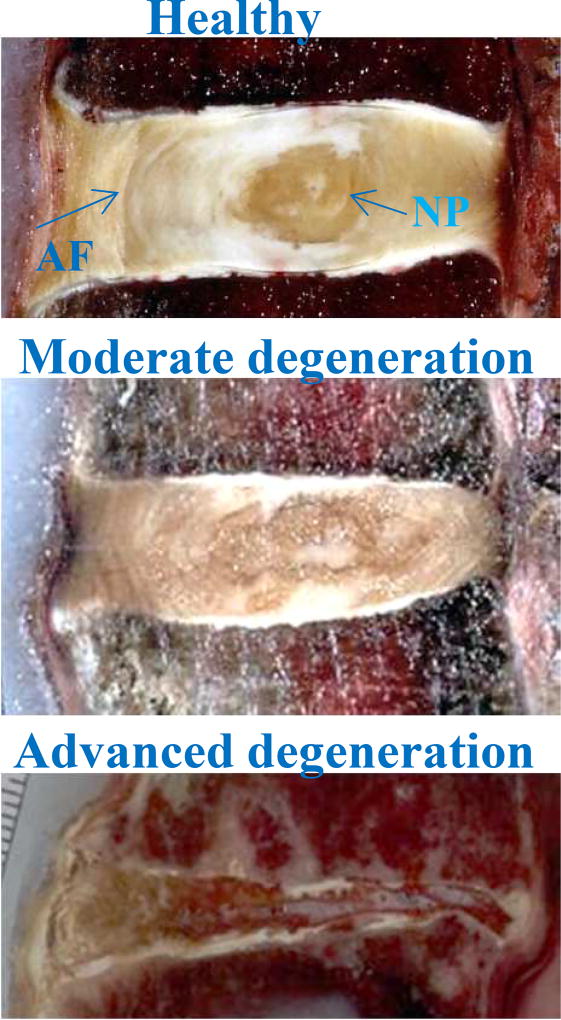
Spinal conditions related to intervertebral disc (IVD) degeneration cost billions of dollars in the US annually. Despite the prevalence and soaring cost, there is no specific treatment that restores the physiological function of the diseased IVD. Thus, it is vital to develop new treatment strategies to repair the degenerating IVD. Persons with IVD degeneration without back pain or radicular leg pain often do not require any intervention. Only patients with severe back pain related to the IVD degeneration or biomechanical instability are likely candidates for cell therapy. The IVD progressively degenerates with age in humans, and strategies to repair the IVD depend on the stage of degeneration. Cell therapy and cell-based gene therapy aim to address moderate disc degeneration; advanced stage disease may require surgery. Studies involving autologous, allogeneic, and xenogeneic cells have all shown good survival of these cells in the IVD, confirming that the disc niche is an immunologically privileged site, permitting long-term survival of transplanted cells. All of the animal studies reviewed here reported some improvement in disc structure, and 2 studies showed attenuation of local inflammation. Among the 50 studies reviewed, 25 used some type of scaffold, and cell leakage is a consistently noted problem, though some studies showed reduced cell leakage. Hydrogel scaffolds may prevent cell leakage and provide biomechanical support until cells can become established matrix producers. However, these gels need to be optimized to prevent this leakage. Many animal models have been leveraged in this research space. Rabbit is the most frequently used model (28 of 50), followed by rat, pig, and dog. Sheep and goat IVDs resemble those of humans in size and in the absence of notochordal cells. Despite this advantage, there were only 2 sheep and 1 goat studies of 50 studies in this cohort. It is also unclear if a study in large animals is needed before clinical trials since some of the clinical trials proceeded without a study in large animals. No animal studies or clinical trials completely restored IVD structure. However, results suggest cause for optimism. In light of the fact that patients primarily seek medical care for back pain, attenuating local inflammation should be a priority in benchmarks for success. Clinicians generally agree that short-term back pain should be treated conservatively. When interventions are considered, the ideal therapy should also be minimally invasive and concurrent with other procedures such as discography or discectomy. Restoration of tissue structure and preservation of spinal motion are desirable.
Copyright © 2016. Published by Elsevier Inc.
Conflict of interest statement
The authors have read the journal’s policy on disclosures of potential conflicts of interest, and have none to declare. All authors have read the journal’s authorship agreement and the manuscript has been reviewed by and approved by all named authors.
Figures
References
-
- Deyo RA, Dworkin SF, Amtmann D, Andersson G, Borenstein D, Carragee E, et al. Report of the NIH task force on research standards for chronic low back pain. Spine (Phila Pa 1976) 2014 Jun 15;39(14):1128–43. - PubMed
-
- Bressler HB, Keyes WJ, Rochon PA, Badley E. The prevalence of low back pain in the elderly. A systematic review of the literature. Spine (Phila Pa 1976) 1999 Sep 1;24(17):1813–9. - PubMed
-
- Moss I, An HS, Shen F, Li Z, Andersson GBJ, Zhang Y. The Nonsurgical Treatment of Back Pain. In: Shapiro Irving M, Risbud Makarand V., editors. The Intervertebral Disc: Molecular and Structural Studies of the Disc in Health and Disease. Springer-Verlag Wien; 2014. pp. 250–9.
-
- Zhang Y, Chee A, Thonar EJ, An HS. Intervertebral disk repair by protein, gene, or cell injection: a framework for rehabilitation-focused biologics in the spine. PM R. 2011 Jun;3(6 Suppl 1):S88–94. - PubMed
-
- Maidhof R, Alipui DO, Rafiuddin A, Levine M, Grande DA, Chahine NO. Emerging trends in biological therapy for intervertebral disc degeneration. Discov Med. 2012 Dec;14(79):401–11. - PubMed
Publication types
MeSH terms
Grants and funding
LinkOut - more resources
Full Text Sources
Other Literature Sources
