


Cytochrome P-450 2D6 (CYP2D6) Genotype and Breast Cancer Recurrence in Tamoxifen-Treated Patients: Evaluating the Importance of Loss of Heterozygosity
- PMID: 27988492
- PMCID: PMC5253974
- DOI: 10.1093/aje/kww178
Cytochrome P-450 2D6 (CYP2D6) Genotype and Breast Cancer Recurrence in Tamoxifen-Treated Patients: Evaluating the Importance of Loss of Heterozygosity
Abstract
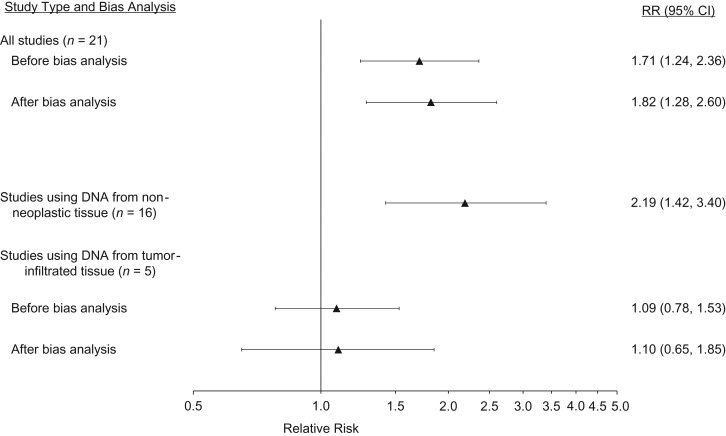
Tamoxifen therapy for estrogen receptor-positive breast cancer reduces the risk of recurrence by approximately one-half. Cytochrome P-450 2D6, encoded by the polymorphic cytochrome P-450 2D6 gene (CYP2D6), oxidizes tamoxifen to its most active metabolites. Steady-state concentrations of endoxifen (4-hydroxy-N-desmethyltamoxifen), the most potent antiestrogenic metabolite, are reduced in women whose CYP2D6 genotypes confer poor enzyme function. Thirty-one studies of the association of CYP2D6 genotype with breast cancer survival have yielded heterogeneous results. Some influential studies genotyped DNA from tumor-infiltrated tissues, and their results may have been susceptible to germline genotype misclassification from loss of heterozygosity at the CYP2D6 locus. We systematically reviewed 6 studies of concordance between genotypes obtained from paired nonneoplastic and breast tumor-infiltrated tissues, all of which showed excellent CYP2D6 genotype agreement. We applied these concordance data to a quantitative bias analysis of the subset of the 31 studies that were based on genotypes from tumor-infiltrated tissue to examine whether genotyping errors substantially biased estimates of association. The bias analysis showed negligible bias by discordant genotypes. Summary estimates of association, with or without bias adjustment, indicated no clinically important association between CYP2D6 genotype and breast cancer survival in tamoxifen-treated women.
Keywords: breast neoplasms; cytochrome P-450 2D6; tamoxifen.
© The Author 2016. Published by Oxford University Press on behalf of the Johns Hopkins Bloomberg School of Public Health. All rights reserved. For permissions, please e-mail: journals.permissions@oup.com.
Figures
References
-
- Jordan VC. Metabolites of tamoxifen in animals and man: identification, pharmacology, and significance. Breast Cancer Res Treat. 1982;2(2):123–138. - PubMed
-
- Early Breast Cancer Trialists’ Collaborative Group Effects of chemotherapy and hormonal therapy for early breast cancer on recurrence and 15-year survival: an overview of the randomised trials. Lancet. 2005;365(9472):1687–1717. - PubMed
Publication types
MeSH terms
Substances
Grants and funding
LinkOut - more resources
Full Text Sources
Other Literature Sources
Medical
