


Published Erratum
doi: 10.1155/2016/1468106.
Epub 2016 Nov 20.
Corrigendum to "Autoimmune Hepatitis: Progress from Global Immunosuppression to Personalised Regulatory T Cell Therapy"
Affiliations
- PMID: 27990413
- PMCID: PMC5136383
- DOI: 10.1155/2016/1468106
Item in Clipboard
Published Erratum
Corrigendum to "Autoimmune Hepatitis: Progress from Global Immunosuppression to Personalised Regulatory T Cell Therapy"
Can J Gastroenterol Hepatol.
2016.
Abstract
[This corrects the article DOI: 10.1155/2016/7181685.].
Figures
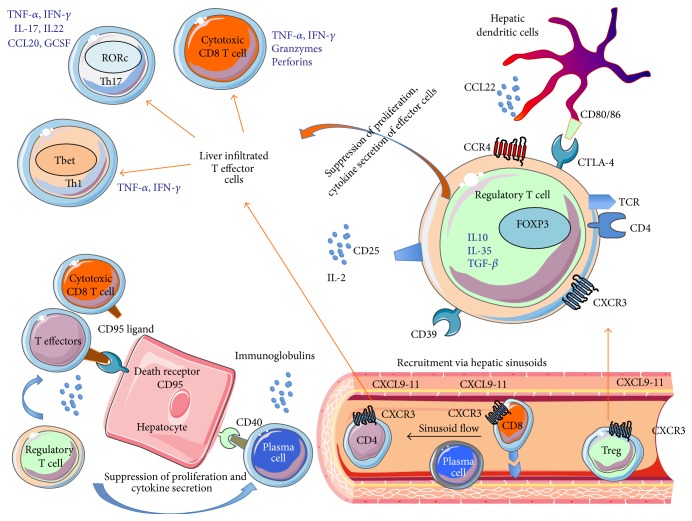
Pathogenesis of autoimmune hepatitis. Both effector T cells (CD4, CD8) and regulatory T cells (Treg) are recruited to inflamed autoimmune hepatitis liver via hepatic sinusoids. T effector cells lead to apoptosis of hepatocytes via CD95 ligand (dead ligand) expressed on them, which binds to CD95 on the hepatocytes. This killing action of T effector cells is regulated by regulatory T cells, which suppress proliferation and cytokine secretion of effector T cells. Plasma cells are also involved in immune-pathogenesis and they secrete immunoglobulin. Liver infiltrated T effector cells consist of Th17, Th1, and cytotoxic T cells. Th1 cells have T bet transcription factor; Th17 cells have transcription factor RORc. Cytotoxic T cells secrete IFN, TNF, granzyme, and perforins. Regulatory T cells (Treg = CD4CD25highCD127low) express liver tissue homing chemokine receptor CXCR3, which binds to its ligands CXCL9-11 expressed on inflamed hepatic sinusoid, hepatocytes, and bile ducts. Treg also expresses its functional markers CTLA4 (interacting with CD80/CD86 on dendritic cells). Dendritic cells secrete chemokine CCL22, which binds to chemokine receptor CCR4 on the regulatory T cells. CD39 on the Treg can generate immunosuppressive adenosine from ATP in the hepatic microenvironment. IL-2, which acts on its receptor CD25, is crucial for intrahepatic Treg survival and function.
Erratum for
-
Autoimmune Hepatitis: Progress from Global Immunosuppression to Personalised Regulatory T Cell Therapy.Can J Gastroenterol Hepatol. 2016;2016:7181685. doi: 10.1155/2016/7181685. Epub 2016 May 18. Can J Gastroenterol Hepatol. 2016. PMID: 27446862 Free PMC article. Review.
References
Publication types
LinkOut - more resources
Full Text Sources
Other Literature Sources
