


doi: 10.1001/jama.2016.17383.
Trends in Marijuana Use Among Pregnant and Nonpregnant Reproductive-Aged Women, 2002-2014
Affiliations
- PMID: 27992619
- PMCID: PMC5595220
- DOI: 10.1001/jama.2016.17383
Item in Clipboard
Trends in Marijuana Use Among Pregnant and Nonpregnant Reproductive-Aged Women, 2002-2014
JAMA.
.
No abstract available
Figures
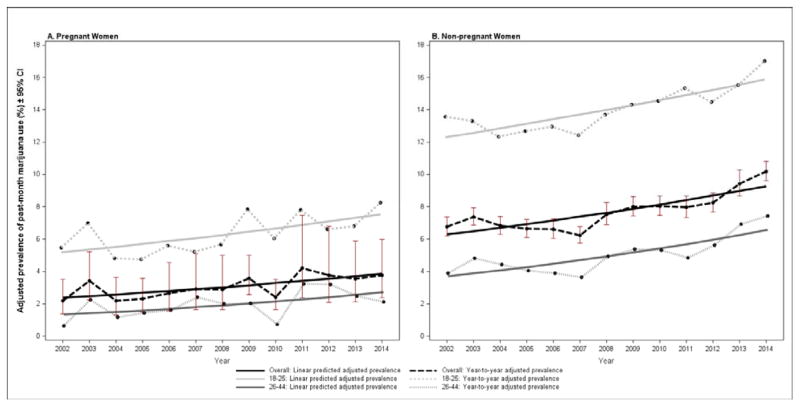
Year-to-year prevalencea of past-month marijuana useb, pregnant and non-pregnant women, overall and by age, 2002–2014 a“Year-to-year” and “Linear predicted” adjusted prevalence estimates are from log-Poisson regressions. Models controlled for race/ethnicity (non-Hispanic White, non-Hispanic Black, Hispanic, and other non-Hispanic minorities), family income ($0–19,999, $20,000–49,999, $50,000–74,999, $75,000+), age (18–25, 26–34, 35–44), education (less than high school, high school, at least some college), year (year was categorical in the “year-to-year” model, and continuous in the “linear predicted model”), pregnancy status, pregnancy*year interaction, covariate*pregnancy interactions and complex survey design. 95% confidence bars are shown for “Year-to-year” adjusted prevalence estimates for the overall group. Percent of variability in dichotomous marijuana use explained by the model with year as a continuous variable was 6% (McFadden’s pseudo-R2); the ratio of the pseudo-R2 statistics for the models with year as a continuous vs. categorical variable is 0.98, indicating strong evidence for a linear trend. bPast-month marijuana use was defined as responding “within the past 30 days” to the question, “How long has it been since you last used marijuana or hashish?”. cData are from the U.S. National Survey on Drug Use and Health (NSDUH). Sample size across all years combined: Pregnant women (n=10,587), non-pregnant women (n=189,923). N’s represent actual number of participants, not weighted values.
Comment in
-
Use of Marijuana Among Pregnant Women Increases.Am J Nurs. 2017 Jun;117(6):70-71. doi: 10.1097/01.NAJ.0000520260.72706.3c. Am J Nurs. 2017. PMID: 28541996 No abstract available.
References
-
- American College of Obstetricians and Gynecologists. Committee Opinion No. 637: Marijuana use during pregnancy and lactation. Obstet Gynecol. 2015;126(1):234–238. - PubMed
-
- Center for Behavioral Health Statistics and Quality. 2014 National Survey on Drug Use and Health: Methodological summary and definitions. Rockville, MD: Substance Abuse and Mental Health Services Administration; 2015.
MeSH terms
Grants and funding
LinkOut - more resources
Full Text Sources
Other Literature Sources
Medical
