


Multiplex KRASG12/G13 mutation testing of unamplified cell-free DNA from the plasma of patients with advanced cancers using droplet digital polymerase chain reaction
- PMID: 27993791
- PMCID: PMC5834133
- DOI: 10.1093/annonc/mdw670
Multiplex KRASG12/G13 mutation testing of unamplified cell-free DNA from the plasma of patients with advanced cancers using droplet digital polymerase chain reaction
Abstract
Background: Cell-free DNA (cfDNA) from plasma offers easily obtainable material for KRAS mutation analysis. Novel, multiplex, and accurate diagnostic systems using small amounts of DNA are needed to further the use of plasma cfDNA testing in personalized therapy.
Patients and methods: Samples of 16 ng of unamplified plasma cfDNA from 121 patients with diverse progressing advanced cancers were tested with a KRASG12/G13 multiplex assay to detect the seven most common mutations in the hotspot of exon 2 using droplet digital polymerase chain reaction (ddPCR). The results were retrospectively compared to mutation analysis of archival primary or metastatic tumor tissue obtained at different points of clinical care.
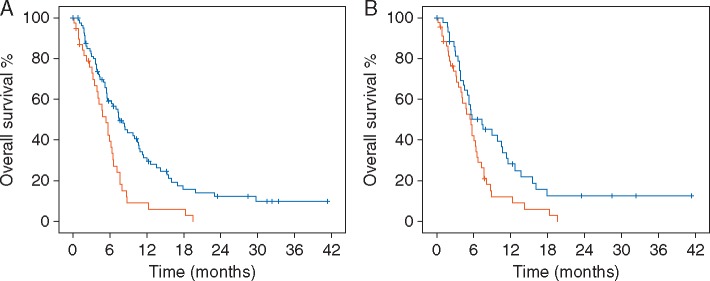
Results: Eighty-eight patients (73%) had KRASG12/G13 mutations in archival tumor specimens collected on average 18.5 months before plasma analysis, and 78 patients (64%) had KRASG12/G13 mutations in plasma cfDNA samples. The two methods had initial overall agreement in 103 (85%) patients (kappa, 0.66; ddPCR sensitivity, 84%; ddPCR specificity, 88%). Of the 18 discordant cases, 12 (67%) were resolved by increasing the amount of cfDNA, using mutation-specific probes, or re-testing the tumor tissue, yielding overall agreement in 115 patients (95%; kappa 0.87; ddPCR sensitivity, 96%; ddPCR specificity, 94%). The presence of ≥ 6.2% of KRASG12/G13 cfDNA in the wild-type background was associated with shorter survival (P = 0.001).
Conclusion(s): Multiplex detection of KRASG12/G13 mutations in a small amount of unamplified plasma cfDNA using ddPCR has good sensitivity and specificity and good concordance with conventional clinical mutation testing of archival specimens. A higher percentage of mutant KRASG12/G13 in cfDNA corresponded with shorter survival.
Keywords: cell-free DNA; KRAS; droplet digital PCR; multiplex.
© The Author 2016. Published by Oxford University Press on behalf of the European Society for Medical Oncology. All rights reserved. For permissions, please email: journals.permissions@oup.com.
Figures
References
-
- Hutchins G, Southward K, Handley K. et al. Value of mismatch repair, KRAS, and BRAF mutations in predicting recurrence and benefits from chemotherapy in colorectal cancer. J Clin Oncol 2011; 29: 1261–1270. - PubMed
-
- Douillard JY, Oliner KS, Siena S. et al. Panitumumab-FOLFOX4 treatment and RAS mutations in colorectal cancer. N Engl J Med 2013; 369: 1023–1034. - PubMed
MeSH terms
Substances
Grants and funding
LinkOut - more resources
Full Text Sources
Other Literature Sources
Miscellaneous
