. 2017 Apr 7;45(6):3116-3129.
doi: 10.1093/nar/gkw1273.

Arabidopsis SWI/SNF chromatin remodeling complex binds both promoters and terminators to regulate gene expression

Affiliations

Arabidopsis SWI/SNF chromatin remodeling complex binds both promoters and terminators to regulate gene expression

Rafal Archacki et al. Nucleic Acids Res. .

Abstract

ATP-dependent chromatin remodeling complexes are important regulators of gene expression in Eukaryotes. In plants, SWI/SNF-type complexes have been shown critical for transcriptional control of key developmental processes, growth and stress responses. To gain insight into mechanisms underlying these roles, we performed whole genome mapping of the SWI/SNF catalytic subunit BRM in Arabidopsis thaliana, combined with transcript profiling experiments. Our data show that BRM occupies thousands of sites in Arabidopsis genome, most of which located within or close to genes. Among identified direct BRM transcriptional targets almost equal numbers were up- and downregulated upon BRM depletion, suggesting that BRM can act as both activator and repressor of gene expression. Interestingly, in addition to genes showing canonical pattern of BRM enrichment near transcription start site, many other genes showed a transcription termination site-centred BRM occupancy profile. We found that BRM-bound 3΄ gene regions have promoter-like features, including presence of TATA boxes and high H3K4me3 levels, and possess high antisense transcriptional activity which is subjected to both activation and repression by SWI/SNF complex. Our data suggest that binding to gene terminators and controlling transcription of non-coding RNAs is another way through which SWI/SNF complex regulates expression of its targets.


Figures

Figure 1.
Figure 1.
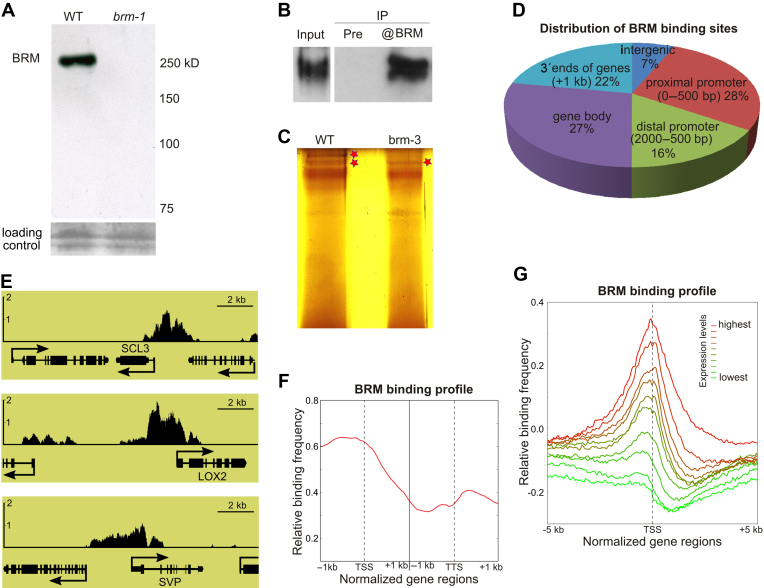
Genome-wide identification of BRAHMA (BRM) occupancy using ChIP-chip. (A–C) Specificity of anti-BRM antibody used for ChIP-chip. (A) Western blot of nuclear extracts from WT and brm-1 null mutant. (B) Western blot showing precipitation of BRM from WT nuclear extracts; pre-immunization serum (Pre) was used as a negative control. (C) Silver-stained gel showing immunoprecipitated BRM (asterisks) from WT and brm-3 whole-cell extracts. (D) Distribution of BRM-bound regions throughout the Arabidopsis genome. (E) BRM occupancy at selected regions around known BRM target genes SCL3, LOX2 and SVP. Y axis represents BRM enrichment. (F) Frequency of BRM-binding sites across a virtually normalized gene unit. TSS, transcription start site; TTS, transcription termination site. (G) Analysis of average BRM binding site frequency surrounding the TSS. Genes were classified into 10 groups based on expression levels.
Figure 2.
Figure 2.
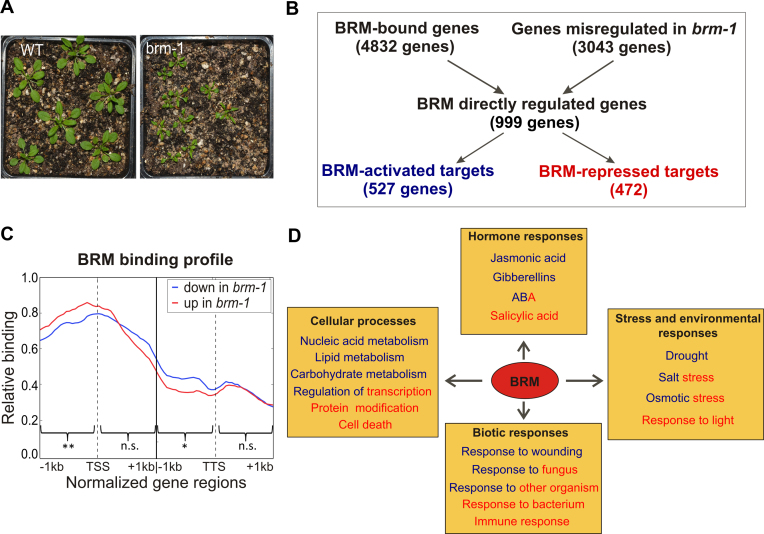
Analysis of direct transcriptional BRM targets. (A) Three-week old WT and brm-1 mutant plants used for ChIP-chip and transcriptome analyses. (B) BRM ChIP-chip and transcript profiling data of WT and brm-1 mutant were used to identify directly regulated genes. (C) Frequency of BRM-binding sites across a virtually normalized gene unit. Genes were classified into two groups based on expression changes in brm-1 mutant. TSS, transcription start site; TTS, transcription termination site. Asterisks indicate significant differences between the groups (Wilcoxon test, * P < 0.05; ** P < 0.01; n.s. not significant). (D) Functional classification of directly regulated genes based on gene ontology (GO) using AgriGo tool. GO categories enriched within BRM-activated and BRM-repressed targets are shown in blue and red color, respectively.
Figure 3.
Figure 3.
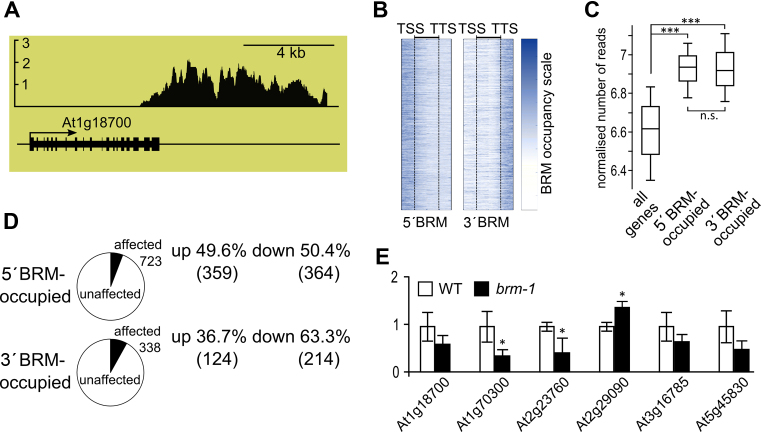
Characterization of 3΄ BRM bound genes. (A) Example of 3΄ BRM-occupied gene (At1g18700) from whole-genome ChIP-chip using anti-BRM antibodies, y-axis represents BRM enrichment. (B) BRM occupancy along genes; genes with BRM bound at 5΄ end or near 3΄ end are shown. TSS and TTS represent aligned transcription start and transcription termination sites, respectively, of genes in each class. (C) Expression levels of all, 5΄ and 3΄ BRM-occupied genes using RNAseq data from (47). Asterisks indicate significant differences between the 5΄BRM and 3΄BRM groups (Wilcoxon signed-rank p-test; *** P < 0.001; n.s. not significant). (D) Comparison of expression of 5΄ and 3΄ BRM-occupied genes in brm-1 null mutant and WT plants. (E) RT-qPCR analysis of mRNA expression for selected 3΄ BRM-bound genes in brm-1 mutant and WT. * significant change between brm-1 and WT (t-test, P < 0.05).
Figure 4.
Figure 4.
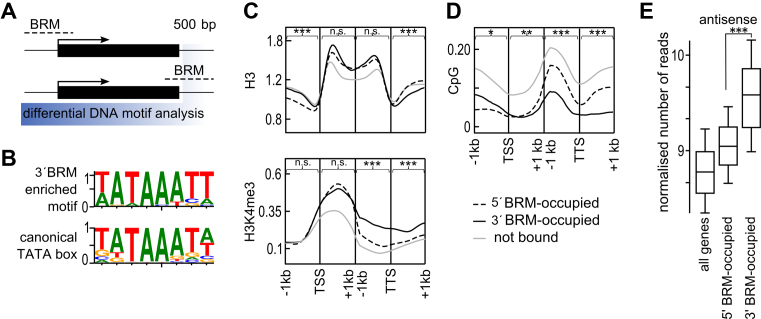
TTS regions occupied by BRM act as promoters of antisense transcription. (A) Schematic of de novo motif discovery procedure used to define motifs enriched in 500 bp region behind TTS (highlighted in blue) of 3΄BRM-occupied genes. Black rectangles represent genes and dashed lines indicate BRM binding sites. (B) Weblogo of discovered motif, with canonical TATA box motif shown below, y-axis – information context. (C) Genes were grouped based on BRM occupancy into 5΄, 3΄ and BRM – not bound, and for each class occupancy profiles along a 1 kb region around TSS and TTS were plotted. Top to bottom occupancy profile of H3 and H3K4me3, using published ChIP-seq data (–59). (D) CG DNA methylation profiles for 5΄BRM, 3΄BRM and BRM – not bound genes for a 1 kb region around TSS and TTS were plotted based on (61). (E) 3΄BRM-occupied genes show high antisense levels. RNAseq data (47) were combined, normalized for gene length and average for each gene category was plotted. Asterisks in C, D and E indicate significant differences between the 5΄BRM and 3΄BRM groups (Wilcoxon test, *P < 0.05; **P <0.01; ***P < 0.001; n.s. not significant).
Figure 5.
Figure 5.
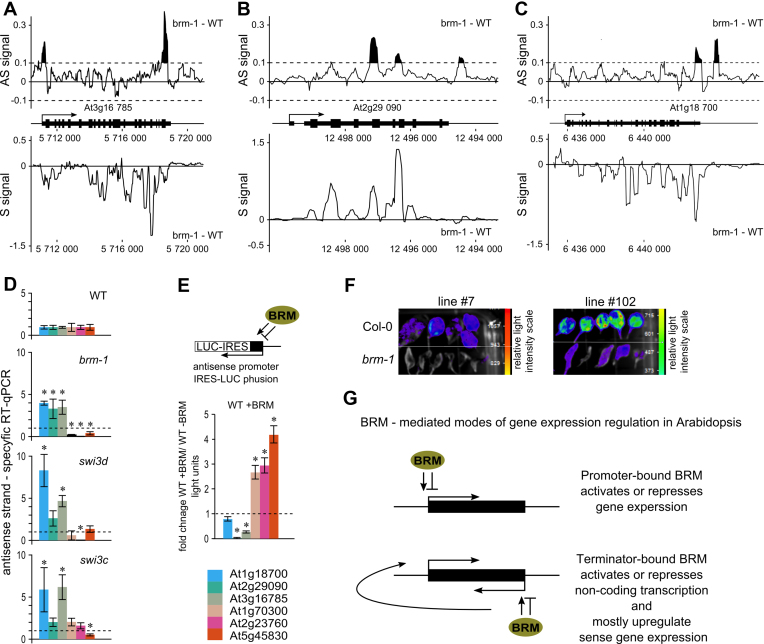
SWI/SNF complex regulates antisense transcription. (A, B and C) Difference (brm-1 – WT) in intensity for antisense (AS signal) and sense (S signal) expression values from whole genome tilling arrays was plotted along the selected target genes. Negative values indicate down and positive up regulation. For the antisense signal a cut-off value of 0.1 (black filled picks) was used to indicate changes in antisense expression above background. (D) Mutants in SWI/SNF subunits show misregulation of antisense transcription. Strand specific RT-qPCR quantification of antisense transcripts at selected 3΄BRM-bound genes. (E) BRM controls antisense transcription from TTS regions of 3΄BRM-occupied genes. TTS regions of selected genes were cloned into luciferase marker gene (LUC) reporter construct and used for transient co-transformation of Arabidopsis Col-0 (WT) seedlings with or without BRM expression construct. Data represent fold change in LUC activity upon BRM overexpression relative to seedlings transformed with empty expression vector; data are mean ±SE for at least 20 individually transformed plants. (F) pAS-At5g45830::LUC transgene was transformed into BRM/brm-1 plant line. brm-1 heterozygotes segregating 3:1 for the transgene were selected and their offspring were genotyped to select WT and brm-1 homozygous plants. Data for two independent transformants (line #7 and #102) are shown. (G) Model of 5΄BRM driven activation or repression of gene expression (Top), and 3΄BRM driven regulation of antisense transcription leading to concomitant sense gene regulation (Bottom). * significant change (t-test, P < 0.05).

References

    1. Clapier C.R., Cairns B.R.. The biology of chromatin remodeling complexes. Annu. Rev. Biochem. 2009; 78:273–304. - PubMed
    1. Narlikar G.J., Sundaramoorthy R., Owen-Hughes T.. Mechanisms and functions of ATP-dependent chromatin-remodeling enzymes. Cell. 2013; 154:490–503. - PMC - PubMed
    1. Phelan M.L., Sif S., Narlikar G.J., Kingston R.E.. Reconstitution of a core chromatin remodeling complex from SWI/SNF subunits. Mol. Cell. 1999; 3:247–253. - PubMed
    1. Yen K., Vinayachandran V., Batta K., Koerber R.T., Pugh B.F.. Genome-wide nucleosome specificity and directionality of chromatin remodelers. Cell. 2012; 149:1461–1473. - PMC - PubMed
    1. De S., Wurster A.L., Precht P., Wood W.H., Becker K.G., Pazin M.J.. Dynamic BRG1 recruitment during T helper differentiation and activation reveals distal regulatory elements. Mol. Cell. Biol. 2011; 31:1512–1527. - PMC - PubMed

Publication types

MeSH terms