


Phylogenetic evidence for the modular evolution of metazoan signalling pathways
- PMID: 27994120
- PMCID: PMC5182411
- DOI: 10.1098/rstb.2015.0477
Phylogenetic evidence for the modular evolution of metazoan signalling pathways
Abstract
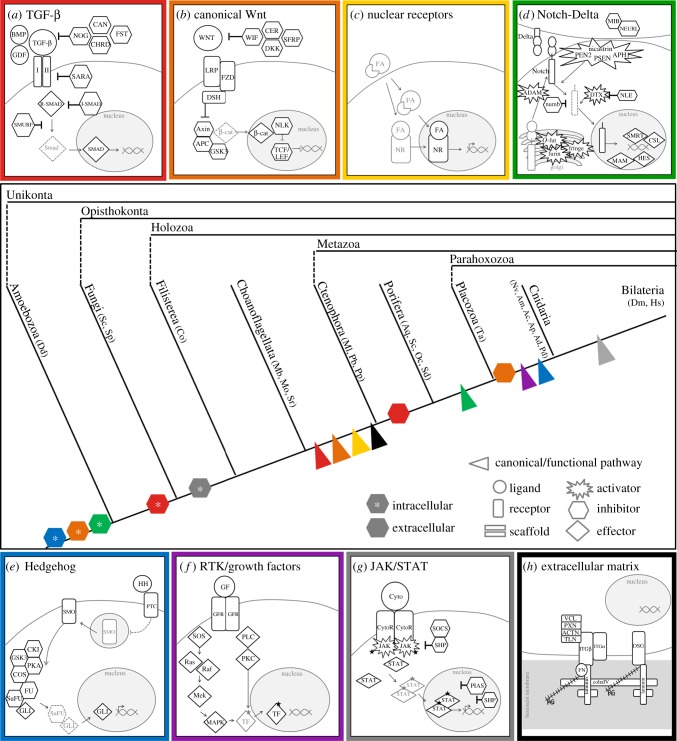
Communication among cells was paramount to the evolutionary increase in cell type diversity and, ultimately, the origin of large body size. Across the diversity of Metazoa, there are only few conserved cell signalling pathways known to orchestrate the complex cell and tissue interactions regulating development; thus, modification to these few pathways has been responsible for generating diversity during the evolution of animals. Here, we summarize evidence for the origin and putative function of the intracellular, membrane-bound and secreted components of seven metazoan cell signalling pathways with a special focus on early branching metazoans (ctenophores, poriferans, placozoans and cnidarians) and basal unikonts (amoebozoans, fungi, filastereans and choanoflagellates). We highlight the modular incorporation of intra- and extracellular components in each signalling pathway and suggest that increases in the complexity of the extracellular matrix may have further promoted the modulation of cell signalling during metazoan evolution. Most importantly, this updated view of metazoan signalling pathways highlights the need for explicit study of canonical signalling pathway components in taxa that do not operate a complete signalling pathway. Studies like these are critical for developing a deeper understanding of the evolution of cell signalling.This article is part of the themed issue 'Evo-devo in the genomics era, and the origins of morphological diversity'.
Keywords: cell signalling; complexity; ctenophore; evolution; metazoa.
© 2016 The Author(s).
Figures
References
-
- Grosberg RK, Strathmann RR. 2007. The evolution of multicellularity: a minor major transition? Annu. Rev. Ecol. Evol. Syst. 38, 621–654. (10.1146/annurev.ecolsys.36.102403.114735) - DOI
Publication types
MeSH terms
Associated data
Grants and funding
LinkOut - more resources
Full Text Sources
Other Literature Sources
