Review
. 2017 Jul;45(7):1718-1730.
doi: 10.1007/s10439-016-1776-2. Epub 2016 Dec 19.

Uterine Tissue Engineering and the Future of Uterus Transplantation

Affiliations
Review

Uterine Tissue Engineering and the Future of Uterus Transplantation

Mats Hellström et al. Ann Biomed Eng. 2017 Jul.

Abstract

The recent successful births following live donor uterus transplantation are proof-of-concept that absolute uterine factor infertility is a treatable condition which affects several hundred thousand infertile women world-wide due to a dysfunctional uterus. This strategy also provides an alternative to gestational surrogate motherhood which is not practiced in most countries due to ethical, religious or legal reasons. The live donor surgery involved in uterus transplantation takes more than 10 h and is then followed by years of immunosuppressive medication to prevent uterine rejection. Immunosuppression is associated with significant adverse side effects, including nephrotoxicity, increased risk of serious infections, and diabetes. Thus, the development of alternative approaches to treat absolute uterine factor infertility would be desirable. This review discusses tissue engineering principles in general, but also details strategies on how to create a bioengineered uterus that could be used for transplantation, without risky donor surgery and any need for immunosuppression. We discuss scaffolds derived from decellularized organs/tissues which may be recellularized using various types of autologous somatic/stem cells, in particular for uterine tissue engineering. It further highlights the hurdles that lay ahead in developing an alternative to an allogeneic source for uterus transplantation.

Keywords: Bioengineering; Bioreactor; Decellularization; Mesenchymal stem cells; Recellularization; Reproduction; Scaffold.


Figures
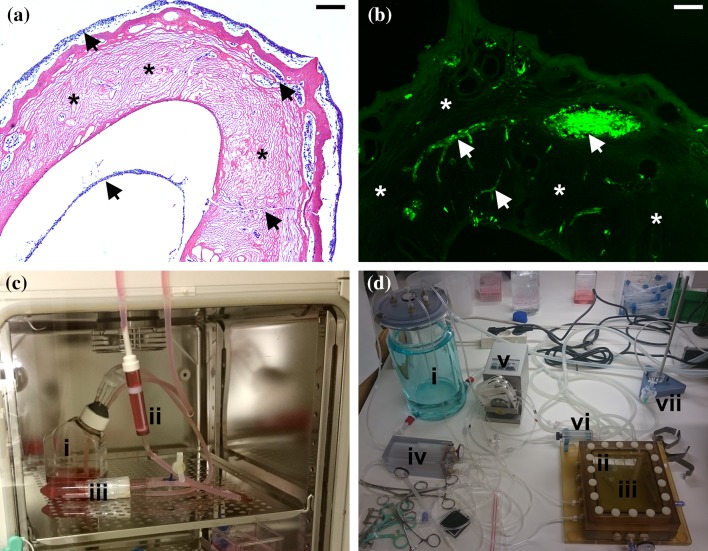
Figure 1
Figure 1
Previously unpublished pictures of a Hematoxylin and Eosin stained section (a), and of a section with green fluorescent protein (GFP) labeled cells (b) from a recellularized whole rat uterus scaffold that was kept for 7 days in vitro after recellularization with about 300 million rat GFP-labeled bone marrow derived mesenchymal stem cells (MSCs). The scaffold was generated by a decellularization protocol based on perfusing the ionic detergent sodium deoxycholate and deionized H2O sequentially for 5 days. After recellularization, the engineered uterus construct was kept submerged in media that circulated in a closed, homemade, perfusion bioreactor which was maintained in a 37 °C humidified chamber supplemented with 5% CO2 (c). Note the vast cell-free scaffold areas in (a, b), and that cells mainly localized around the outside and on the luminal side of the scaffold (a), and in isolated pockets within the scaffold (b). (c) Picture of the homemade bioreactor used for the particular experiment shown in (a, b). Note that this particular system did not provide any extra oxygen supply to the media. We have now invested in a highly sophisticated perfusion bioreactor system from Hugo Sachs Electronic—Harvard Apparatus GmbH (jacketed psu moist chamber with tubing heat exchanger type 834/10) which gives us much better conditions for 3D-cell culturing, including temperature regulation, media oxygenation and pressure measurements (d). All animal experiments were approved by the Animal Ethics Committee in Gothenburg, Sweden. We are currently optimizing our recellularization techniques using this innovative system which hopefully also will extend our culturing times and reduce the contamination prevalence which has been a significant problem. Scale bar 200 µm. i, media cistern; ii, bubble trap; iii, organ perfusion site and reservoir; iv, oxygenator; v, peristaltic pump (not shown in c); vi, media heat exchanger; vii, pressure measure device.

References

    1. Arnold JT, Kaufman DG, Seppala M, Lessey BA. Endometrial stromal cells regulate epithelial cell growth in vitro: a new co-culture model. Hum. Reprod. 2001;16:836–845. doi: 10.1093/humrep/16.5.836. - DOI - PubMed
    1. Atala A. Tissue engineering of reproductive tissues and organs. Fertil. Steril. 2012;98:21–29. doi: 10.1016/j.fertnstert.2012.05.038. - DOI - PubMed
    1. Atala A, Bauer SB, Soker S, Yoo JJ, Retik AB. Tissue-engineered autologous bladders for patients needing cystoplasty. Lancet. 2006;367:1241–1246. doi: 10.1016/S0140-6736(06)68438-9. - DOI - PubMed
    1. Atiyeh BS, Costagliola M. Cultured epithelial autograft (CEA) in burn treatment: three decades later. Burns. 2007;33:405–413. doi: 10.1016/j.burns.2006.11.002. - DOI - PubMed
    1. Azimzadeh AM, Lees JR, Ding Y, Bromberg JS. Immunobiology of transplantation: impact on targets for large and small molecules. Clin. Pharmacol. Ther. 2011;90:229–242. doi: 10.1038/clpt.2011.106. - DOI - PubMed

LinkOut - more resources
