


Anti-Müllerian Hormone in Obese Adolescent Girls With Polycystic Ovary Syndrome
- PMID: 27998701
- PMCID: PMC5326592
- DOI: 10.1016/j.jadohealth.2016.10.015
Anti-Müllerian Hormone in Obese Adolescent Girls With Polycystic Ovary Syndrome
Abstract
Purpose: Anti-Müllerian hormone (AMH) is proposed as a biomarker of polycystic ovary syndrome (PCOS). This study investigated: (1) AMH concentrations in obese adolescents with PCOS versus without PCOS; (2) the relationship of AMH to sex steroid hormones, adiposity, and insulin resistance; and (3) the optimal AMH value and the multivariable prediction model to determine PCOS in obese adolescents.
Methods: AMH levels were measured in 46 obese PCOS girls and 43 obese non-PCOS girls. Sex steroid hormones, clamp-measured insulin sensitivity and secretion, body composition, and abdominal adiposity were evaluated. Logistic regression and receiver-operating characteristic curve analyses were used, and multivariate prediction models were developed to test the utility of AMH for the diagnosis of PCOS.
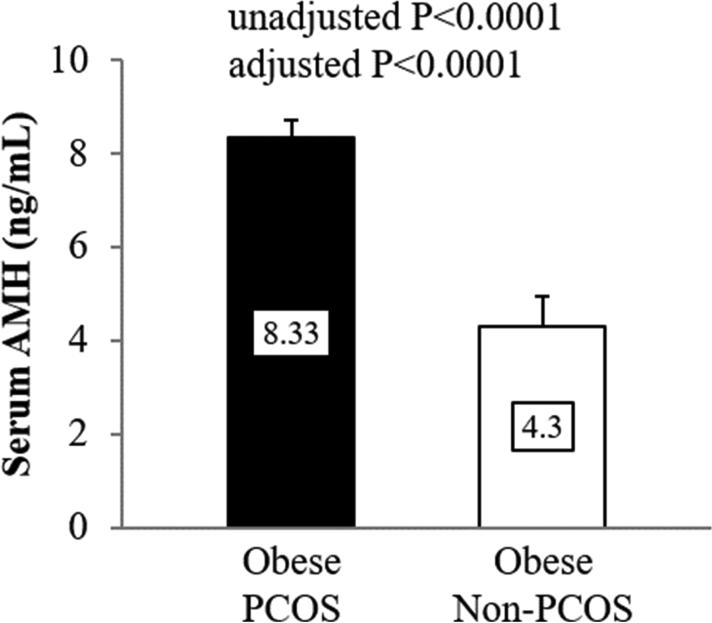
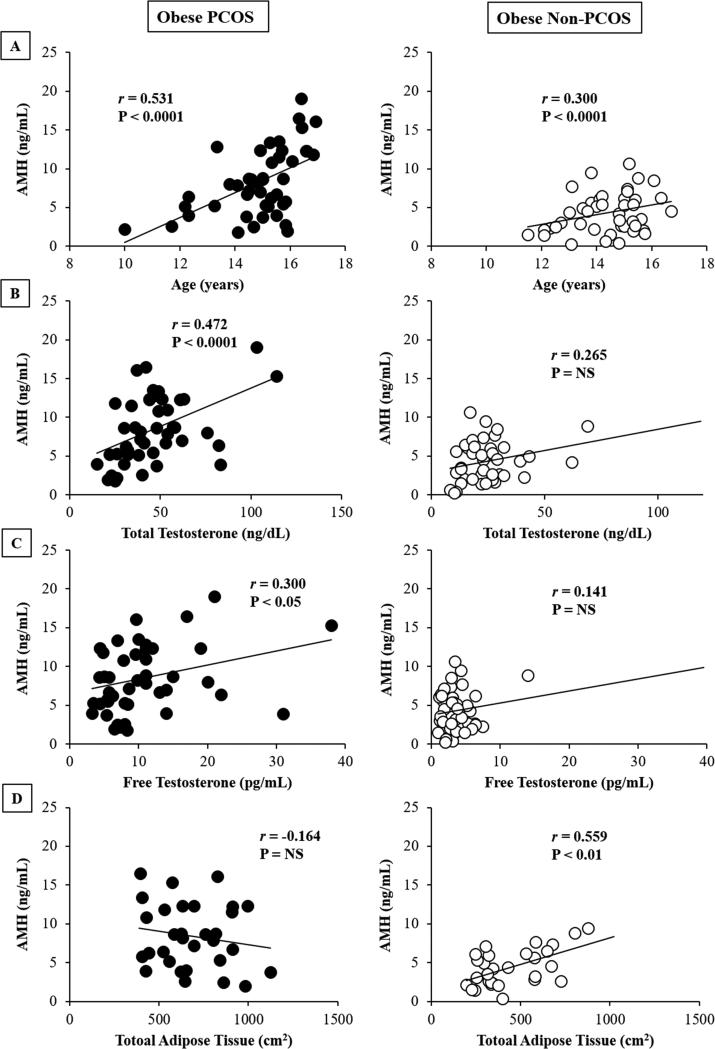
Results: AMH levels were higher in obese PCOS versus non-PCOS girls (8.3 ± .6 vs. 4.3 ± .4 ng/mL, p < .0001), of comparable age and puberty. AMH concentrations correlated positively with age in both groups, total and free testosterone in PCOS girls only, abdominal adipose tissue in non-PCOS girls, with no correlation to in vivo insulin sensitivity and secretion in either groups. A multivariate model including AMH (cutoff 6.26 ng/mL, area under the curve .788) together with sex hormone-binding globulin and total testosterone exhibited 93.4% predictive power for diagnosing PCOS.
Conclusions: AMH may be a useful biomarker for the diagnosis of PCOS in obese adolescent girls.
Keywords: AMH; Hyperandrogenemia; Obese adolescents; PCOS.
Copyright © 2016 Society for Adolescent Health and Medicine. Published by Elsevier Inc. All rights reserved.
Figures
References
-
- Rotterdam ESHRE/ASRM-sponsored PCOS consensus workshop group Revised 2003 consensus on diagnostic criteria and long-term health risks related to polycystic ovary syndrome. Fertil Steril. 2004;81:19–25. - PubMed
-
- Witchel SF, Oberfield S, Rosenfield RL, et al. The Diagnosis of Polycystic Ovary Syndrome during Adolescence. Horm Res Paediatr. 2015 [Epub ahead of print] - PubMed
-
- Pasquali R, Pelusi C, Genghini S, et al. Obesity and reproductive disorders in women. Hum Reprod Update. 2003;9:359–72. - PubMed
MeSH terms
Substances
Grants and funding
LinkOut - more resources
Full Text Sources
Other Literature Sources
Medical
