


The Use and Effectiveness of Mobile Apps for Depression: Results From a Fully Remote Clinical Trial
- PMID: 27998876
- PMCID: PMC5209607
- DOI: 10.2196/jmir.6482
The Use and Effectiveness of Mobile Apps for Depression: Results From a Fully Remote Clinical Trial
Abstract
Background: Mobile apps for mental health have the potential to overcome access barriers to mental health care, but there is little information on whether patients use the interventions as intended and the impact they have on mental health outcomes.
Objective: The objective of our study was to document and compare use patterns and clinical outcomes across the United States between 3 different self-guided mobile apps for depression.
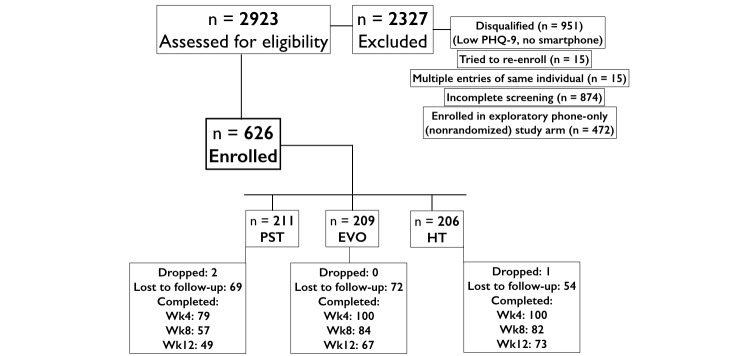
Methods: Participants were recruited through Web-based advertisements and social media and were randomly assigned to 1 of 3 mood apps. Treatment and assessment were conducted remotely on each participant's smartphone or tablet with minimal contact with study staff. We enrolled 626 English-speaking adults (≥18 years old) with mild to moderate depression as determined by a 9-item Patient Health Questionnaire (PHQ-9) score ≥5, or if their score on item 10 was ≥2. The apps were (1) Project: EVO, a cognitive training app theorized to mitigate depressive symptoms by improving cognitive control, (2) iPST, an app based on an evidence-based psychotherapy for depression, and (3) Health Tips, a treatment control. Outcomes were scores on the PHQ-9 and the Sheehan Disability Scale. Adherence to treatment was measured as number of times participants opened and used the apps as instructed.
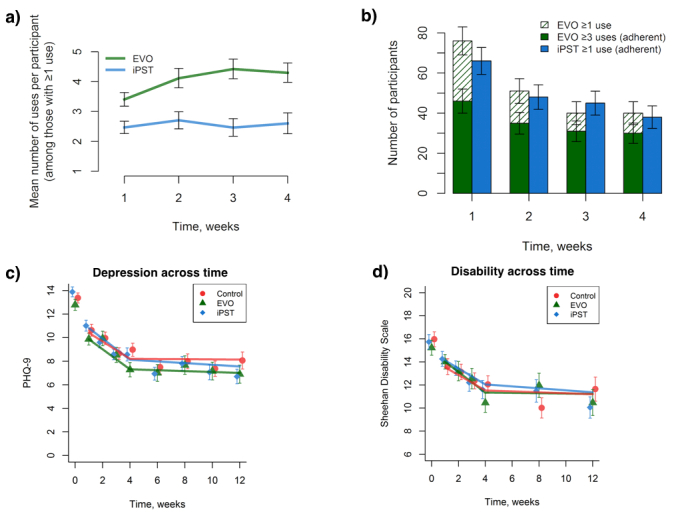
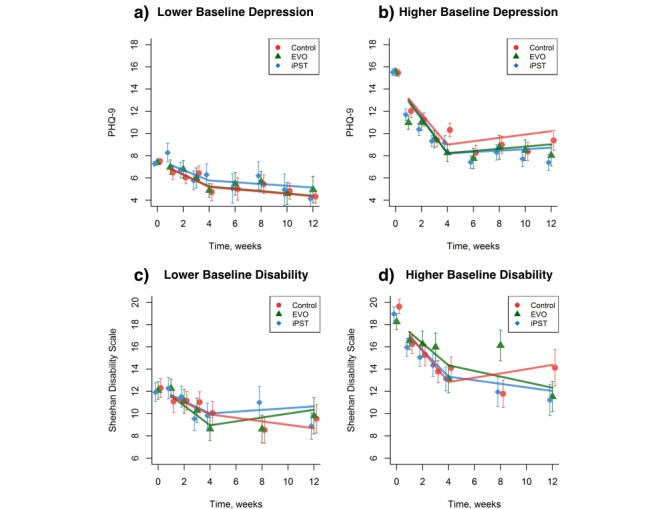
Results: We randomly assigned 211 participants to iPST, 209 to Project: EVO, and 206 to Health Tips. Among the participants, 77.0% (482/626) had a PHQ-9 score >10 (moderately depressed). Among the participants using the 2 active apps, 57.9% (243/420) did not download their assigned intervention app but did not differ demographically from those who did. Differential treatment effects were present in participants with baseline PHQ-9 score >10, with the cognitive training and problem-solving apps resulting in greater effects on mood than the information control app (χ22=6.46, P=.04).
Conclusions: Mobile apps for depression appear to have their greatest impact on people with more moderate levels of depression. In particular, an app that is designed to engage cognitive correlates of depression had the strongest effect on depressed mood in this sample. This study suggests that mobile apps reach many people and are useful for more moderate levels of depression.
Clinicaltrial: Clinicaltrials.gov NCT00540865; https://www.clinicaltrials.gov/ct2/show/NCT00540865 (Archived by WebCite at http://www.webcitation.org/6mj8IPqQr).
Keywords: RCT; cognitive training; depression; iPST; mobile apps; problem-solving therapy; randomized controlled trial.
©Patricia A Arean, Kevin A Hallgren, Joshua T Jordan, Adam Gazzaley, David C Atkins, Patrick J Heagerty, Joaquin A Anguera. Originally published in the Journal of Medical Internet Research (http://www.jmir.org), 20.12.2016.
Conflict of interest statement
AG is cofounder, chief science advisor, and shareholder of Akili Interactive Labs, a company that develops cognitive training software. AG has a patent pending for a game-based cognitive training intervention, “Enhancing cognition in the presence of distraction and/or interruption,” on which the cognitive training app (Project: EVO) that was used in this study was based. No other author has any conflict of interest to report.
Figures
References
-
- Kessler RC, Berglund P, Demler O, Jin R, Koretz D, Merikangas KR, Rush AJ, Walters EE, Wang PS, National Comorbidity Survey Replication The epidemiology of major depressive disorder: results from the National Comorbidity Survey Replication (NCS-R) JAMA. 2003 Jun 18;289(23):3095–105. doi: 10.1001/jama.289.23.3095.289/23/3095 - DOI - PubMed
-
- Cuijpers P, Geraedts AS, van Oppen P, Andersson G, Markowitz JC, van Straten A. Interpersonal psychotherapy for depression: a meta-analysis. Am J Psychiatry. 2011 Jun;168(6):581–92. doi: 10.1176/appi.ajp.2010.10101411. http://europepmc.org/abstract/MED/21362740 appi.ajp.2010.10101411 - DOI - PMC - PubMed
Publication types
MeSH terms
Associated data
Grants and funding
LinkOut - more resources
Full Text Sources
Other Literature Sources
Medical
