. 2016 Dec 6:9:137.
doi: 10.3389/fnmol.2016.00137. eCollection 2016.

Exogenous Ketone Supplements Reduce Anxiety-Related Behavior in Sprague-Dawley and Wistar Albino Glaxo/Rijswijk Rats

Affiliations

Exogenous Ketone Supplements Reduce Anxiety-Related Behavior in Sprague-Dawley and Wistar Albino Glaxo/Rijswijk Rats

Csilla Ari et al. Front Mol Neurosci. .

Erratum in

Abstract

Nutritional ketosis has been proven effective for seizure disorders and other neurological disorders. The focus of this study was to determine the effects of ketone supplementation on anxiety-related behavior in Sprague-Dawley (SPD) and Wistar Albino Glaxo/Rijswijk (WAG/Rij) rats. We tested exogenous ketone supplements added to food and fed chronically for 83 days in SPD rats and administered sub-chronically for 7 days in both rat models by daily intragastric gavage bolus followed by assessment of anxiety measures on elevated plus maze (EPM). The groups included standard diet (SD) or SD + ketone supplementation. Low-dose ketone ester (LKE; 1,3-butanediol-acetoacetate diester, ~10 g/kg/day, LKE), high dose ketone ester (HKE; ~25 g/kg/day, HKE), beta-hydroxybutyrate-mineral salt (βHB-S; ~25 g/kg/day, KS) and βHB-S + medium chain triglyceride (MCT; ~25 g/kg/day, KSMCT) were used as ketone supplementation for chronic administration. To extend our results, exogenous ketone supplements were also tested sub-chronically on SPD rats (KE, KS and KSMCT; 5 g/kg/day) and on WAG/Rij rats (KE, KS and KSMCT; 2.5 g/kg/day). At the end of treatments behavioral data collection was conducted manually by a blinded observer and with a video-tracking system, after which blood βHB and glucose levels were measured. Ketone supplementation reduced anxiety on EPM as measured by less entries to closed arms (sub-chronic KE and KS: SPD rats and KSMCT: WAG/Rij rats), more time spent in open arms (sub-chronic KE: SPD and KSMCT: WAG/Rij rats; chronic KSMCT: SPD rats), more distance traveled in open arms (chronic KS and KSMCT: SPD rats) and by delayed latency to entrance to closed arms (chronic KSMCT: SPD rats), when compared to control. Our data indicates that chronic and sub-chronic ketone supplementation not only elevated blood βHB levels in both animal models, but reduced anxiety-related behavior. We conclude that ketone supplementation may represent a promising anxiolytic strategy through a novel means of inducing nutritional ketosis.

Keywords: animal models; anxiety; elevated plus maze; exogenous ketone supplements; ketones.


Figures
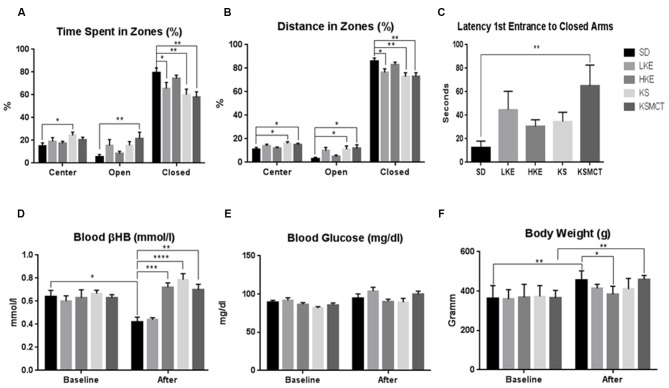
Figure 1
Figure 1
Response of Sprague-Dawley (SPD) rats to chronic feeding of exogenous ketone supplementation. (A) Rats consuming KSMCT supplements spent more time in open arms (open), Low-dose ketone ester (LKE), KS and KSMCT groups spent less time in closed arms (closed), showing reduced anxiety compared to control (SD) group; (B) Rats consuming ketone supplements traveled more distance in open arms (KS and KSMCT) and less in closed arms (LKE, KS and KSMCT), showing reduced anxiety compared to control group; (C) Rats consuming KSMCT entered the closed arms later, showing reduced anxiety compared to control group; (D) Rats consuming high dose ketone ester (HKE), KS and KSMCT showed elevated blood ketone levels after 13 weeks (after) compared to control group; (E) Blood glucose levels did not change significantly were lower in HKE and KSMCT groups compared to control after 13 weeks; and (F) body weight was lower in HKE group after 13 weeks compared to control. Abbreviations: SD, standard rodent chow + water (~25 g/kg b.w. water/day); LKE, SD + LKE (1,3-butanediol-acetoacetate diester, ~10 g/kg b.w./day); HKE, SD + HKE (~25 g/kg b.w./day); KS, SD + beta-hydroxybutyrate-mineral salt (βHB-S; ~25 g/kg b.w./day); KSMCT, SD + βHB-S+medium chain triglyceride (MCT; ~25 g/kg b.w./day); (*p < 0.05; **p < 0.01; ***p < 0.001; ****p < 0.0001).
Figure 2
Figure 2
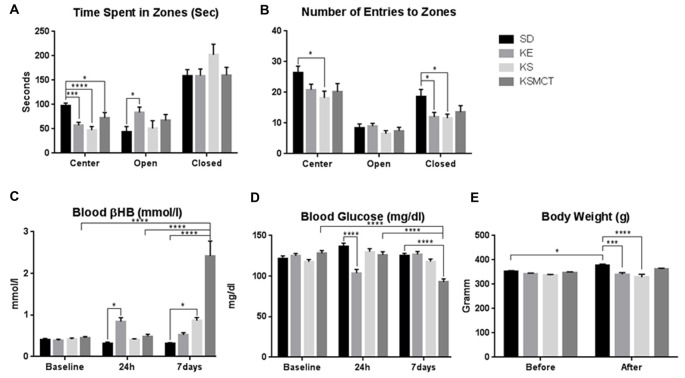
Response of SPD rats to 7 days oral administration (gavage) of exogenous ketone supplementation. (A) More time spent in open arms (open) by KE group and less time spent in center by KE, KS and KSMCT groups were detected compared to control; (B) Less entries in closed arms (closed) by KE and KS groups; (C) Blood βHB levels were higher in KE group after 24 h and in KS and KSMCT groups after 7 days, compared to control; (D) Blood glucose levels were lower in KE group after 24 h and in KSMCT group compared to baseline, control and 24 h; (E) Body weight was lower in KE and KS groups compared to control after 7 days. Abbreviations: SD, standard rodent chow + water (~5 g/kg b.w. water/day); KE, SD + ketone ester (1,3-butanediol-acetoacetate diester, ~5 g/kg b.w./day); KS, SD + beta-hydroxybutyrate-mineral salt (βHB-S; ~5 g/kg b.w./day); KSMCT, SD + βHB-S + MCT (~5 g/kg b.w./day); (*p < 0.05; ***p < 0.001; ****p < 0.0001).
Figure 3
Figure 3
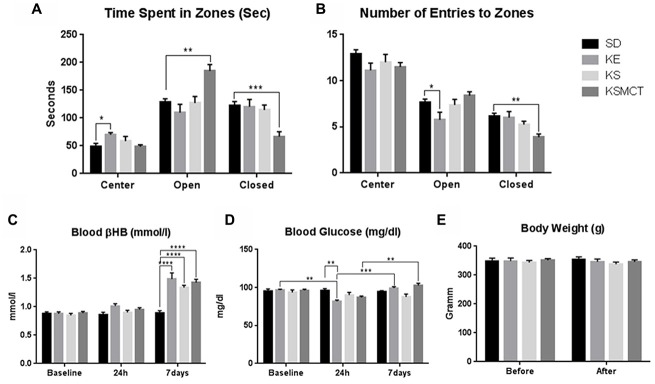
Response of Wistar Albino Glaxo/Rijswijk (WAG/Rij) rats to 7 days oral administration of exogenous ketone supplementation. (A) More time spent in open arms (open) and less time spent in closed arms (closed) by KSMCT group were demonstrated compared to control; (B) Less entries in closed arms by KSMCT group and in open arms by KE group; (C) Blood βHB levels were higher in all treatment groups (KE, KS and KSMCT) after 7 days, compared to baseline, 24h and control. (D) Blood glucose levels decreased after 24 h in KE group compared to control and baseline, but increased after 7 days compared to 24 h in KE and KSMCT group; (E) Body weight did not change significantly in either groups. Abbreviations: SD, standard rodent chow + water (~2.5 g/kg b.w. water/day); KE, SD + ketone ester (1,3-butanediol-acetoacetate diester, ~2.5 g/kg b.w./day); KS, SD + beta-hydroxybutyrate-mineral salt (βHB-S; ~2.5 g/kg b.w./day); KSMCT, SD + beta-hydroxybutyrate-mineral salt (BHB-S) + MCT (KSMCT; ~2.5 g/kg b.w./day); (*p < 0.05; **p < 0.01; ***p < 0.001; ****p < 0.0001).
Figure 4
Figure 4
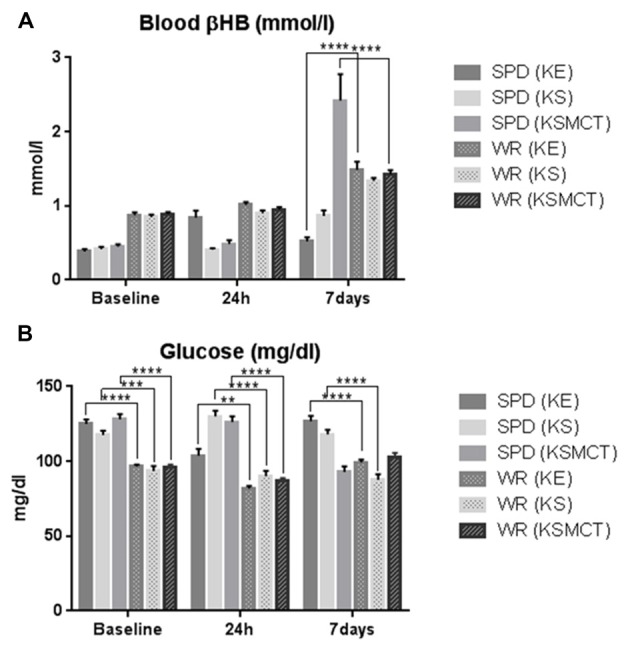
Blood βHB and glucose levels compared between the two animal models. (A) Blood βHB levels were higher at 7 days in WAG/Rij rats after KE and KSMCT treatment. (B) Blood glucose levels were significantly lower in WAG/Rij rats, except in KSMCT group at 7 days. (**p < 0.01; ***p < 0.001; ****p < 0.0001).

References

    1. Albert C. M., Chae C. U., Rexrode K. M., Manson J. E., Kawachi I. (2005). Phobic anxiety and risk of coronary heart disease and sudden cardiac death among women. Circulation 111, 480–487. 10.1161/01.cir.0000153813.64165.5d - DOI - PubMed
    1. Barnett S. A. (1975). The Rat—A Study in Behavior. Chicago, IL: University of Chicago Press.
    1. Bough K. J., Rho J. M. (2007). Anticonvulsant mechanisms of the ketogenic diet. Epilepsia 48, 43–58. 10.1111/j.1528-1167.2007.00915.x - DOI - PubMed
    1. Brunengraber H. (1997). Potential of ketone body esters for parenteral and oral nutrition. Nutrition 13, 233–235. 10.1016/s0899-9007(96)00409-1 - DOI - PubMed
    1. Ciarlone S. L., Grieco J. C., D’Agostino D. P., Weeber E. J. (2016). Ketone ester supplementation attenuates seizure activity and improves behavior and hippocampal synaptic plasticity in an Angelman syndrome mouse model. Neurobiol. Dis. 96, 38–46. 10.1016/j.nbd.2016.08.002 - DOI - PubMed