


Fecal microbiota transplant in severe and severe-complicated Clostridium difficile: A promising treatment approach
- PMID: 28001467
- PMCID: PMC5479393
- DOI: 10.1080/19490976.2016.1273998
Fecal microbiota transplant in severe and severe-complicated Clostridium difficile: A promising treatment approach
Abstract
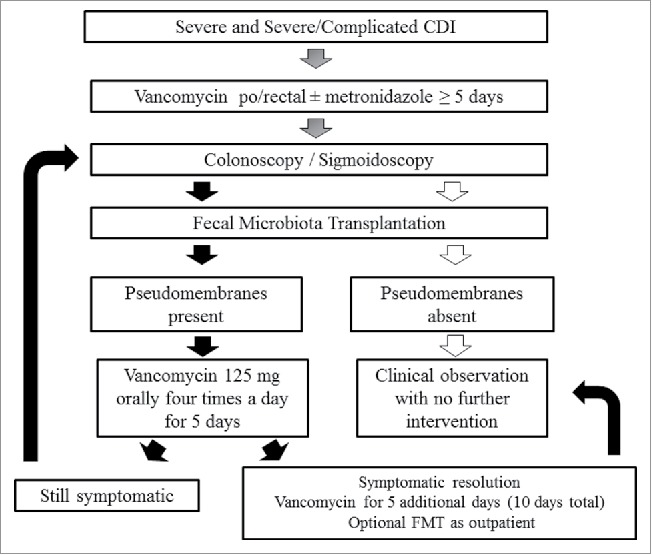
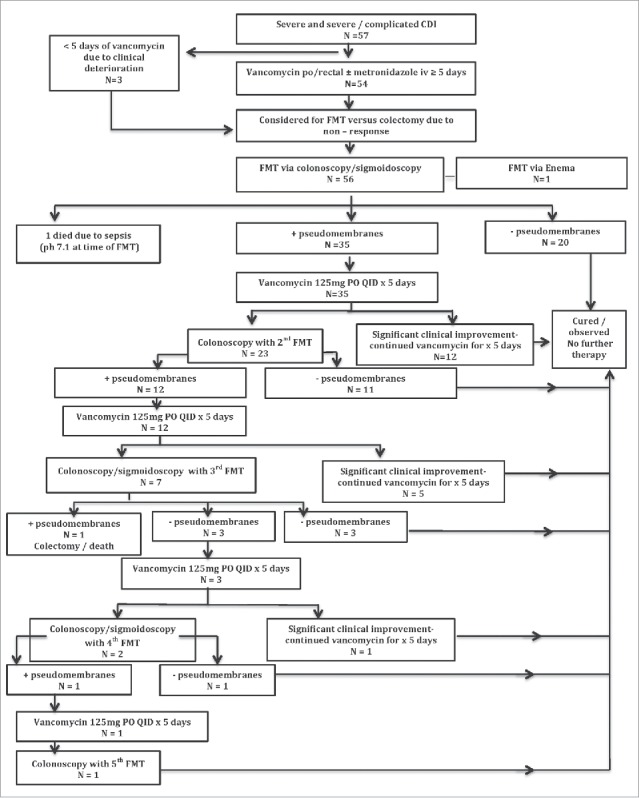
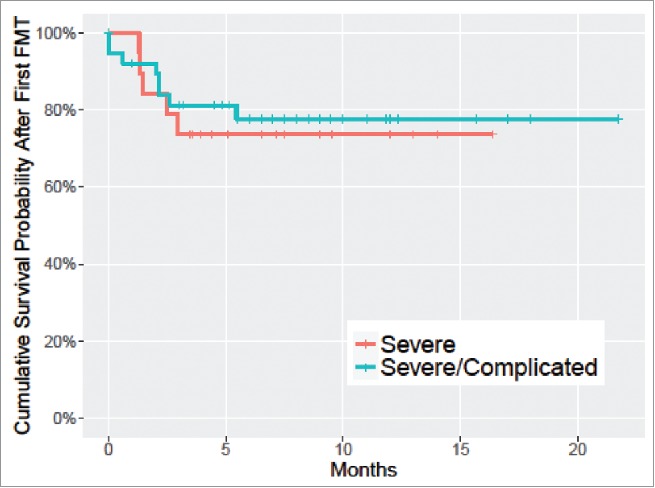
Severe and severe-complicated Clostridium difficile infection (CDI) is associated with high morbidity and mortality. Colectomy is standard of care; however, post-surgical mortality rates approach 50%. Case reports suggest fecal microbiota transplant (FMT) is a promising treatment of severe and severe-complicated disease but there is a paucity of data. Here, we present a single center experience with a novel sequential FMT protocol for patients refractory to maximal medical therapy. This approach consists of at least one FMT delivered via colonoscopy with criteria for repeat FMT and continued vancomycin therapy based on clinical response and pseudomembranes. Our cohort included 57 consecutive inpatients diagnosed with severe or severe-complicated CDI and treated with FMT. Overall, 91% (52/57) experienced clinical cure at 1 month with a 100% cure rate among severe CDI (n = 19) patients and an 87% cure rate for severe-complicated CDI (n = 33) patients. For the cohort, the survival rate was 94.7% at 1 month and 78.6% at 3 months. There were no serious adverse events related to FMT including no procedure-related complications or perforation. There was no difference in outcome between fresh or frozen fecal material. Sequential FMT for inpatients with severe or severe-complicated CDI is promising and may be preferred over colectomy in certain patients.
Keywords: FMT; Fecal microbiota transplant; fulminant C. difficile; pseudomembranes; severe C. difficile infection; severe and complicated C. difficile infection.
Figures
References
-
- Prevention CfDCa. Antibiotic Resistance Threats in the United States, 2013. Accessed at www.cdc.gov/drugresistance/threat-report-2013).
-
- Lessa FC, Winston LG, McDonald LC. Emerging Infections Program CdST. Burden of Clostridium difficile infection in the United States. N Engl J Med 2015; 372:2369-70; PMID:26061850; http://dx.doi.org/ 10.1056/NEJMoa1408913 - DOI - PMC - PubMed
-
- Adams SD, Mercer DW. Fulminant Clostridium difficile colitis. Curr Opin Crit Care 2007; 13:450-5; PMID:17599017; http://dx.doi.org/ 10.1097/MCC.0b013e3282638879 - DOI - PubMed
-
- Dallal RM, Harbrecht BG, Boujoukas AJ, Sirio CA, Farkas LM, Lee KK, Simmons RL. Fulminant Clostridium difficile: an underappreciated and increasing cause of death and complications. Ann Surg 2002; 235:363-72; PMID:11882758; http://dx.doi.org/ 10.1097/00000658-200203000-00008 - DOI - PMC - PubMed
-
- Seder CW, Villalba MR Jr., Robbins J, Ivascu FA, Carpenter CF, Dietrich M, Villalba MR Sr.. Early colectomy may be associated with improved survival in fulminant Clostridium difficile colitis: an 8-year experience. Am J Surg 2009; 197:302-7; PMID:19245905; http://dx.doi.org/ 10.1016/j.amjsurg.2008.11.001 - DOI - PubMed
Publication types
MeSH terms
Substances
Grants and funding
LinkOut - more resources
Full Text Sources
Other Literature Sources
