


Recruiting Pregnant Patients for Survey Research: A Head to Head Comparison of Social Media-Based Versus Clinic-Based Approaches
- PMID: 28003174
- PMCID: PMC5215244
- DOI: 10.2196/jmir.6593
Recruiting Pregnant Patients for Survey Research: A Head to Head Comparison of Social Media-Based Versus Clinic-Based Approaches
Abstract
Background: Recruiting a diverse sample of pregnant women for clinical research is a challenging but crucial task for improving obstetric services and maternal and child health outcomes.
Objective: To compare the feasibility and cost of recruiting pregnant women for survey research using social media-based and clinic-based approaches.
Methods: Advertisements were used to recruit pregnant women from the social media website Facebook. In-person methods were used to recruit pregnant women from the outpatient clinic of a large, tertiary care center. In both approaches, potential respondents were invited to participate in a 15-minute Web-based survey. Each recruitment method was monitored for 1 month. Using bivariate statistics, we compared the number, demographic characteristics, and health characteristics of women recruited and the cost per completed survey for each recruitment method.
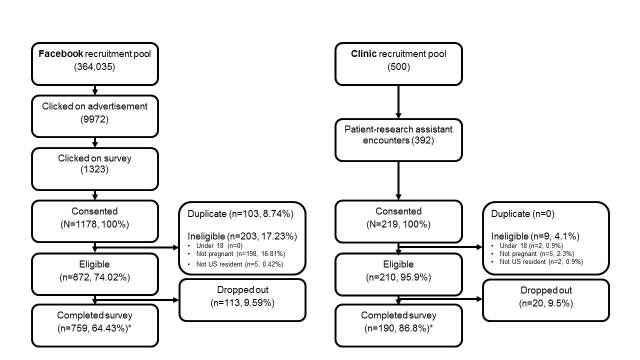
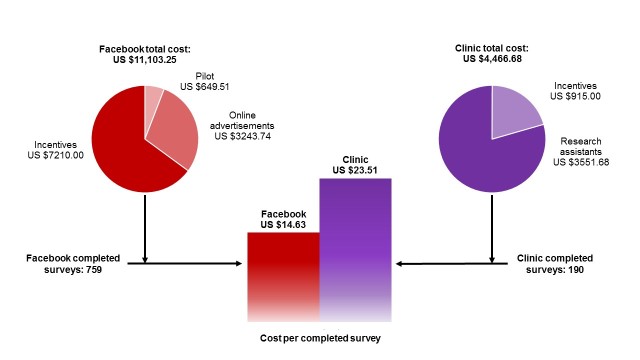
Results: The social media-based approach recruited 1178 women and the clinic-based approach recruited 219 women. A higher proportion of subjects recruited through social media identified as African American (29.4%, 207/705 vs 11.2%, 20/179), reported household incomes <US $30,000 per year (56.8%, 409/720 vs 25.8%, 47/182), reported being in early pregnancy (18.6%, 135/726 vs 10.4%, 19/183 first trimester), and rated their health as fair or poor (22.2%, 160/722 vs 8.2%, 15/183; all P<.001). A smaller proportion of subjects recruited through social media had earned a college degree (21.3%, 153/717 vs 62.3%, 114/183) and were married or in a domestic partnership (45.7%, 330/722 vs 72.1%, 132/183; all P<.001). Social media-based recruitment costs were US $14.63 per completed survey, compared with US $23.51 for clinic-based recruitment.
Conclusions: Web-based recruitment through a social networking platform is a feasible, inexpensive, and rapid means of recruiting a large, diverse sample of pregnant women for survey research.
Keywords: methods; pregnant women; social media; surveys and questionnaires.
©Lindsay Admon, Jessica K Haefner, Giselle E Kolenic, Tammy Chang, Matthew M Davis, Michelle H Moniz. Originally published in the Journal of Medical Internet Research (http://www.jmir.org), 21.12.2016.
Conflict of interest statement
Conflicts of Interest: None declared.
Figures

References
-
- Arcia A. Facebook advertisements for inexpensive participant recruitment among women in early pregnancy. Health Educ Behav. 2013 Sep 30;41(3):237–241. doi: 10.1177/1090198113504414. http://europepmc.org/abstract/MED/24082026 1090198113504414 - DOI - PMC - PubMed
-
- Gatny HH, Axinn WG. Willingness to participate in research during pregnancy: race, experience, and motivation. Field methods. 2011 Oct 9;24(2):135–154. doi: 10.1177/1525822X11419819. http://europepmc.org/abstract/MED/22798727 - DOI - PMC - PubMed
-
- Perrin A, Duggan M. [2016-12-12]. Americans' Internet Access: 2000-2015. 2015 Jun 26. Pew Research Center. http://www.pewinternet.org/2015/06/26/americans-internet-access-2000-201... .
-
- Alexa. [2016-08-31]. How popular is facebook.com? http://www.alexa.com/siteinfo/facebook.com .
MeSH terms
LinkOut - more resources
Full Text Sources
Other Literature Sources
Medical
