


Endothelial Function Assessed by Automatic Measurement of Enclosed Zone Flow-Mediated Vasodilation Using an Oscillometric Method Is an Independent Predictor of Cardiovascular Events
- PMID: 28003249
- PMCID: PMC5210444
- DOI: 10.1161/JAHA.116.004385
Endothelial Function Assessed by Automatic Measurement of Enclosed Zone Flow-Mediated Vasodilation Using an Oscillometric Method Is an Independent Predictor of Cardiovascular Events
Abstract
Background: A new device for automatic measurement of flow-mediated vasodilation (FMD) using an oscillometric method has been developed to solve technical problems of conventional FMD measurement. This device measures enclosed zone FMD (ezFMD). The purpose of this study was to evaluate the prognostic value of endothelial function assessed by ezFMD for future cardiovascular events.
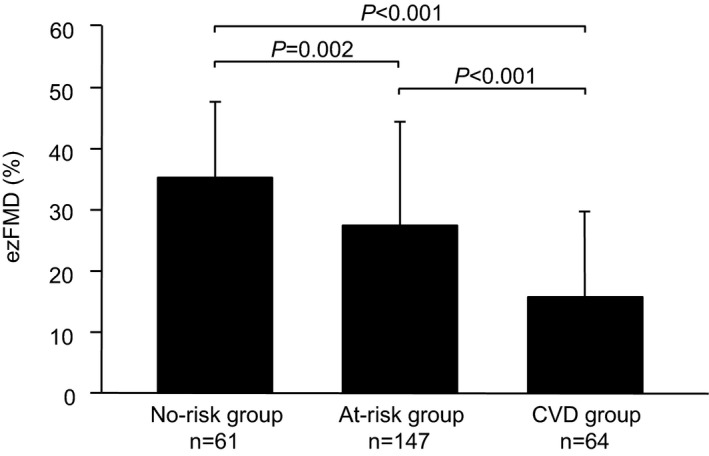
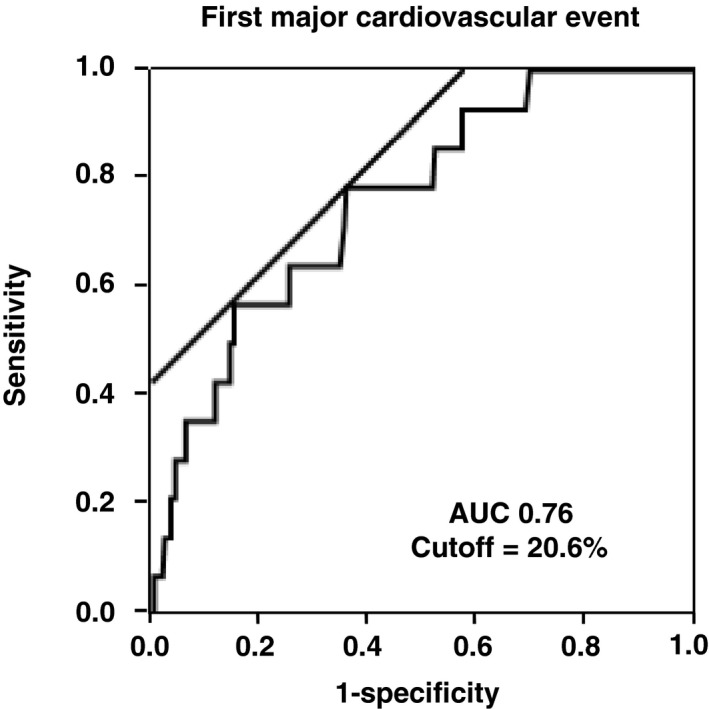
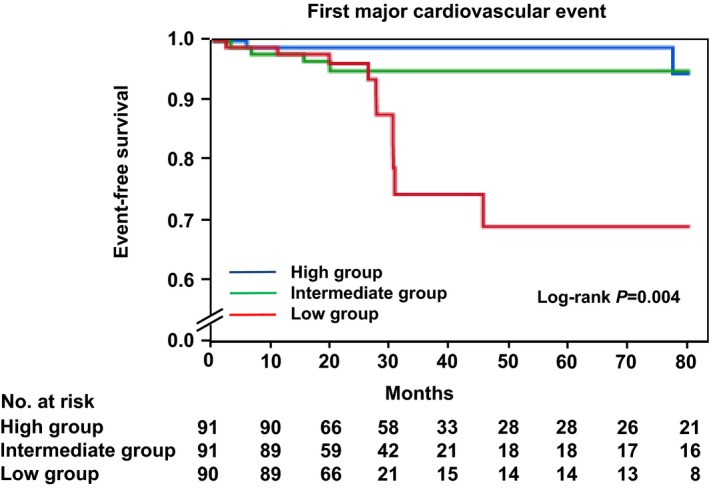
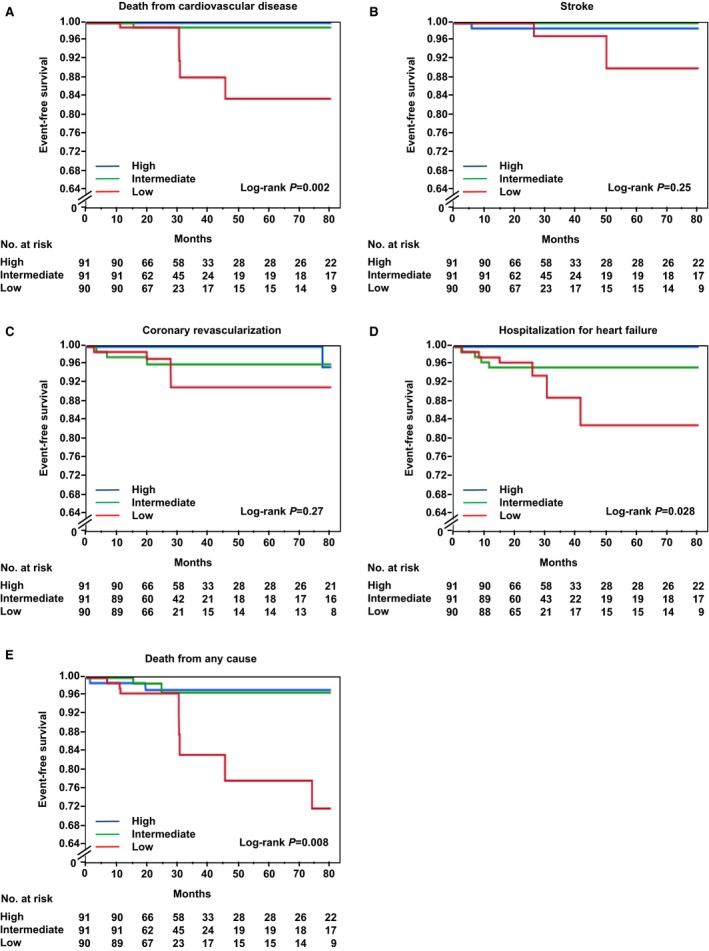
Methods and results: We measured ezFMD in 272 participants who underwent health-screening examinations. First, we investigated cross-sectional associations between ezFMD and cardiovascular risk factors, and then we assessed the associations between ezFMD and first major cardiovascular events (death from cardiovascular causes, stroke, and coronary revascularization). Univariate regression analysis revealed that ezFMD was significantly correlated with age, triglycerides, glucose, smoking pack-years, estimated glomerular filtration rate, high-sensitivity C-reactive protein, and Framingham risk score. During a median follow-up period of 36.1 months (interquartile range 18.8-40.1 months), 12 participants died (6 from cardiovascular causes), 3 had stroke, 8 had coronary revascularization, and 10 were hospitalized for heart failure. There was no episode of acute coronary syndrome during the study period. Participants were divided into tertiles (low, intermediate, and high) based on ezFMD. Kaplan-Meier curves for first major cardiovascular events among the 3 groups were significantly different (P=0.004). After adjustment for cardiovascular risk factors, the low group was significantly associated with an increased risk of first major cardiovascular events compared with the high group (hazard ratio 6.47; 95% CI 1.09-125.55; P=0.038).
Conclusions: These findings suggest that endothelial function assessed by ezFMD may be useful as a surrogate marker of future cardiovascular events.
Clinical trial registration: URL: https://upload.umin.ac.jp. Unique identifier: UMIN000004902.
Keywords: atherosclerosis; biomarker; cardiovascular events; endothelial function.
© 2016 The Authors. Published on behalf of the American Heart Association, Inc., by Wiley Blackwell.
Figures
References
-
- Ross R. Atherosclerosis‐an inflammatory disease. N Engl J Med. 1999;340:115–126. - PubMed
-
- Higashi Y, Noma K, Yoshizumi M, Kihara Y. Oxidative stress and endothelial function in cardiovascular diseases. Circ J. 2009;73:411–418. - PubMed
-
- Panza JA, Quyyumi AA, Brush JE Jr, Epstein SE. Abnormal endothelium‐dependent vascular relaxation in patients with essential hypertension. N Engl J Med. 1990;323:22–27. - PubMed
-
- Celermajer DS, Sorensen KE, Gooch VM, Spiegelhalter DJ, Miller OI, Sullivan ID, Lloyd JK, Deanfield JE. Non‐invasive detection of endothelial dysfunction in children and adults at risk of atherosclerosis. Lancet. 1992;340:1111–1115. - PubMed
-
- Corretti MC, Anderson TJ, Benjamin EJ, Celermajer D, Charbonneau F, Creager MA, Deanfield J, Drexler H, Gerhard‐Herman M, Herrington D, Vallance P, Vita J, Vogel R; International Brachial Artery Reactivity Task Force . Guidelines for the ultrasound assessment of endothelial‐dependent flow‐mediated vasodilation of the brachial artery: a report of the International Brachial Artery Reactivity Task Force. J Am Coll Cardiol. 2002;39:257–265. - PubMed
Publication types
MeSH terms
Associated data
- Actions
LinkOut - more resources
Full Text Sources
Other Literature Sources
Research Materials
