


Parallel recovery of consciousness and sleep in acute traumatic brain injury
- PMID: 28003503
- PMCID: PMC5272791
- DOI: 10.1212/WNL.0000000000003508
Parallel recovery of consciousness and sleep in acute traumatic brain injury
Abstract
Objective: To investigate whether the progressive recuperation of consciousness was associated with the reconsolidation of sleep and wake states in hospitalized patients with acute traumatic brain injury (TBI).
Methods: This study comprised 30 hospitalized patients (age 29.1 ± 13.5 years) in the acute phase of moderate or severe TBI. Testing started 21.0 ± 13.7 days postinjury. Consciousness level and cognitive functioning were assessed daily with the Rancho Los Amigos scale of cognitive functioning (RLA). Sleep and wake cycle characteristics were estimated with continuous wrist actigraphy. Mixed model analyses were performed on 233 days with the RLA (fixed effect) and sleep-wake variables (random effects). Linear contrast analyses were performed in order to verify if consolidation of the sleep and wake states improved linearly with increasing RLA score.
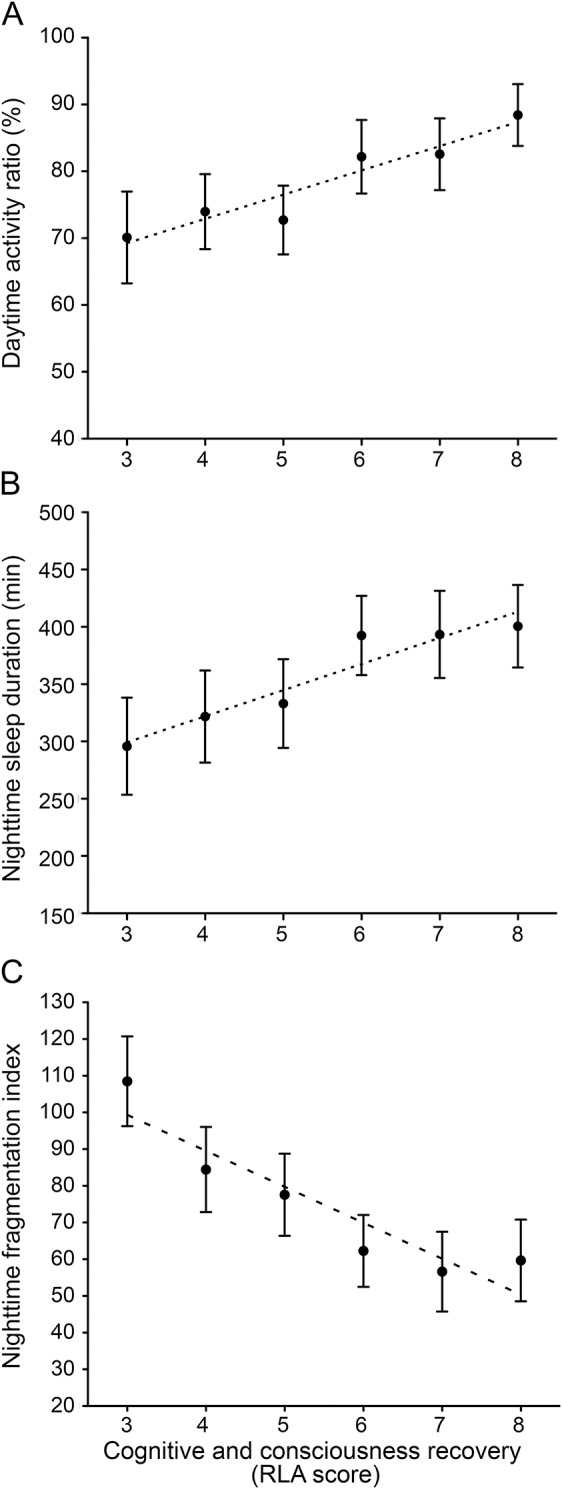
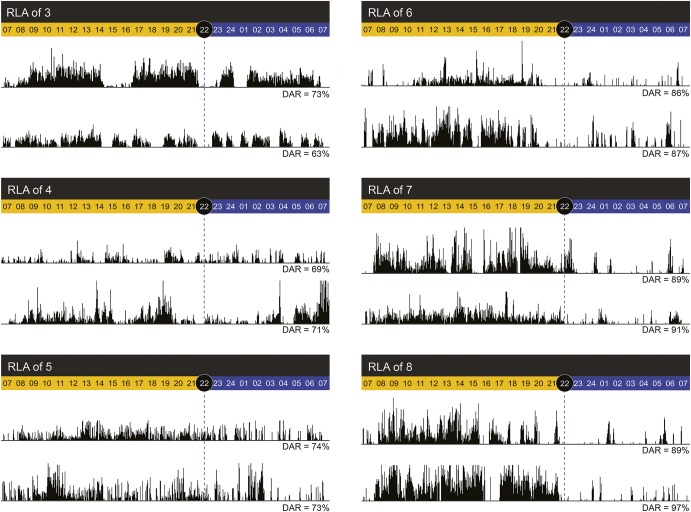
Results: Associations were found between scores on the consciousness/cognitive functioning scale and measures of sleep-wake cycle consolidation (p < 0.001), nighttime sleep duration (p = 0.018), and nighttime fragmentation index (p < 0.001). These associations showed strong linear relationships (p < 0.01 for all), revealing that consciousness and cognition improved in parallel with sleep-wake quality. Consolidated 24-hour sleep-wake cycle occurred when patients were able to give context-appropriate, goal-directed responses.
Conclusions: Our results showed that when the brain has not sufficiently recovered a certain level of consciousness, it is also unable to generate a 24-hour sleep-wake cycle and consolidated nighttime sleep. This study contributes to elucidating the pathophysiology of severe sleep-wake cycle alterations in the acute phase of moderate to severe TBI.
© 2016 American Academy of Neurology.
Figures
Comment in
-
A good sleep for a fresh mind in patients with acute traumatic brain injury.Neurology. 2017 Jan 17;88(3):226-227. doi: 10.1212/WNL.0000000000003529. Epub 2016 Dec 21. Neurology. 2017. PMID: 28003498 No abstract available.
References
-
- Duclos C, Dumont M, Blais H, et al. Rest-activity cycle disturbances in the acute phase of moderate to severe traumatic brain injury. Neurorehabil Neural Repair 2013;28:472–482. - PubMed
-
- Chiu HY, Chen PY, Chen NH, Chuang LP, Tsai PS. Trajectories of sleep changes during the acute phase of traumatic brain injury: a 7-day actigraphy study. J Formos Med Assoc 2013;112:545–553. - PubMed
-
- Gabor JY, Cooper AB, Crombach SA, et al. Contribution of the intensive care unit environment to sleep disruption in mechanically ventilated patients and healthy subjects. Am J Respir Crit Care Med 2003;167:708–715. - PubMed
-
- Sabir M, Gaudreault PO, Freyburger M, et al. Impact of traumatic brain injury on sleep structure, electrocorticographic activity and transcriptome in mice. Brain Behav Immun 2015;47:118–130. - PubMed
MeSH terms
LinkOut - more resources
Full Text Sources
Other Literature Sources
Medical
