. 2016 Dec 22:7:13971.
doi: 10.1038/ncomms13971.

Environmental variation and the evolution of large brains in birds

Affiliations

Environmental variation and the evolution of large brains in birds

Ferran Sayol et al. Nat Commun. .

Abstract

Environmental variability has long been postulated as a major selective force in the evolution of large brains. However, assembling evidence for this hypothesis has proved difficult. Here, by combining brain size information for over 1,200 bird species with remote-sensing analyses to estimate temporal variation in ecosystem productivity, we show that larger brains (relative to body size) are more likely to occur in species exposed to larger environmental variation throughout their geographic range. Our reconstructions of evolutionary trajectories are consistent with the hypothesis that larger brains (relative to body size) evolved when the species invaded more seasonal regions. However, the alternative-that the species already possessed larger brains when they invaded more seasonal regions-cannot be completely ruled out. Regardless of the exact mechanism, our findings provide strong empirical support for the association between large brains and environmental variability.


Figures
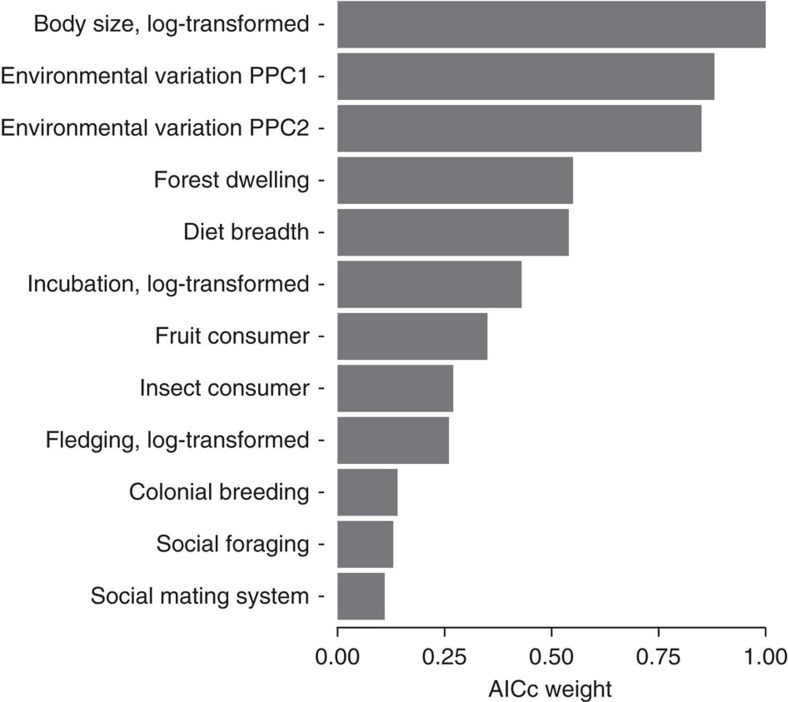
Figure 1
Figure 1. Importance of each factor in a model selection approach based on AICc.
A model selection process using PGLS models with Log(Brain size) as a response variable and environmental variation axes (PPC1 and PPC2) and all factors included in the full model (See Supplementary Table 7) as explanatory variables in resident species (N=242). Here we show the importance of each factor in terms of AICc weights integrated over all possible combinations of models (see Supplementary Table 8 for the best models).
Figure 2
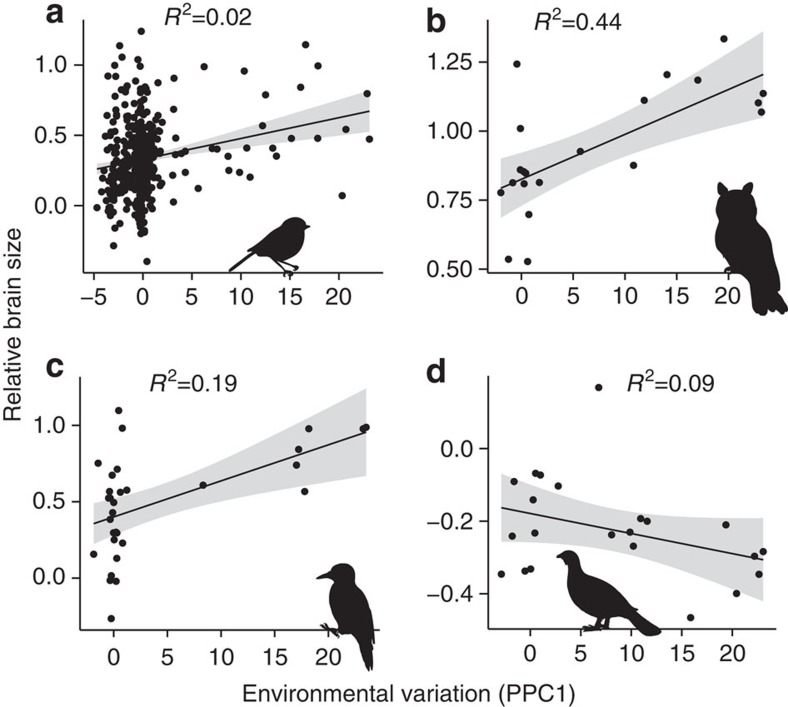
Figure 2. Relative brain size and environmental variation (PPC1) within four avian orders.
We tested the effect of environmental variation in four avian orders with representatives in all the latitudinal gradients using PGLS: relative brain size (Mean±s.e.m.) increase with environmental variation in (a) Passeriformes (0.04±0.01, N=417, P value=0.01), (b) Strigiformes (0.07±0.02, N=21, P value=0.001) and (c) Piciformes (0.06±0.02. N=31, P value=0.008) but not in (d) Galliformes (−0.02±0.01, N=22, P value=0.097). The fitted line and the standard error in the figure are derived from the raw data. Silhouette illustrations came from PhyloPic (http://phylopic.org), contributed by various authors under Public domain license.
Figure 3
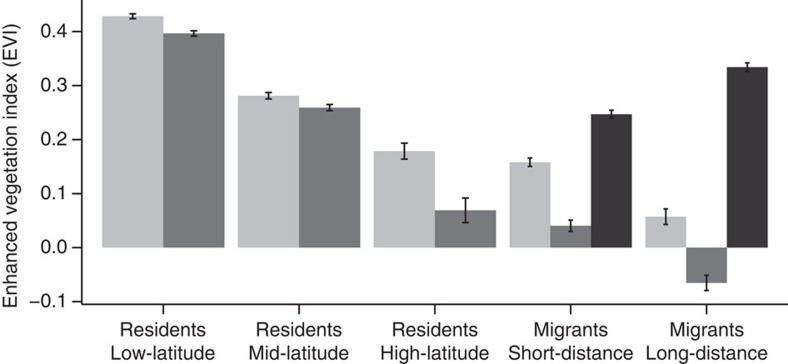
Figure 3. Changes in resource availability during the breeding and non-breeding season.
We measured resource availability (mean±s.e.m.) using the enhanced vegetation index (EVI) in the breeding areas during summer (light grey bars) and winter (dark grey bars). In the breeding areas of residents from higher latitudes (N=50), short-distance (N=230) and long-distance migrants (N=87), there is a larger decrease in EVI during winter (PGLS, P value<0.001, Supplementary Table 10) compared with residents from mid (N=326) and low (N=459) latitudes. Migratory birds skip this decrease in resource availability by moving to wintering areas in lower latitudes (black bars).
Figure 4
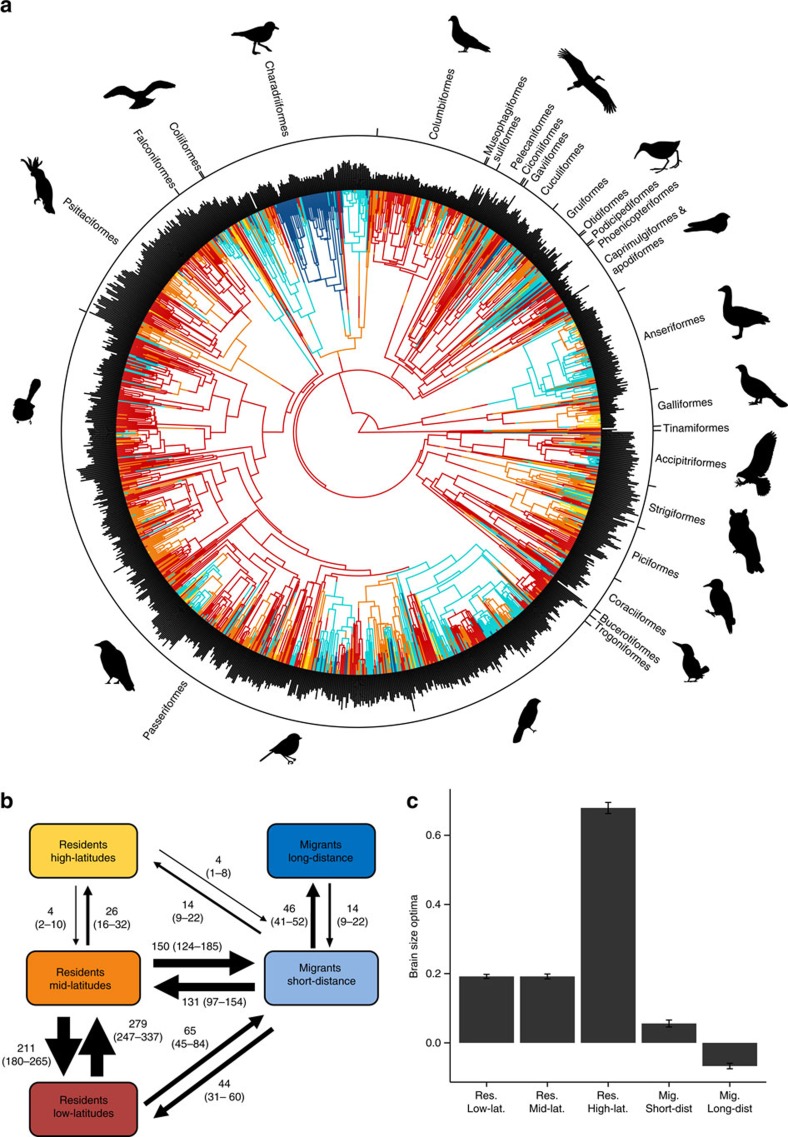
Figure 4. Ancestral reconstruction and the evolution of relative brain size.
We reconstructed different character states representing different exposures to environmental variation. An example of a single reconstruction of shifts between migratory behaviours and breeding regions is shown in a, where each character state is given a distinct colour (see b for colour assignations); outside bars represent the relative brain size of each species, with representative species from the main orders shown. The median number of transitions between different character states and the 97.5 and 2.5% confidence intervals are based on 1,000 reconstructions (b). The mean and s.e. of the estimated brain optima under an OUMV model for 100 phylogenies is shown for each category (c). Silhouette illustrations came from PhyloPic (http://phylopic.org), contributed by various authors under Public domain license.

References

    1. Dunbar R. I. M. & Shultz S. Evolution in the social brain. Science 317, 1344–1347 (2007). - PubMed
    1. Barton R. A. & Capellini I. Maternal investment, life histories, and the costs of brain growth in mammals. Proc. Natl Acad. Sci. USA 108, 6169–6174 (2011). - PMC - PubMed
    1. Isler K. & van Schaik C. P. The Expensive Brain: a framework for explaining evolutionary changes in brain size. J. Hum. Evol. 57, 392–400 (2009). - PubMed
    1. Allman J., McLaughlin T. & Hakeem A. Brain weight and life-span in primate species. Proc. Natl Acad. Sci. USA 90, 118–122 (1993). - PMC - PubMed
    1. Sol D. Revisiting the cognitive buffer hypothesis for the evolution of large brains. Biol. Lett 5, 130–133 (2009). - PMC - PubMed

Publication types

LinkOut - more resources