


An Antiestrogenic Activity Score for tamoxifen and its metabolites is associated with breast cancer outcome
- PMID: 28005246
- PMCID: PMC5812686
- DOI: 10.1007/s10549-016-4083-6
An Antiestrogenic Activity Score for tamoxifen and its metabolites is associated with breast cancer outcome
Abstract
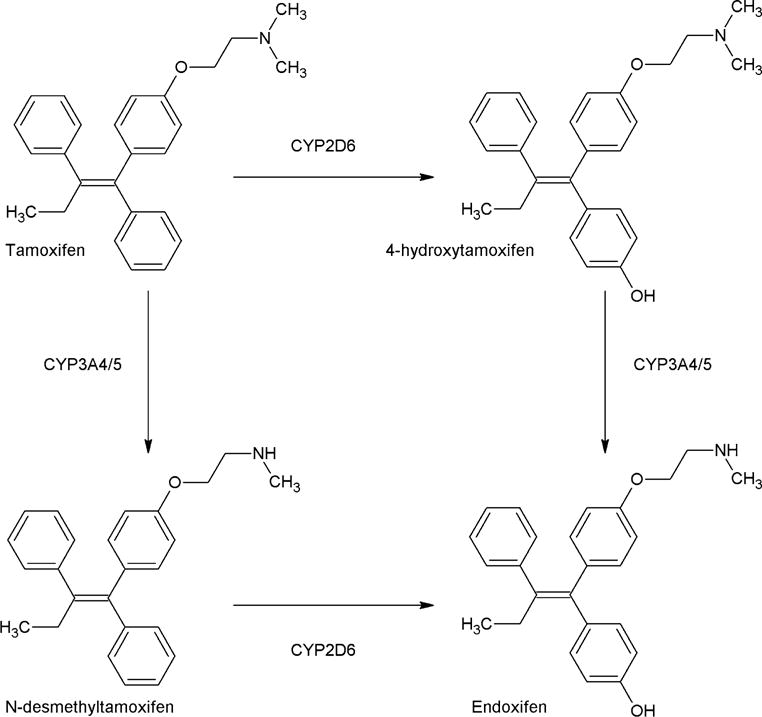
Purpose: Endoxifen concentrations have been associated with breast cancer recurrence in tamoxifen-treated patients. However, tamoxifen itself and other metabolites also show antiestrogenic anti-tumor activity. Therefore, the aim of this study was to develop a comprehensive Antiestrogenic Activity Score (AAS), which accounts for concentration and antiestrogenic activity of tamoxifen and three metabolites. An association between the AAS and recurrence-free survival was investigated and compared to a previously published threshold for endoxifen concentrations of 5.97 ng/mL.
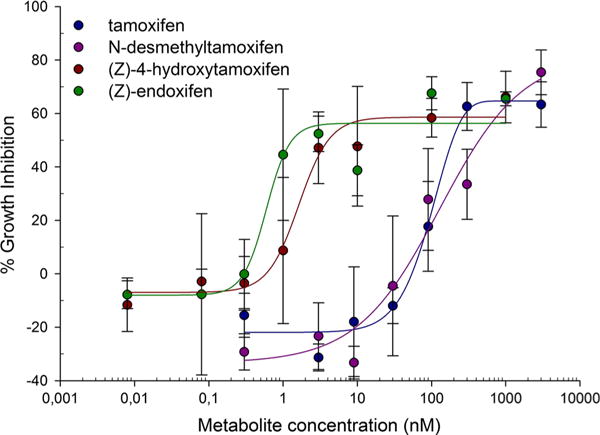
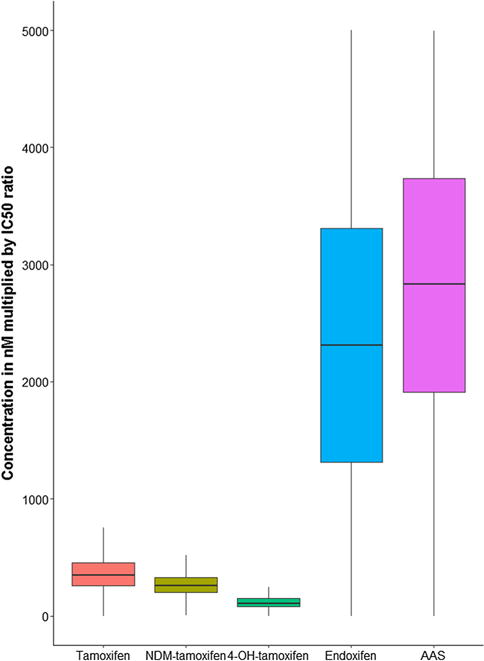
Patients and methods: The antiestrogenic activities of tamoxifen, (Z)-endoxifen, (Z)-4-hydroxytamoxifen, and N-desmethyltamoxifen were determined in a cell proliferation assay. The AAS was determined by calculating the sum of each metabolite concentration multiplied by an IC50 ratio, relative to tamoxifen. The AAS was calculated for 1370 patients with estrogen receptor alpha (ERα)-positive breast cancer. An association between AAS and recurrence was investigated using Cox regression and compared with the 5.97 ng/mL endoxifen threshold using concordance indices.
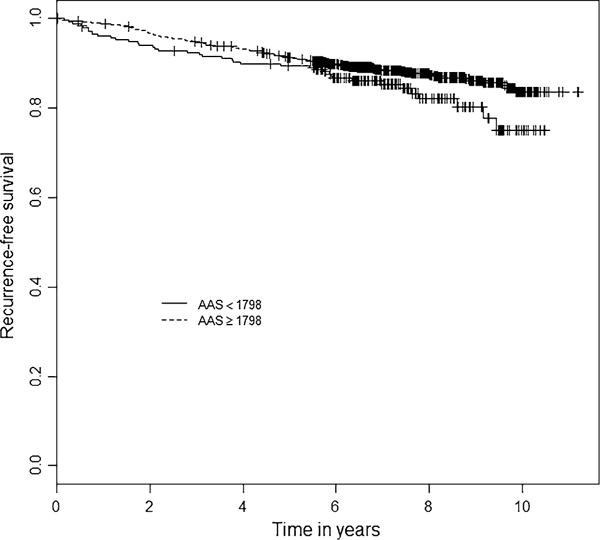
Results: An AAS threshold of 1798 was associated with recurrence-free survival, hazard ratio (HR) 0.67 (95% confidence interval (CI) 0.47-0.96), bias corrected after bootstrap HR 0.69 (95% CI 0.48-0.99). The concordance indices for AAS and endoxifen did not significantly differ; however, using the AAS threshold instead of endoxifen led to different dose recommendations for 5.2% of the patients.
Conclusions: Endoxifen concentrations can serve as a proxy for the antiestrogenic effect of tamoxifen and metabolites. However, for the aggregate effect of tamoxifen and three metabolites, defined by an integrative algorithm, a trend towards improving treatment is seen and moreover, is significantly associated with breast cancer recurrence.
Keywords: Algorithm; Metabolites; Recurrence-free survival; Tamoxifen.
Conflict of interest statement
The authors declare that they have no conflict of interest.
Figures
References
-
- Early Breast Cancer Trialists’ Collaborative Group. Effects of chemotherapy and hormonal therapy for early breast cancer on recurrence and 15-year survival : an overview of the randomised trials. Lancet. 2005;365:1687–1717. - PubMed
-
- Gray R, Rea D, Handley K. ATTom: Long-term effects of continuing adjuvant tamoxifen to 10 years versus stopping at 5 years in 6,953 women with early breast cancer. J Clin Oncol. 2013;31(suppl) abstr 5.
-
- Regan MM, Neven P, Giobbie-Hurder A, et al. Assessment of letrozole and tamoxifen alone and in sequence for post-menopausal women with steroid hormone receptor-positive breast cancer: the BIG 1-98 randomised clinical trial at 8.1 years median follow-up. Lancet Oncol. 2011;12:1101–1108. - PMC - PubMed
-
- Winer EP, Hudis C, Burstein HJ, et al. American Society of Clinical Oncology technology assessment on the use of aromatase inhibitors as adjuvant therapy for postmenopausal women with hormone receptor-positive breast cancer: status report 2004. J Clin Oncol. 2005;23:619–629. - PubMed
Publication types
MeSH terms
Substances
Grants and funding
LinkOut - more resources
Full Text Sources
Other Literature Sources
Medical
