Animals in the Zika Virus Life Cycle: What to Expect from Megadiverse Latin American Countries
- PMID: 28005902
- PMCID: PMC5179043
- DOI: 10.1371/journal.pntd.0005073
Animals in the Zika Virus Life Cycle: What to Expect from Megadiverse Latin American Countries
Abstract
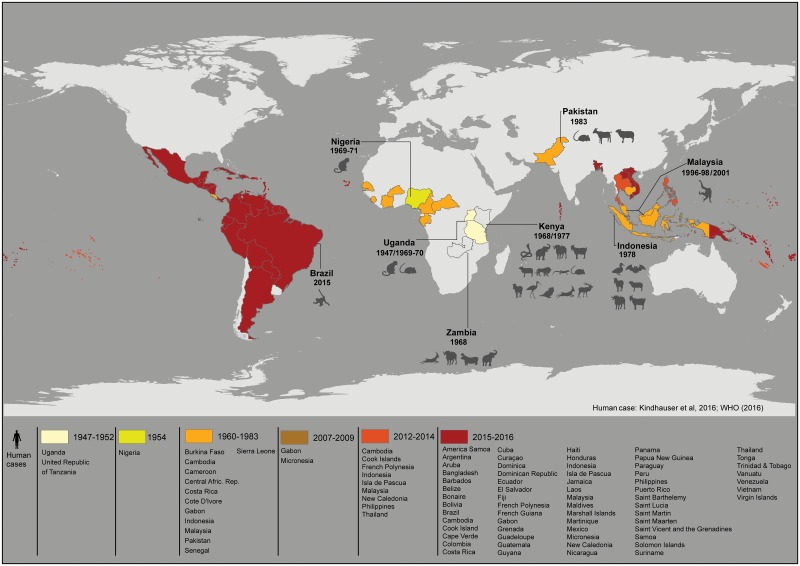
Zika virus (ZIKV) was first isolated in 1947 in primates in Uganda, West Africa. The virus remained confined to the equatorial regions of Africa and Asia, cycling between infecting monkeys, arboreal mosquitoes, and occasionally humans. The ZIKV Asiatic strain was probably introduced into Brazil in or around late 2013. Presently, ZIKV is in contact with the rich biodiversity in all Brazilian biomes, bordering on other Latin American countries. Infections in Brazilian primates have been reported recently, but the overall impact of this virus on wildlife in the Americas is still unknown. The current epidemic in the Americas requires knowledge on the role of mammals, especially nonhuman primates (NHPs), in ZIKV transmission to humans. The article discusses the available data on ZIKV in host animals and issues of biodiversity, rapid environmental change, and impact on human health in megadiverse Latin American countries. The authors reviewed scientific articles and recent news stories on ZIKV in animals, showing that 47 animal species from three orders (mammals, reptiles, and birds) have been investigated for the potential to establish a sylvatic cycle. The review aims to contribute to epidemiological studies and the knowledge on the natural history of ZIKV. The article concludes with questions that require urgent attention in epidemiological studies involving wildlife in order to understand their role as ZIKV hosts and to effectively control the epidemic.
Conflict of interest statement
The authors have declared that no competing interests exist.
Figures
References
-
- International comittee on taxonomy of viruses. Virus taxonomy. 2014. Release 2015. http://www.ictvonline.org/virustaxonomy.asp.
-
- Pierson TC, Diamond MS. Flaviviruses In: Knipe DM, Howley PM, editors, Fields Virol, Lippincott Williams & Wilkins, Philadelphia; 2013. pp. 747–794.
-
- Albuquerque, C. Fiocruz identifica mosquitos Aedes aegypti naturalmente infectados pelo vírus Zika. Portal Fiocruz. 25 May 2016. http://portal.fiocruz.br/pt-br/content/fiocruz-identifica-mosquitos-aede.... Accessed 27 May 2016.
-
- Dick GW, Kitchen SF, Haddow AJ. Zika virus. I. Isolations and serological specificity. Trans R Soc Trop Med Hyg. 1952; 46: 509–520. - PubMed
Publication types
MeSH terms
LinkOut - more resources
Full Text Sources
Other Literature Sources
Medical