Serial dependence promotes object stability during occlusion
- PMID: 28006066
- PMCID: PMC5214222
- DOI: 10.1167/16.15.16
Serial dependence promotes object stability during occlusion
Abstract
Object identities somehow appear stable and continuous over time despite eye movements, disruptions in visibility, and constantly changing visual input. Recent results have demonstrated that the perception of orientation, numerosity, and facial identity is systematically biased (i.e., pulled) toward visual input from the recent past. The spatial region over which current orientations or face identities are pulled by previous orientations or identities, respectively, is known as the continuity field, which is temporally tuned over the past several seconds (Fischer & Whitney, 2014). This perceptual pull could contribute to the visual stability of objects over short time periods, but does it also address how perceptual stability occurs during visual discontinuities? Here, we tested whether the continuity field helps maintain perceived object identity during occlusion. Specifically, we found that the perception of an oriented Gabor that emerged from behind an occluder was significantly pulled toward the random (and unrelated) orientation of the Gabor that was seen entering the occluder. Importantly, this serial dependence was stronger for predictable, continuously moving trajectories, compared to unpredictable ones or static displacements. This result suggests that our visual system takes advantage of expectations about a stable world, helping to maintain perceived object continuity despite interrupted visibility.
Figures
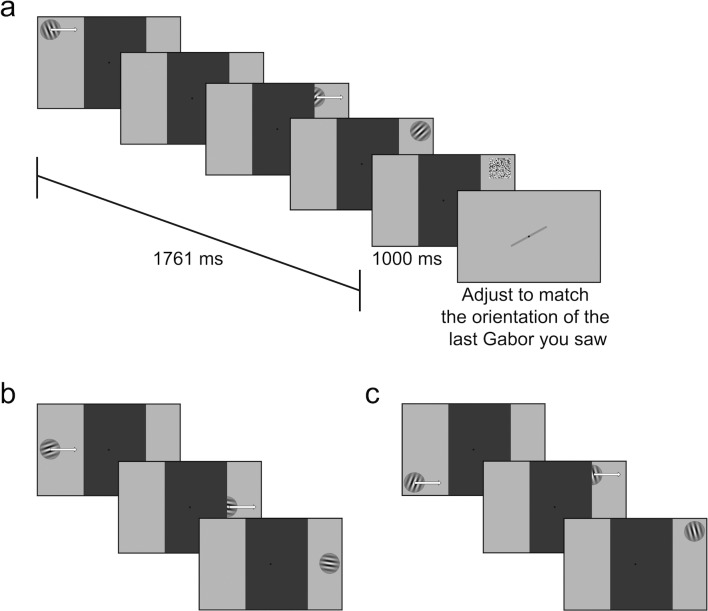
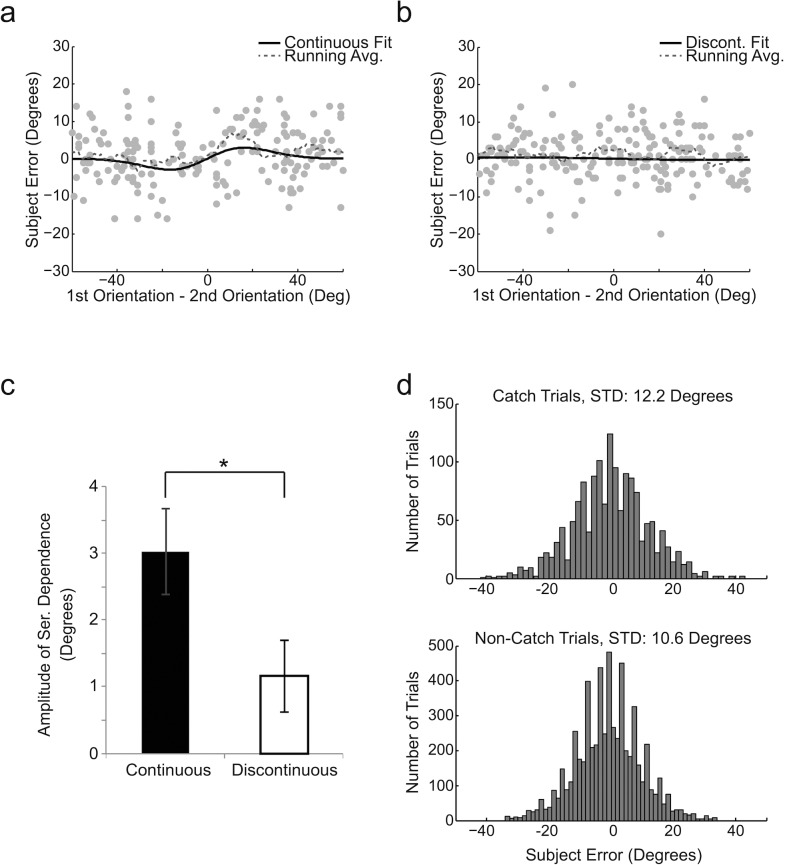
 ) was fit to the entire range of the data. For this DoG function, a = 2.93 (half the peak-to-trough amplitude) and b = 0.043, which scales the width of the Gaussian derivative. Smaller values of b result in a wider Gaussian derivative. (b) Example data from the same representative subject for all discontinuous moving trajectory trials. For this DoG function, a = −0.37 and b = 0.015. (c) Average amplitude of serial dependence across 11 subjects for continuous and discontinuous trials. Error bars are SEM. Serial dependence was significantly stronger when the object moved along a continuous versus discontinuous trajectory behind the occluder, t(10) = 4.69, p = 0.003, dav = 0.92 (FDR-corrected, two-tailed, paired t test). (d) Subject performance (response error in degrees) in catch trials and noncatch trials. Subjects were more accurate in responding to the orientation of the noncatch trial Gabors yet still showed a high level of accuracy in catch trials even though these trials accounted for a random and surprise 20% of responses.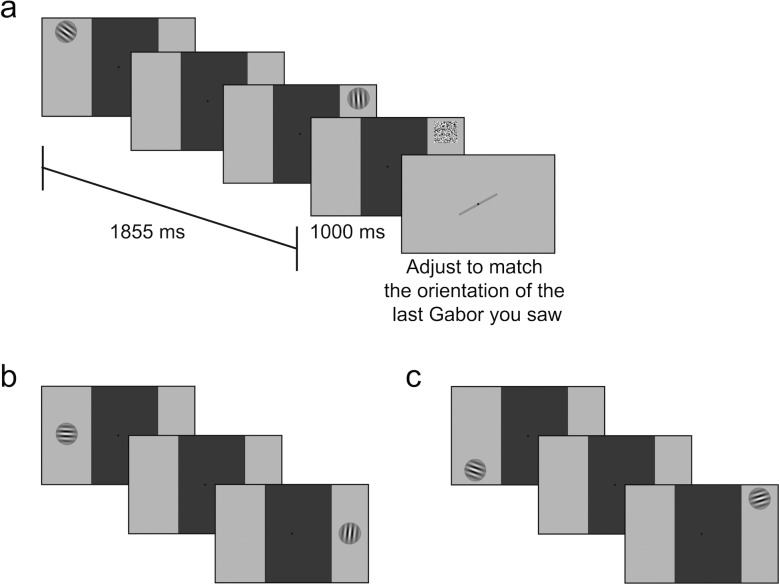
References
-
- Akaike, H. (1974). A new look at the statistical identification model. IEEE Transactions on Automatic Control, 19, 716–723.
-
- Anstis, S, Verstraten, F. A. J, & Mather, G.. (1998). The motion aftereffect. Trends in Cognitive Sciences, 2 (3), 111–117. - PubMed
-
- Baillargeon, R, Spelke, E. S, & Wasserman, S.. (1985). Object permanence in five-month-old infants. Cognition, 20 (3), 191–208. - PubMed
-
- Benjamini, Y, & Hochberg, Y.. (1995). Controlling the false discovery rate: A practical and powerful approach to multiple testing. Journal of the Royal Statistical Society Series B (Methodological), 57 (1), 289–300.
-
- Brainard, D. H. (1997). The psychophysics toolbox. Spatial Vision, 10, 433–436. - PubMed
MeSH terms
Grants and funding
LinkOut - more resources
Full Text Sources
Other Literature Sources
Miscellaneous