Review
. 2017 Jun 23:652:25-34.
doi: 10.1016/j.neulet.2016.12.002. Epub 2016 Dec 19.

Rewiring the spinal cord: Direct and indirect strategies

Affiliations
Review

Rewiring the spinal cord: Direct and indirect strategies

Maria Teresa Dell'Anno et al. Neurosci Lett. .

Abstract

Spinal cord injury is currently incurable. Treatment is limited to minimizing secondary complications and maximizing residual function by rehabilitation. Neurologic recovery is prevented by the poor intrinsic regenerative capacity of neurons in the adult central nervous system and by the presence of growth inhibitors in the adult brain and spinal cord. Here we identify three approaches to rewire the spinal cord after injury: axonal regeneration (direct endogenous reconnection), axonal sprouting (indirect endogenous reconnection) and neural stem cell transplantation (indirect exogenous reconnection). Regeneration and sprouting of axonal fibers can be both enhanced through the neutralization of myelin- and extracellular matrix-associated inhibitors described in the first part of this review. Alternatively, in the second part we focus on the formation of a novel circuit through the grafting of neural stem cells in the lesion site. Transplanted neural stem cells differentiate in vivo into neurons and glial cells which form an intermediate station between the rostral and caudal segment of the recipient spinal cord. In particular, here we describe how neural stem cells-derived neurons are endowed with the ability to extend long-distance axons to regain the transmission of motor and sensory information.


Conflict of interest statement

Conflicts Of Interest

S.M.S. is a co-founder of Axerion Therapeutics seeking to develop NgR1-based treatments.

Figures
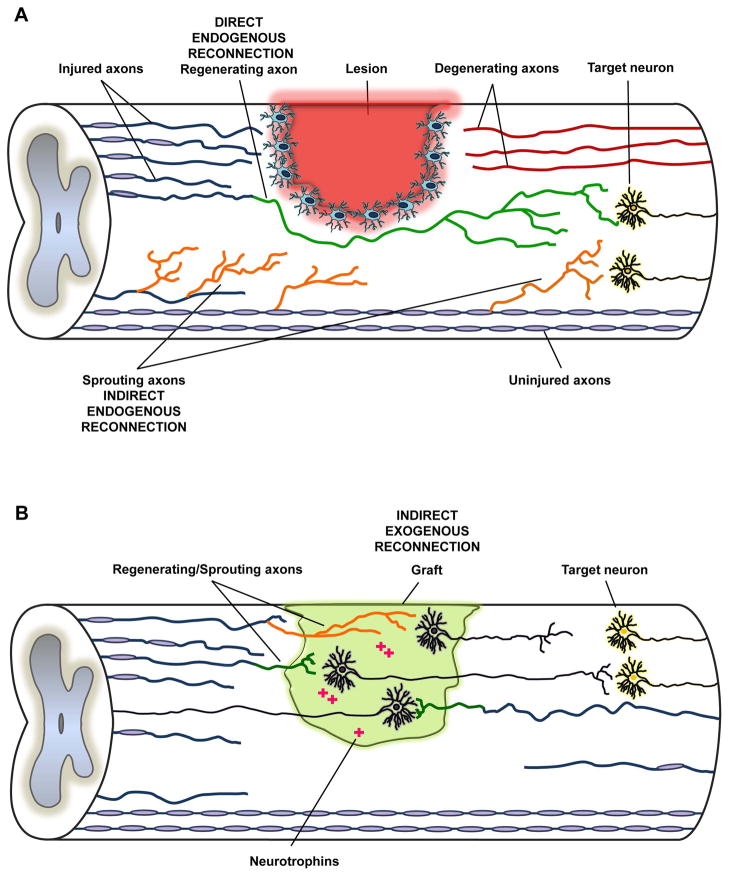
Figure 1
Figure 1. Schematic representation of direct and indirect interventions on the injured spinal cord
(A) The neutralization of myelin and matrix associated inhibitors supports both regeneration (in green) and sprouting (in orange) of axonal fibers. Regenerating fibers make connections with the original target neurons (direct endogenous reconnection), whereas sprouting collaterals form new synaptic contacts (indirect endogenous reconnection). (B) Grafted neural stem cells, on the other hand, offer an alternative strategy (indirect exogenous reconnection) through cellualr differentiation at the injury site into neurons, astrocytes and oligodendrocytes. In particular, newly differentiated neurons are intrinsically primed for long-distance axonal growth which helps the indirect transmission of motor and sensory information. Descending supraspinal axons regenerate into and make synaptic connections with grafted neurons in the lesion site. Grafted neurons extend their axons into the caudal spinal cord and form new synaptic connections with host neurons. Similarly, grafted neurons can make a functional circuit for the ascending sensory system. Transplanted neural stem cells also help regeneration of severed axonal fibers by releasing neurotrophins in the damaged area.

References

    1. Mothe AJ, Tator CH. Advances in stem cell therapy for spinal cord injury. J Clin Invest. 2012;122:3824–3834. - PMC - PubMed
    1. Moore DL, Blackmore MG, Hu Y, Kaestner KH, Bixby JL, Lemmon VP, Goldberg JL. KLF family members regulate intrinsic axon regeneration ability. Science. 2009;326:298–301. - PMC - PubMed
    1. Liu K, Lu Y, Lee JK, Samara R, Willenberg R, Sears-Kraxberger I, Tedeschi A, Park KK, Jin D, Cai B, Xu B, Connolly L, Steward O, Zheng B, He Z. PTEN deletion enhances the regenerative ability of adult corticospinal neurons. Nat Neurosci. 2010;13:1075–1081. - PMC - PubMed
    1. Pun RY, Rolle IJ, Lasarge CL, Hosford BE, Rosen JM, Uhl JD, Schmeltzer SN, Faulkner C, Bronson SL, Murphy BL, Richards DA, Holland KD, Danzer SC. Excessive activation of mTOR in postnatally generated granule cells is sufficient to cause epilepsy. Neuron. 2012;75:1022–1034. - PMC - PubMed
    1. Akhavan D, Cloughesy TF, Mischel PS. mTOR signaling in glioblastoma: lessons learned from bench to bedside. Neuro Oncol. 2010;12:882–889. - PMC - PubMed
