


Urinary Phthalate Metabolites and Biomarkers of Oxidative Stress in a Mexican-American Cohort: Variability in Early and Late Pregnancy
- PMID: 28008399
- PMCID: PMC5171220
- DOI: 10.3390/toxics4010007
Urinary Phthalate Metabolites and Biomarkers of Oxidative Stress in a Mexican-American Cohort: Variability in Early and Late Pregnancy
Abstract
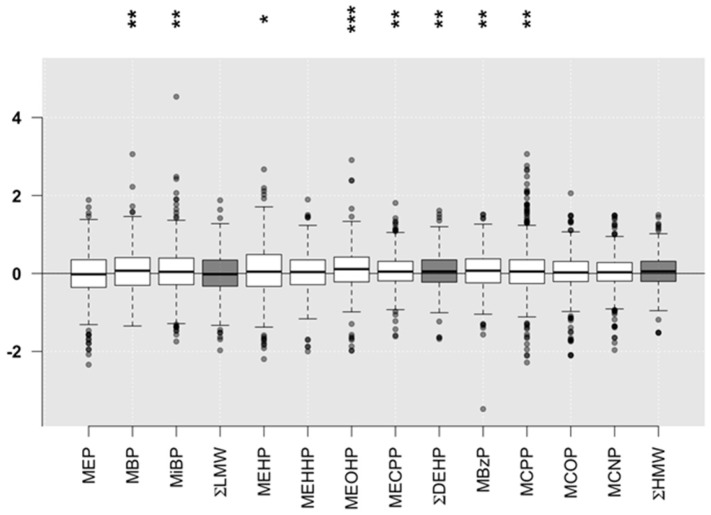
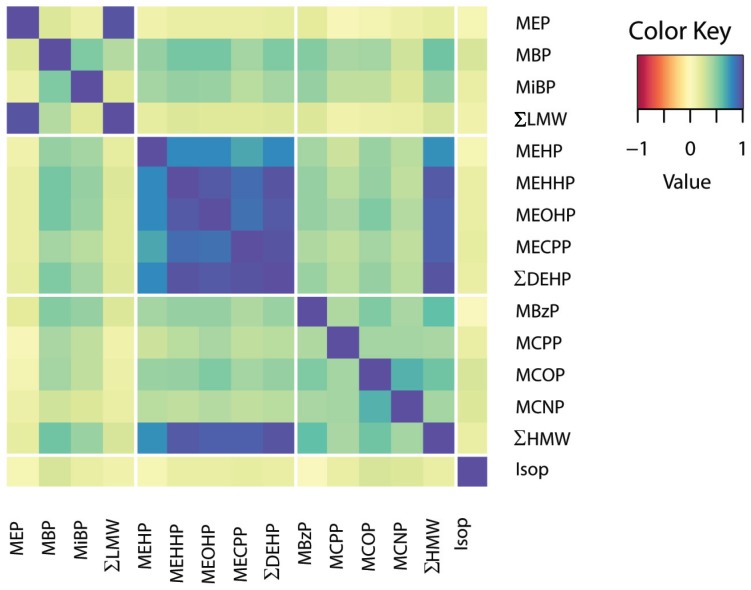
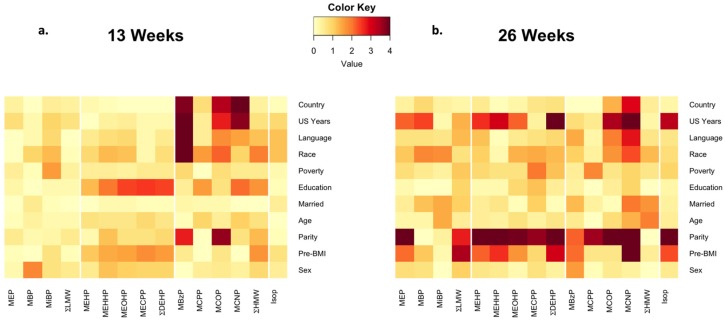
People are exposed to phthalates through their wide use as plasticizers and in personal care products. Many phthalates are endocrine disruptors and have been associated with adverse health outcomes. However, knowledge gaps exist in understanding the molecular mechanisms associated with the effects of exposure in early and late pregnancy. In this study, we examined the relationship of eleven urinary phthalate metabolites with isoprostane, an established marker of oxidative stress, among pregnant Mexican-American women from an agricultural cohort. Isoprostane levels were on average 20% higher at 26 weeks than at 13 weeks of pregnancy. Urinary phthalate metabolite concentrations suggested relatively consistent phthalate exposures over pregnancy. The relationship between phthalate metabolite concentrations and isoprostane levels was significant for the sum of di-2-ethylhexyl phthalate and the sum of high molecular weight metabolites with the exception of monobenzyl phthalate, which was not associated with oxidative stress at either time point. In contrast, low molecular weight metabolite concentrations were not associated with isoprostane at 13 weeks, but this relationship became stronger later in pregnancy (p-value = 0.009 for the sum of low molecular weight metabolites). Our findings suggest that prenatal exposure to phthalates may influence oxidative stress, which is consistent with their relationship with obesity and other adverse health outcomes.
Keywords: birth cohort; endocrine disruptors; in utero exposure; isoprostane; oxidative stress; phthalates; pregnancy.
Conflict of interest statement
Asa Bradman has served as a volunteer member of the Board for The Organic Center, a non-profit organization that provides information for scientific research about organic food and farming. The funding sponsors had no role in the design of the study; in the collection, analyses or interpretation of data; in the writing of the manuscript; nor in the decision to publish the results.
Figures
References
-
- Centers for Disease Control and Prevention . Fourth National Report on Human Exposure to Environmental Chemicals. U.S. Department of Health and Human Services, Centers for Disease Control and Prevention; Atlanta, GA, USA: 2009. [(accessed on 9 March 2016)]. Available online: http://www.cdc.gov/exposurereport/
-
- Silva M.J., Barr D.B., Reidy J.A., Malek N.A., Hodge C.C., Caudill S.P., Brock J.W., Needham L.L., Calafat A.M. Urinary levels of seven phthalate metabolites in the U.S. Population from the national health and nutrition examination survey (NHANES) 1999–2000. Environ. Health Perspect. 2004;112:331–338. doi: 10.1289/ehp.6723. - DOI - PMC - PubMed
Grants and funding
LinkOut - more resources
Full Text Sources
Other Literature Sources
