


The Association of Vitamin D Deficiency and Incident Frailty in Older Women: The Role of Cardiometabolic Diseases
- PMID: 28008596
- PMCID: PMC5357177
- DOI: 10.1111/jgs.14677
The Association of Vitamin D Deficiency and Incident Frailty in Older Women: The Role of Cardiometabolic Diseases
Abstract
Objectives: Evidence suggests vitamin D deficiency is associated with developing frailty. However, cardiometabolic factors are related to both conditions and may confound and/or mediate the vitamin D-frailty association. We aimed to determine the association of vitamin D concentration with incidence of frailty, and the role of cardiometabolic diseases (cardiovascular disease, diabetes, hyperlipidemia, hypertension) in this relationship.
Design: Prospective longitudinal cohort study (7 visits from 1994-2008).
Setting: Baltimore, Maryland.
Participants: Three hundred sixty-nine women from the Women's Health and Aging Study II aged 70-79 years, free of frailty at baseline.
Measurements: Serum circulating 25-hydroxyvitamin D (25[OH]D) concentration was assessed at baseline and categorized as: <10; 10-19.9; 20-29.9; and ≥30 ng/mL. Frailty incidence was determined based on presence of three or more criteria: weight loss, low physical activity, exhaustion, weakness, and slowness. Cardiometabolic diseases were ascertained at baseline. Analyses included Cox regression models adjusted for key covariates.
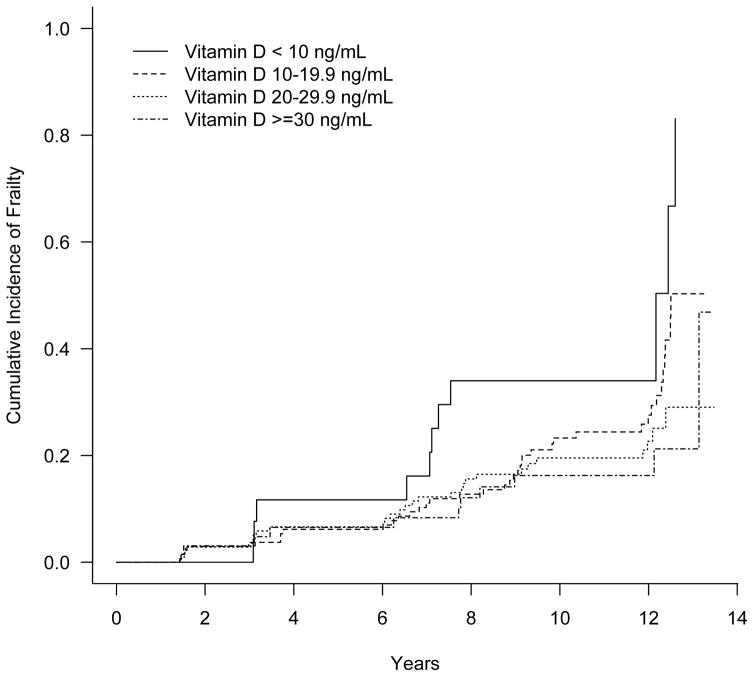
Results: Incidence rate of frailty was 32.2 per 1,000 person-years in participants with 25(OH)D < 10 ng/mL, compared to 12.9 per 1,000 person-years in those with 25(OH)D ≥ 30 ng/mL (mean follow-up = 8.5 ± 3.7 years). In cumulative incidence analyses, those with lower 25(OH)D exhibited higher frailty incidence, though differences were non-significant (P = .057). In regression models adjusted for demographics, smoking, and season, 25(OH)D < 10 ng/mL (vs ≥30 ng/mL) was associated with nearly three-times greater frailty incidence (hazard ratio (HR) = 2.77, 95% CI = 1.14, 6.71, P = .02). After adjusting for BMI, the relationship of 25(OH)D < 10 ng/mL (vs ≥30 ng/mL) with incident frailty persisted, but was attenuated after further accounting for cardiometabolic diseases (HR = 2.29, 95% CI = 0.92, 5.69, P = .07).
Conclusion: Low serum vitamin D concentration is associated with incident frailty in older women; interestingly, the relationship is no longer significant after accounting for the presence of cardiometabolic diseases. Future studies should explore mechanisms to explain this relationship.
Keywords: aging; cardiometabolic diseases; frailty; vitamin D.
© 2016, Copyright the Authors Journal compilation © 2016, The American Geriatrics Society.
Conflict of interest statement
Figures
Comment in
-
Vitamin D for Healthy Aging.J Am Geriatr Soc. 2017 Jul;65(7):1629-1630. doi: 10.1111/jgs.14885. Epub 2017 Apr 13. J Am Geriatr Soc. 2017. PMID: 28407208 No abstract available.
References
-
- Holick MF, Binkley NC, Bischoff-Ferrari HA, et al. Evaluation, treatment, and prevention of vitamin D deficiency: An Endocrine Society clinical practice guideline. J Clin Endocrinol Metab. 2011;96:1911–1930. - PubMed
-
- Forrest KY, Stuhldreher WL. Prevalence and correlates of vitamin D deficiency in US adults. Nutr Res. 2011;31:48–54. - PubMed
-
- Lips P, van Schoor MN. The effect of vitamin D on bone and osteoporosis. Best Pract Res Clin Endocrinol Metab. 2011;25:585–591. - PubMed
-
- Fried LP, Tangen CM, Walston JD, et al. Frailty in older adults: Evidence for a phenotype. J Gerontol A Biol Sci Med Sci. 2001;56A:M146–M156. - PubMed
Publication types
MeSH terms
Substances
Grants and funding
LinkOut - more resources
Full Text Sources
Other Literature Sources
Medical
