


Diagnostic and prognostic value of circulating tumor DNA in gastric cancer: a meta-analysis
- PMID: 28009985
- PMCID: PMC5351635
- DOI: 10.18632/oncotarget.14064
Diagnostic and prognostic value of circulating tumor DNA in gastric cancer: a meta-analysis
Abstract
Background: Circulating tumor DNA (ctDNA) has offered a minimally invasive approach for detection and measurement of gastric cancer (GC). However, its diagnostic and prognostic value in gastric cancer still remains unclear.
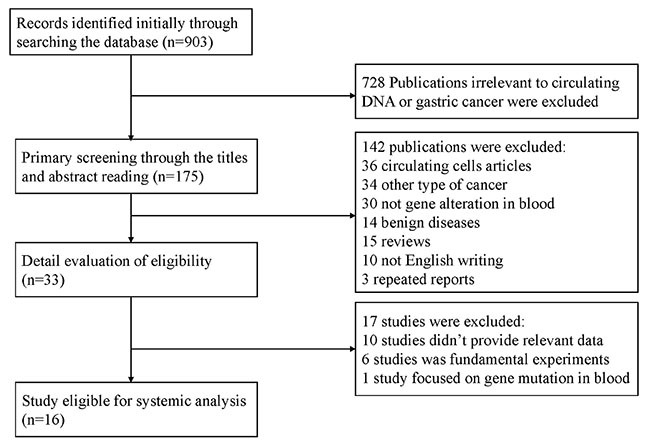
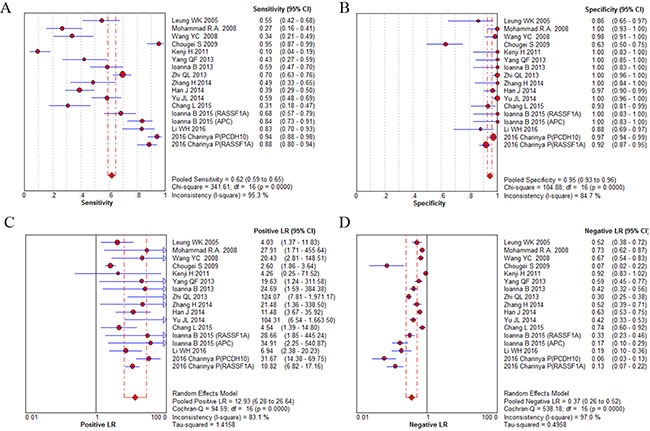
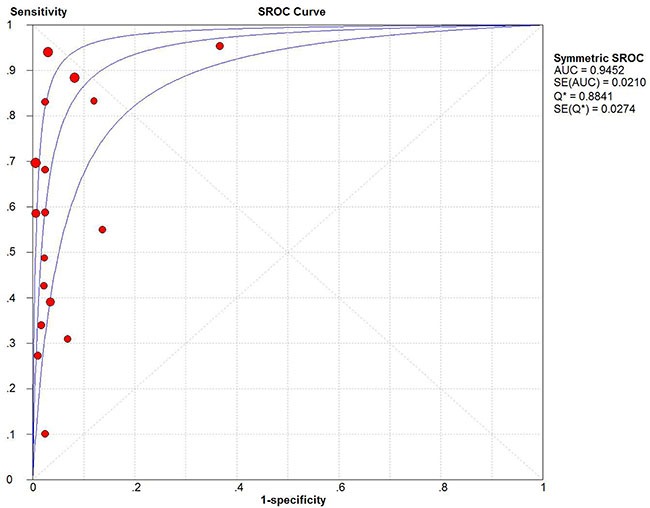
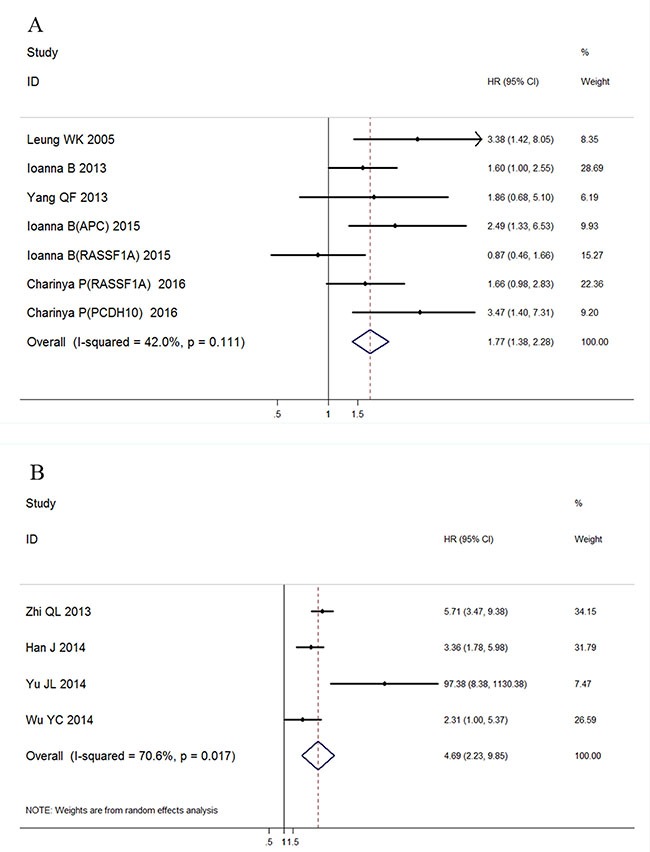
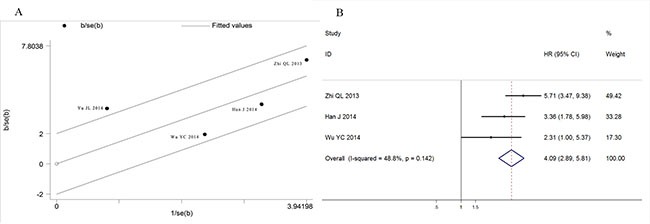
Results: A total of 16 studies comprising 1193 GC patients met our inclusion criteria. The pooled sensitivity and specificity were 0.62 (95% confidence intervals (CI) 0.59-0.65) and 0.95 (95% CI 0.93-0.96), respectively. The AUSROC (area under SROC) curve was 0.94 (95% CI 0.89-0.98). The results showed that the presence of certain ctDNA markers was associated with larger tumor size (OR: 0.26, 95% CI 0.11-0.61, p = 0.002), TNM stage (I + II/III + IV, OR: 0.11, 95% CI 0.07-0.17, p = 0.000), as well as H. pylori infection. (H.p negative/H.p positive, OR: 0.57, 95% CI 0.36-0.91, p = 0.018). Moreover, there was also a significant association between the presence of ctDNA and worse overall survival (HR 1.77, 95% CI 1.38-2.28, p < 0.001), as well as disease-free survival (HR 4.36, 95% CI 3.08-6.16, p < 0.001).
Materials and methods: Pubmed, Embase, Cochrane Library and Web of Science databases were searched for relating literature published up until November 30, 2016. Diagnostic accuracy variables were pooled by the Meta-Disc software. Engauge Digitizer and Stata software were applied for prognostic data extraction and analysis.
Conclusions: Our meta-analysis indicates the detection of certain ctDNA targets is significantly associated with poor prognosis of GC patients, with high specificity and relatively moderate sensitivity.
Keywords: ctDNA; diagnosis; gastric cancer; meta-analysis; prognosis.
Conflict of interest statement
The authors declare no competing financial interests.
Figures
References
-
- Stewart BW. World Cancer Report 2014. International Agency for Research on Cancer. 2015
-
- Ferlay J, Steliarova FE, Lortet TJ, Rosso S, Coebergh JW, Comber H, Forman D, Bray F. Cancer incidence and mortality patterns in Europe: estimates for 40 countries in 2012. Eur J Cancer. 2013;49:1374–1403. - PubMed
-
- Dawson SJ, Rosenfeld N, Caldas C. Circulating tumor DNA to monitor metastatic breast cancer. N Engl J Med. 2013;369:93–94. - PubMed
-
- Qiu M, Wang J, Xu Y, Ding X, Li M, Jiang F, Xu L, Yin R. Circulating tumor DNA is effective for the detection of EGFR mutation in non-small cell lung cancer: a meta-analysis. Cancer Epidemiol Biomarkers Prev. 2015;24:206–212. - PubMed
Publication types
MeSH terms
Substances
LinkOut - more resources
Full Text Sources
Other Literature Sources
Medical
Miscellaneous
