. 2016 Dec 23;15(1):214.
doi: 10.1186/s12934-016-0612-6.

Isoprene production by Escherichia coli through the exogenous mevalonate pathway with reduced formation of fermentation byproducts

Affiliations

Isoprene production by Escherichia coli through the exogenous mevalonate pathway with reduced formation of fermentation byproducts

Jung-Hun Kim et al. Microb Cell Fact. .

Abstract

Background: Isoprene, a volatile C5 hydrocarbon, is an important platform chemical used in the manufacturing of synthetic rubber for tires and various other applications, such as elastomers and adhesives.

Results: In this study, Escherichia coli MG1655 harboring Populus trichocarpa isoprene synthase (PtispS) and the exogenous mevalonate (MVA) pathway produced 80 mg/L isoprene. Codon optimization and optimal expression of the ispS gene via adjustment of the RBS strength and inducer concentration increased isoprene production to 199 and 337 mg/L, respectively. To augment expression of MVA pathway genes, the MVA pathway was cloned on a high-copy plasmid (pBR322 origin) with a strong promoter (Ptrc), which resulted in an additional increase in isoprene production up to 956 mg/L. To reduce the formation of byproducts derived from acetyl-CoA (an initial substrate of the MVA pathway), nine relevant genes were deleted to generate the E. coli AceCo strain (E. coli MG1655 ΔackA-pta, poxB, ldhA, dld, adhE, pps, and atoDA). The AceCo strain harboring the ispS gene and MVA pathway showed enhanced isoprene production of 1832 mg/L in flask culture with reduced accumulation of byproducts.

Conclusions: We achieved a 23-fold increase in isoprene production by codon optimization of PtispS, augmentation of the MVA pathway, and deletion of genes involved in byproduct formation.

Keywords: Bioisoprene; Carbon utilization; Escherichia coli; Isoprene synthase; Mevalonate pathway.


Figures
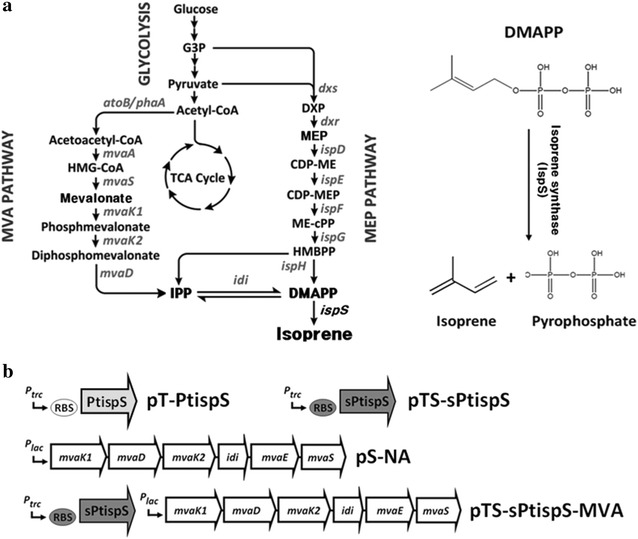
Fig. 1
Fig. 1
Isoprene synthesis pathway (a) and gene clusters used in this study (b). The light and dark gray arrows represent the wild-type isoprene synthase (PtispS) from Populus trichocarpa and its codon-optimized ispS (sPtispS) for expression in Escherichia coli, respectively. The white and dark gray ovals indicate the original RBS of the pTrc99A vector and the modified RBS with higher ribosomal affinity, respectively. The white arrows represent the genes of the MVA pathway (mvaK1, mvaD, and mvaK2 from Streptococcus pneumoniae; mvaE and mvaS from Enterococcus faecalis; and idi from Escherichia coli)
Fig. 2
Fig. 2
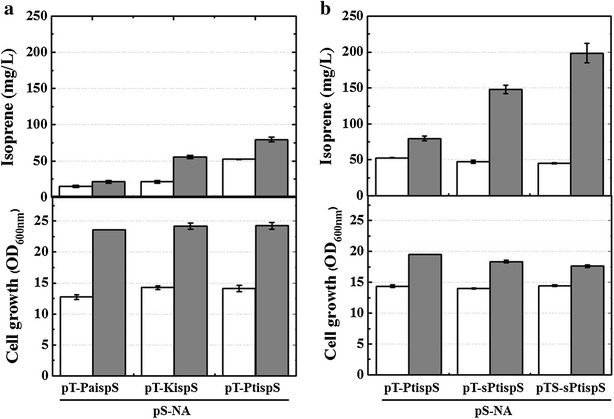
a Comparison of three different isoprene synthases (Populus alba, Pueraria montana [Kudzu vine], and Populus trichocarpa) for isoprene production from recombinant Escherichia coli strains harboring the MVA pathway. b Effects of codon optimization and the strong RBS for expression of Populus trichocarpa IspS on isoprene production and cell growth. Culture was carried out in TB medium containing 2.0% (w/v) glycerol for 24 h at 30 °C. Open bars and closed bars represent the values obtained at 12 and 24 h of culture, respectively
Fig. 3
Fig. 3
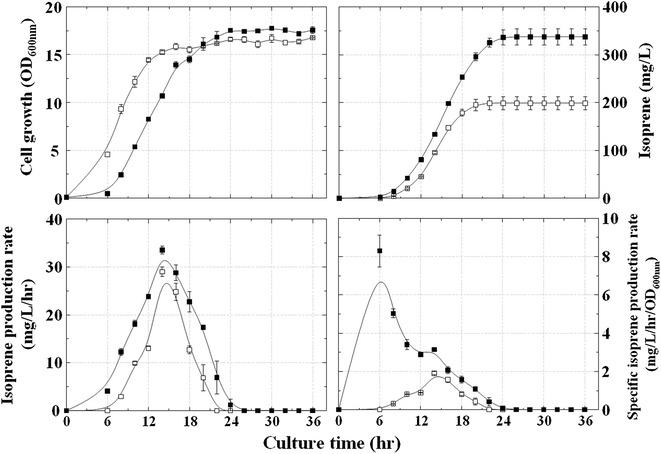
Effects of IPTG induction on isoprene production and cell growth of the MGpsPtpM strain (MG1655 harboring pTS-sPtispS and pS-NA). Culture was carried out in TB medium containing 2.0% (w/v) glycerol without IPTG (open squares) or with 0.1 mM IPTG (closed squares) for 36 h at 30 °C
Fig. 4
Fig. 4
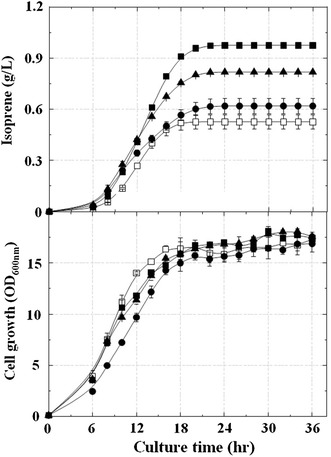
Effects of low IPTG concentrations on isoprene production and cell growth of the MGpsPtM strain (MG1655 harboring pTS-sPtispS-MVA). Culture was carried out in TB medium containing 2.0% (w/v) glycerol for 36 h at 30 °C. IPTG was initially added at concentrations of 0 mM (open squares), 0.01 mM (closed squares), 0.02 mM (closed triangles), and 0.03 mM IPTG (closed circles)
Fig. 5
Fig. 5
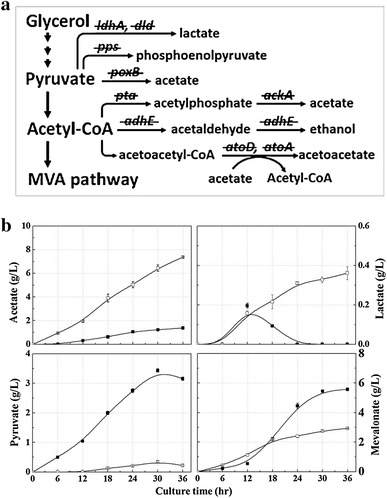
a Pathway of byproduct formation from acetyl-CoA and pyruvate in Escherichia coli. Strikeouts indicate deleted genes in the AceCo strain. The deleted genes and their corresponding enzymes are as follows: ldhA lactate dehydrogenase; dld d-lactate dehydrogenase; pps phosphoenolpyruvate synthetase; poxB pyruvate oxidase; adhE aldehyde-alcohol dehydrogenase; pta phosphate acetyltransferase; ackA acetate kinase; atoD acetoacetyl-CoA transferase; atoA acetoacetyl-CoA transferase. b Analysis of extracellular metabolites (acetate, lactate, pyruvate, and mevalonate) accumulated during the culture of strain MGpsPtM (wild-type MG1655 harboring pTS-sPtispS-MVA) shown in Fig. 4 (open squares) and the strain ApsPtM (the knockout mutant AceCo harboring the same plasmid) shown in Fig. 6 (closed squares) after induction with 0.01 mM IPTG
Fig. 6
Fig. 6
Effects of deletion of genes involved in byproduct formation on isoprene production. The strain ApsPtM (AceCo harboring pTS-sPtispS-MVA) was cultivated in TB medium containing 2.0% (w/v) glycerol and 0.01 mM IPTG at 30 °C

References

    1. Zhang H, Suvorov M, Hutcheson SW. Compositions and methods for the production of isoprene. US Patent, 2012.
    1. Greve H-H. Rubber, 2. Natural. In: Ullmann’s encyclopedia of industrial chemistry. Weinheim: Wiley; 2000.
    1. Lv X, Xie W, Lu W, Guo F, Gu J, Yu H, Ye L. Enhanced isoprene biosynthesis in Saccharomyces cerevisiae by engineering of the native acetyl-CoA and mevalonic acid pathways with a push-pull-restrain strategy. J Biotechnol. 2014;186:128–136. doi: 10.1016/j.jbiotec.2014.06.024. - DOI - PubMed
    1. Schwender J, Zeidler J, Groner R, Muller C, Focke M, Braun S, Lichtenthaler FW, Lichtenthaler HK. Incorporation of 1-deoxy-d-xylulose into isoprene and phytol by higher plants and algae. FEBS Lett. 1997;414:129–134. doi: 10.1016/S0014-5793(97)01002-8. - DOI - PubMed
    1. Goldstein JL, Brown MS. Regulation of the mevalonate pathway. Nature. 1990;343:425–430. doi: 10.1038/343425a0. - DOI - PubMed

MeSH terms

LinkOut - more resources