


Review
doi: 10.1016/j.jad.2016.12.011.
Epub 2016 Dec 16.
Research domain criteria (RDoC) grows up: Strengthening neurodevelopment investigation within the RDoC framework
Affiliations
- PMID: 28010957
- PMCID: PMC5471127
- DOI: 10.1016/j.jad.2016.12.011
Item in Clipboard
Review
Research domain criteria (RDoC) grows up: Strengthening neurodevelopment investigation within the RDoC framework
J Affect Disord.
2017 Jul.
No abstract available
Figures
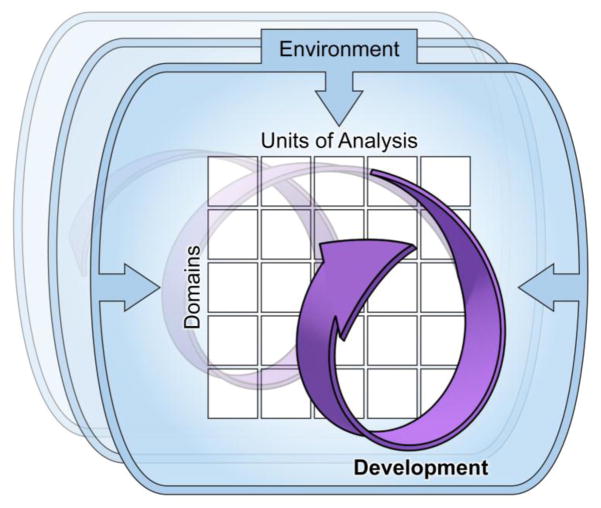
A Research Domain Criteria (RDoC) framework formally has included and continued to refine Constructs and Domains on one axis and Units of Analysis on the other. Although Development and Environment/Context are also central to the RDoC framework, the current standard is to leave incorporation of these factors up to individual researcher. While this does allow for flexability, there are limitations to the approach- namely, factors such as Development may not receive the same level of careful consideration and integration as Constructs/Domains and Units of Analysis (Factors that are specifically mandated in RDoC funding announcements, and most commonly depicted in RDoC conceptual figures). However, future efforts to conduct research in this innovative system will need to place equal weight on each of the four factors. This four-dimensional conceptual figure provides the traditional Constructs/Domains and Units of Analysis axis, but also prominatly displays the critical Environment/Context and Development factors as well. Developmental influences are depicted as non-linear, dynamic, and highly interactive with other RDoC Dimensions.
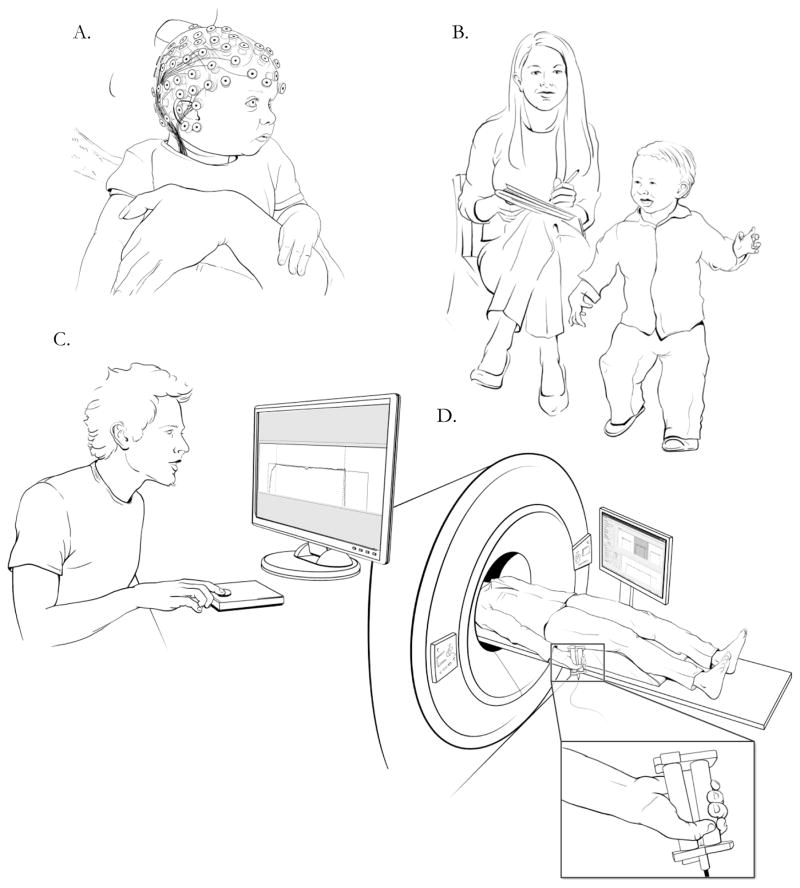
The concept of heterotypic continuity is an important developmental consideration when conducting research in a Research Domain Criteria-RDoC framework. In this series of panels, investigators employ developmentally appropriate assessment strategies to determine how the same underlying circuit vulnerability may reflect different aberrant behaviors across developmental periods. Panel A depicts a proposed future direction, employing more sophisticated assessment approaches to earlier and earlier ages. One promising direction for incorporating Development into RDoC research is the incorporation of experimental designs that allow for standardized in-depth assessment across developmental periods. However, much more preliminary work is required before investigators can practically implement this strategy. Panel B exhibits traditional rater-based assessment of abnormal hand posturing in a toddler. Panel C illustrates an older child participating in a force variability assessment designed to test irregular patterns of muscle contraction, indicative of frontal-striatal circuit pathology. In Panel D an RDoC approach is employed where the same circuit pathology is being evaluated with multiple levels of analysis. An adolescent is being assessed with a grip force task that is designed for use in the scanner (getting at the same circuit assessed by the force variability task in Panel B), and incoming muscle contraction data will be examined in conjunction with patterns of frontal-striatal neural activation.
References
-
- Arvedson JC. Assessment of pediatric dysphagia and feeding disorders: clinical and instrumental approaches. Developmental disabilities research reviews. 2008;14(2):118–127. - PubMed
-
- Cannon M, Caspi A, Moffitt TE, Harrington H, Taylor A, Murray RM, Poulton R. Evidence for early-childhood, pan-developmental impairment specific to schizophreniform disorder: results from a longitudinal birth cohort. Arch Gen Psychiatry. 2002;59:449–456. - PubMed
Publication types
MeSH terms
Grants and funding
LinkOut - more resources
Full Text Sources
Other Literature Sources
Medical
