


Predicting readmission risk following percutaneous coronary intervention at the time of admission
- PMID: 28011244
- PMCID: PMC5494278
- DOI: 10.1016/j.carrev.2016.12.003
Predicting readmission risk following percutaneous coronary intervention at the time of admission
Abstract
Objective: To investigate whether a prediction model based on data available early in percutaneous coronary intervention (PCI) admission can predict the risk of readmission.
Background: Reducing readmissions following hospitalization is a national priority. Identifying patients at high risk for readmission after PCI early in a hospitalization would enable hospitals to enhance discharge planning.
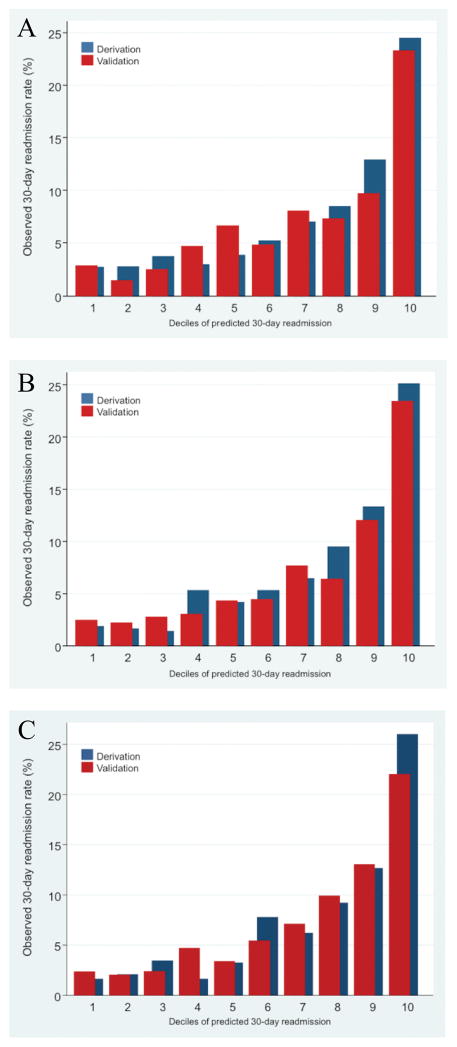
Methods: We developed 3 different models to predict 30-day inpatient readmission to our institution for patients who underwent PCI between January 2010 and April 2013. These models used data available: 1) at admission, 2) at discharge 3) from CathPCI Registry data. We used logistic regression and assessed the discrimination of each model using the c-index. The models were validated with testing on a different patient cohort who underwent PCI between May 2013 and September 2015.
Results: Our cohort included 6717 PCI patients; 3739 in the derivation cohort and 2978 in the validation cohort. The discriminative ability of the admission model was good (C-index of 0.727). The c-indices for the discharge and cath PCI models were slightly better. (C-index of 0.751 and 0.752 respectively). Internal validation of the models showed a reasonable discriminative admission model with slight improvement with adding discharge and registry data (C-index of 0.720, 0.739 and 0.741 respectively). Similarly validation of the models on the validation cohort showed similar results (C-index of 0.703, 0.725 and 0.719 respectively).
Conclusion: Simple models based on available demographic and clinical data may be sufficient to identify patients at highest risk of readmission following PCI early in their hospitalization.
Keywords: Percutaneous coronary intervention; Readmission; Risk prediction.
Copyright © 2016 Elsevier Inc. All rights reserved.
Conflict of interest statement
None of the authors has any conflict of interest to disclose.
Figures
References
-
- Kereiakes DJ. Return to sender hospital readmission after percutaneous coronary intervention. J Am Coll Cardiol. 2009;54:908–910. - PubMed
-
- U.S. Department of health and human services. [Accessed june 9, 2014];Administration implements new health reform provision to improve care quality, lower costs. Http://www.Healthcare.Gov/news/factsheets/2011/04/valuebasedpurchasing04....
-
- Curtis JP, Schreiner G, Wang Y, Chen J, Spertus JA, Rumsfeld JS, et al. All-cause readmission and repeat revascularization after percutaneous coronary intervention in a cohort of medicare patients. J Am Coll Cardiol. 2009;54:903–907. - PubMed
-
-
Patient protection and affordable care act of 2010. Publ no. 111–148. 124 stat 119.
-
-
- Krumholz HM, Normand SL, Spertus JA, Shahian DM, Bradley EH. Measuring performance for treating heart attacks and heart failure: The case for outcomes measurement. Health Aff. 2007;26:75–85. - PubMed
MeSH terms
Grants and funding
LinkOut - more resources
Full Text Sources
Other Literature Sources
Miscellaneous
