


Genital Injury Signatures and Microbiome Alterations Associated With Depot Medroxyprogesterone Acetate Usage and Intravaginal Drying Practices
- PMID: 28011908
- PMCID: PMC5388302
- DOI: 10.1093/infdis/jiw590
Genital Injury Signatures and Microbiome Alterations Associated With Depot Medroxyprogesterone Acetate Usage and Intravaginal Drying Practices
Abstract
Background: Increasing evidence suggests depot medroxyprogesterone acetate (DMPA) and intravaginal practices may be associated with human immunodeficiency virus (HIV-1) infection risk; however, the mechanisms are not fully understood. This study evaluated the effect of DMPA and intravaginal practices on the genital proteome and microbiome to gain mechanistic insights.
Methods: Cervicovaginal secretions from 86 Kenyan women, including self-reported DMPA users (n = 23), nonhormonal contraceptive users (n = 63), and women who practice vaginal drying (n = 46), were analyzed using tandem-mass spectrometry.
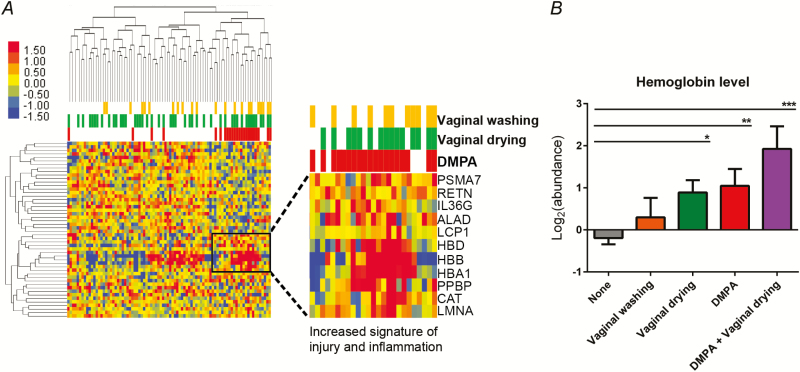
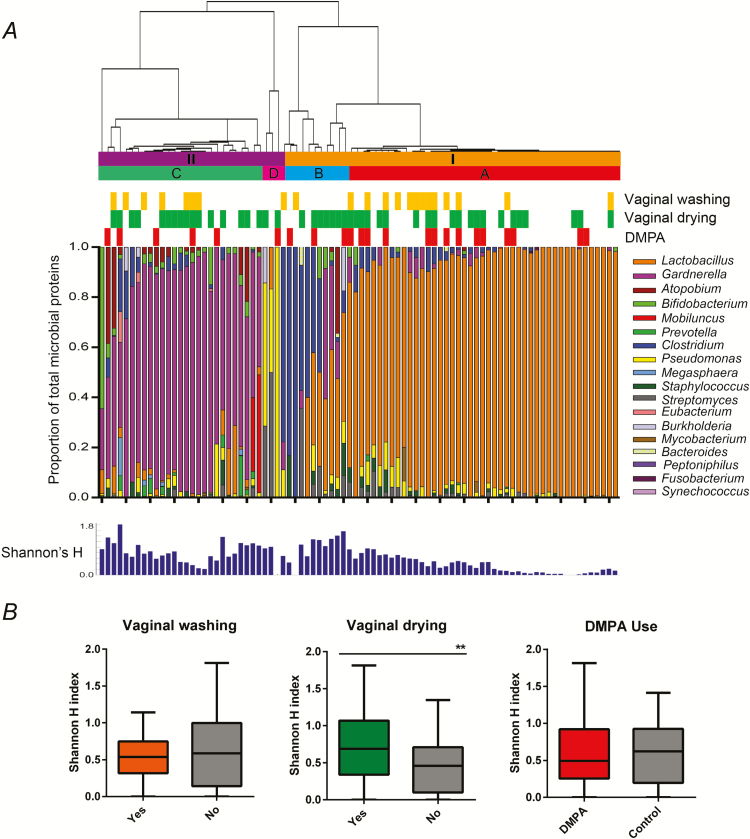
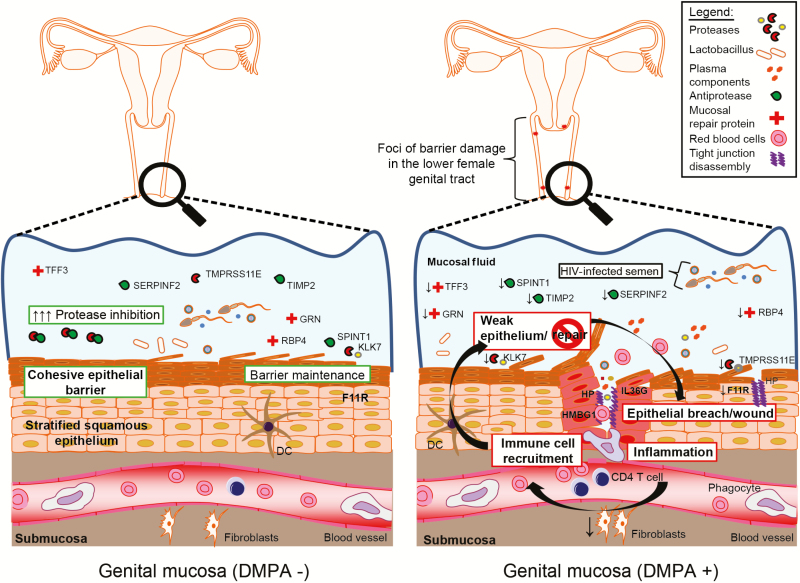
Results: We identified 473 human and 486 bacterial proteins from 18 different genera. Depot medroxyprogesterone acetate use associated with increased hemoglobin and immune activation (HBD, HBB, IL36G), and decreased epithelial repair proteins (TFF3, F11R). Vaginal drying associated with increased hemoglobin and decreased phagocytosis factors (AZU1, MYH9, PLAUR). Injury signatures were exacerbated in DMPA users who also practiced vaginal drying. More diverse (H index: 0.71 vs 0.45; P = .009) bacterial communities containing Gardnerella vaginalis associated with vaginal drying, whereas DMPA showed no significant association with community composition or diversity.
Conclusions: These findings provide new insights into the impact of DMPA and vaginal drying on mucosal barriers. Future investigations are needed to confirm their relationship with HIV risk in women.
Keywords: DMPA; Depot medroxyprogesterone acetate; HIV; Mucosa; genital injury; metaproteome; microbiome; progestin; proteomics; vaginal drying.
© The Author 2016. Published by Oxford University Press for the Infectious Diseases Society of America.
Figures
References
-
- UNAIDS. Global AIDS update—2016. Geneva, Switzerland: Joint United Nations Programme on HIV/AIDS (UNAIDS), 2016.
-
- Glynn JR, Caraël M, Auvert B, et al. Why do young women have a much higher prevalence of HIV than young men? A study in Kisumu, Kenya and Ndola, Zambia. AIDS 2001; 15 Suppl 4:S51–60. - PubMed
MeSH terms
Substances
Grants and funding
LinkOut - more resources
Full Text Sources
Other Literature Sources
Medical
Miscellaneous
