


Low carbohydrate, high fat diet impairs exercise economy and negates the performance benefit from intensified training in elite race walkers
- PMID: 28012184
- PMCID: PMC5407976
- DOI: 10.1113/JP273230
Low carbohydrate, high fat diet impairs exercise economy and negates the performance benefit from intensified training in elite race walkers
Abstract
Key points: Three weeks of intensified training and mild energy deficit in elite race walkers increases peak aerobic capacity independent of dietary support. Adaptation to a ketogenic low carbohydrate, high fat (LCHF) diet markedly increases rates of whole-body fat oxidation during exercise in race walkers over a range of exercise intensities. The increased rates of fat oxidation result in reduced economy (increased oxygen demand for a given speed) at velocities that translate to real-life race performance in elite race walkers. In contrast to training with diets providing chronic or periodised high carbohydrate availability, adaptation to an LCHF diet impairs performance in elite endurance athletes despite a significant improvement in peak aerobic capacity.
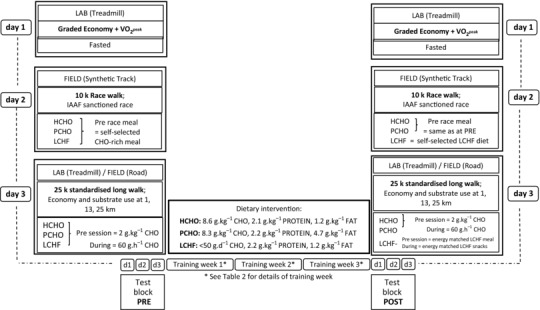
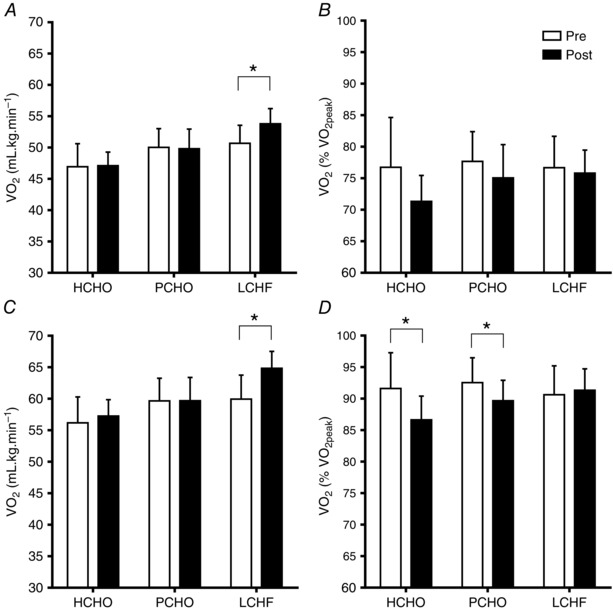
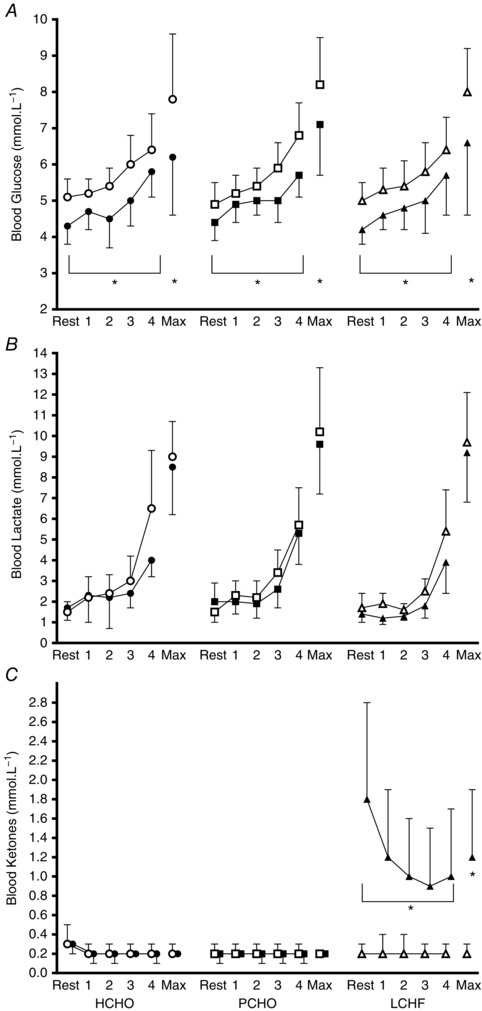
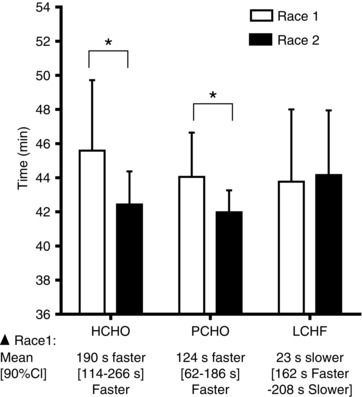
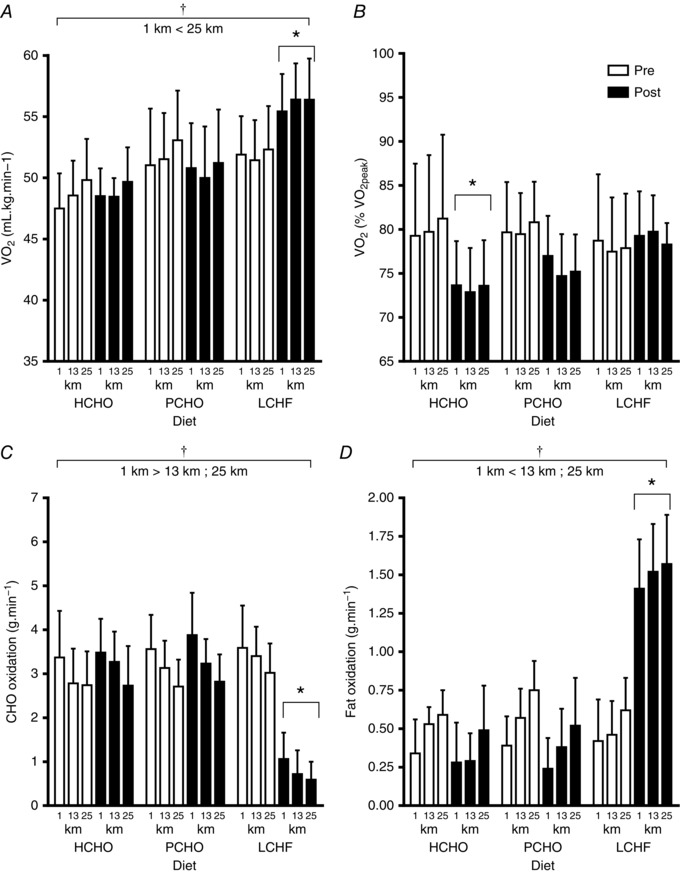
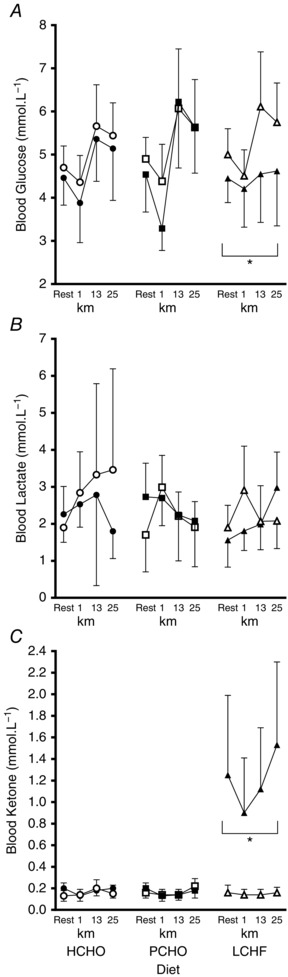
Abstract: We investigated the effects of adaptation to a ketogenic low carbohydrate (CHO), high fat diet (LCHF) during 3 weeks of intensified training on metabolism and performance of world-class endurance athletes. We controlled three isoenergetic diets in elite race walkers: high CHO availability (g kg-1 day-1 : 8.6 CHO, 2.1 protein, 1.2 fat) consumed before, during and after training (HCHO, n = 9); identical macronutrient intake, periodised within or between days to alternate between low and high CHO availability (PCHO, n = 10); LCHF (< 50 g day-1 CHO; 78% energy as fat; 2.1 g kg-1 day-1 protein; LCHF, n = 10). Post-intervention, V̇O2 peak during race walking increased in all groups (P < 0.001, 90% CI: 2.55, 5.20%). LCHF was associated with markedly increased rates of whole-body fat oxidation, attaining peak rates of 1.57 ± 0.32 g min-1 during 2 h of walking at ∼80% V̇O2 peak . However, LCHF also increased the oxygen (O2 ) cost of race walking at velocities relevant to real-life race performance: O2 uptake (expressed as a percentage of new V̇O2 peak ) at a speed approximating 20 km race pace was reduced in HCHO and PCHO (90% CI: -7.047, -2.55 and -5.18, -0.86, respectively), but was maintained at pre-intervention levels in LCHF. HCHO and PCHO groups improved times for 10 km race walk: 6.6% (90% CI: 4.1, 9.1%) and 5.3% (3.4, 7.2%), with no improvement (-1.6% (-8.5, 5.3%)) for the LCHF group. In contrast to training with diets providing chronic or periodised high-CHO availability, and despite a significant improvement in V̇O2 peak , adaptation to the topical LCHF diet negated performance benefits in elite endurance athletes, in part due to reduced exercise economy.
Keywords: athletic performance; ketogenic diet; sports nutrition.
© 2016 The Authors. The Journal of Physiology published by John Wiley & Sons Ltd on behalf of The Physiological Society.
Figures
Comment in
-
A high carbohydrate diet remains the evidence based choice for elite athletes to optimise performance.J Physiol. 2017 May 1;595(9):2775. doi: 10.1113/JP273830. Epub 2017 Feb 8. J Physiol. 2017. PMID: 28044326 Free PMC article. No abstract available.
-
We are what we eat? Eating 'against the grain' may not be as beneficial to performance and 'economy' in endurance athletes.J Physiol. 2017 May 1;595(9):2777-2778. doi: 10.1113/JP274136. Epub 2017 Apr 11. J Physiol. 2017. PMID: 28294339 Free PMC article. No abstract available.
-
Reply from Louise M. Burke.J Physiol. 2017 May 1;595(9):2993-2994. doi: 10.1113/JP274011. J Physiol. 2017. PMID: 28452135 Free PMC article. No abstract available.
-
Methodological issues question the validity of observed performance impairment of a low carbohydrate, high fat diet.J Physiol. 2017 May 1;595(9):2989. doi: 10.1113/JP273990. J Physiol. 2017. PMID: 28452138 Free PMC article. No abstract available.
-
Low versus high carbohydrates in the diet of the world-class athlete: insights from McArdle's disease.J Physiol. 2017 May 1;595(9):2991-2992. doi: 10.1113/JP274060. J Physiol. 2017. PMID: 28452139 Free PMC article. No abstract available.
References
-
- Bartlett JD, Hawley JA & Morton JP (2015). Carbohydrate availability and exercise training adaptation: too much of a good thing? Eur J Sport Sci 15, 3–12. - PubMed
-
- Bates D, Maechler M, Bolker B & Walker S (2015). Fitting linear mixed‐effects models using lme4. J Statist Software 67, 1–48.
-
- Bentley DJ, Millet GP, Vleck VE & McNaughton LR (2002). Specific aspects of contemporary triathlon: implications for physiological analysis and performance. Sports Med 32, 345–359. - PubMed
-
- Bergman BC, Butterfield GE, Wolfel EE, Casazza GA, Lopaschuk GD & Brooks GA (1999). Evaluation of exercise and training on muscle lipid metabolism. Am J Physiol 276, E106–E117. - PubMed
-
- Bergström J, Hermansen L, Hultman E & Saltin B (1967). Diet, muscle glycogen and physical performance. Acta Physiol Scand 71, 140–150. - PubMed
Publication types
MeSH terms
LinkOut - more resources
Full Text Sources
Other Literature Sources
Medical
Research Materials
Miscellaneous
