


Two-Year Impact of Prevention Programs on Adolescent Depression: an Integrative Data Analysis Approach
- PMID: 28013420
- PMCID: PMC5483191
- DOI: 10.1007/s11121-016-0737-1
Two-Year Impact of Prevention Programs on Adolescent Depression: an Integrative Data Analysis Approach
Abstract
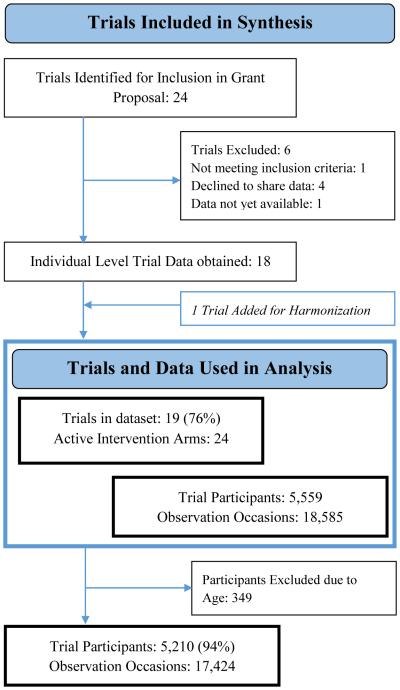
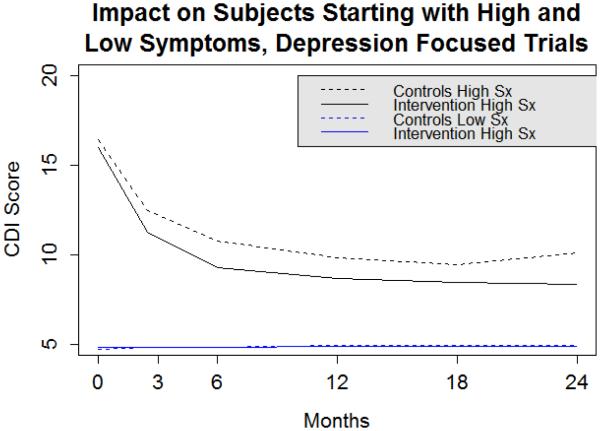
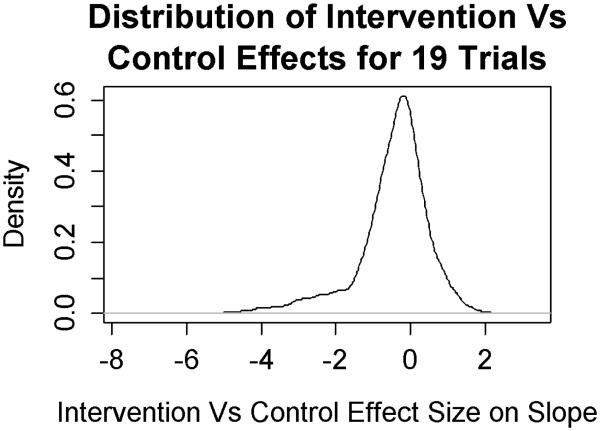
This paper presents the first findings of an integrative data analysis of individual-level data from 19 adolescent depression prevention trials (n = 5210) involving nine distinct interventions across 2 years post-randomization. In separate papers, several interventions have been found to decrease the risk of depressive disorders or elevated depressive/internalizing symptoms among youth. One type of intervention specifically targets youth without a depressive disorder who are at risk due to elevated depressive symptoms and/or having a parent with a depressive disorder. A second type of intervention targets two broad domains: prevention of problem behaviors, which we define as drug use/abuse, sexual risk behaviors, conduct disorder, or other externalizing problems, and general mental health. Most of these latter interventions improve parenting or family factors. We examined the shared and unique effects of these interventions by level of baseline youth depressive symptoms, sociodemographic characteristics of the youth (age, sex, parent education, and family income), type of intervention, and mode of intervention delivery to the youth, parent(s), or both. We harmonized eight different measures of depression utilized across these trials and used growth models to evaluate intervention impact over 2 years. We found a significant overall effect of these interventions on reducing depressive symptoms over 2 years and a stronger impact among those interventions that targeted depression specifically rather than problem behaviors or general mental health, especially when baseline symptoms were high. Implications for improving population-level impact are discussed.
Keywords: Cognitive behavioral therapy; Data synthesis; Growth mixture modeling; Growth modeling; Interpersonal therapy; Parenting interventions; Person-level meta-analysis.
Figures
References
-
- Achenbach TM. Manual for the Child Behavior Checklist/4-18 and 1991 Profile. University of Vermont Department of Psychiatry; Burlington, VT: 1991.
-
- Achenbach TM, Rescorla L. The Manual for the ASEBA school-age forms & profiles. University of Vermont, Research Center for Children, Youth, and Families; Burlington: 2001.
-
- Andrews G, Sanderson K, Corry J, Lapsley HM. Using epidemiological data to model efficiency in reducing the burden of depression. The journal of mental health policy and economics. 2000;3(4):175–186. - PubMed
-
- Asarnow JR, Jaycox LH, Duan N, LaBorde AP, Rea MM, Murray P, Wells KB. Effectiveness of a quality improvement intervention for adolescent depression in primary care clinics: a randomized controlled trial. Jama. 2005;293(3):311–319. doi:10.1001/jama.293.3.311. - PubMed
-
- Avenevoli S, Swendsen J, He J-P, Burstein M, Merikangas KR. Major Depression in the National Comorbidity Survey–Adolescent Supplement: Prevalence, Correlates, and Treatment. Journal of the American Academy of Child & Adolescent Psychiatry. 2015;54(1):37–44. e32. doi:10.1016/j.jaac.2014.10.010. - PMC - PubMed
Publication types
MeSH terms
Grants and funding
- R01 DA018374/DA/NIDA NIH HHS/United States
- R01 MH052270/MH/NIMH NIH HHS/United States
- R01 MH090035/MH/NIMH NIH HHS/United States
- R01 DA026874/DA/NIDA NIH HHS/United States
- R37 DA007031/DA/NIDA NIH HHS/United States
- R01 MH064717/MH/NIMH NIH HHS/United States
- R01 MH064707/MH/NIMH NIH HHS/United States
- U01 PS000671/PS/NCHHSTP CDC HHS/United States
- 961730/William T. Grant Foundation/International
- R01 DA040756/DA/NIDA NIH HHS/United States
- R01 MH064735/MH/NIMH NIH HHS/United States
- R01 DA007031/DA/NIDA NIH HHS/United States
- P30 MH039246/MH/NIMH NIH HHS/United States
- R01 MH049155/MH/NIMH NIH HHS/United States
- R01 MH040859/MH/NIMH NIH HHS/United States
- K23 MH071320/MH/NIMH NIH HHS/United States
- R01 DA017462/DA/NIDA NIH HHS/United States
- R01 DA025894/DA/NIDA NIH HHS/United States
- R01 MH064503/MH/NIMH NIH HHS/United States
- K08 MH072918/MH/NIMH NIH HHS/United States
- P30 MH068685/MH/NIMH NIH HHS/United States
LinkOut - more resources
Full Text Sources
Other Literature Sources
Medical
