


A systems approach to vaccine decision making
- PMID: 28017430
- PMCID: PMC5460980
- DOI: 10.1016/j.vaccine.2016.11.033
A systems approach to vaccine decision making
Abstract
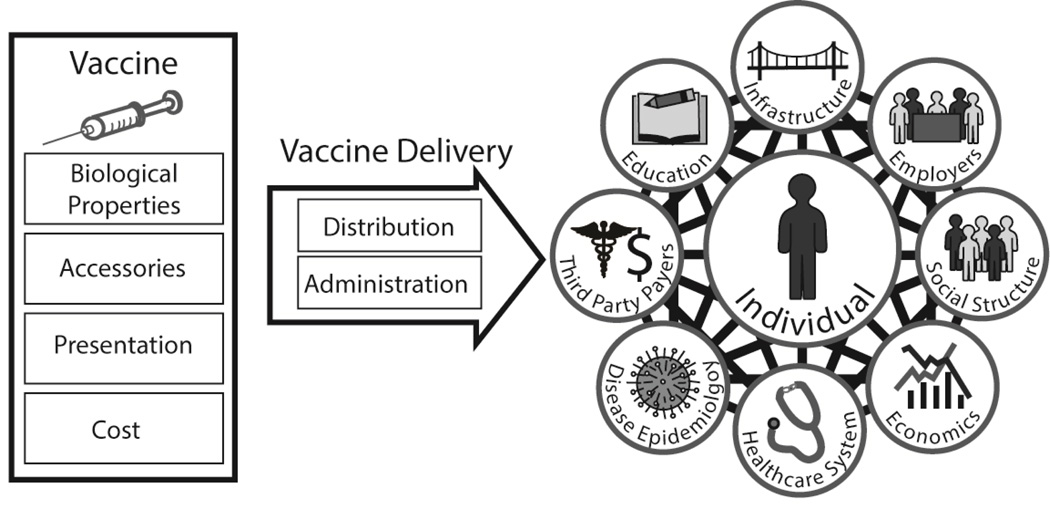
Vaccines reside in a complex multiscale system that includes biological, clinical, behavioral, social, operational, environmental, and economical relationships. Not accounting for these systems when making decisions about vaccines can result in changes that have little effect rather than solutions, lead to unsustainable solutions, miss indirect (e.g., secondary, tertiary, and beyond) effects, cause unintended consequences, and lead to wasted time, effort, and resources. Mathematical and computational modeling can help better understand and address complex systems by representing all or most of the components, relationships, and processes. Such models can serve as "virtual laboratories" to examine how a system operates and test the effects of different changes within the system. Here are ten lessons learned from using computational models to bring more of a systems approach to vaccine decision making: (i) traditional single measure approaches may overlook opportunities; (ii) there is complex interplay among many vaccine, population, and disease characteristics; (iii) accounting for perspective can identify synergies; (iv) the distribution system should not be overlooked; (v) target population choice can have secondary and tertiary effects; (vi) potentially overlooked characteristics can be important; (vii) characteristics of one vaccine can affect other vaccines; (viii) the broader impact of vaccines is complex; (ix) vaccine administration extends beyond the provider level; and (x) the value of vaccines is dynamic.
Keywords: Computational modeling; Decision making; Systems; Vaccines.
Copyright © 2016 Elsevier Ltd. All rights reserved.
Figures
References
Publication types
MeSH terms
Substances
Grants and funding
LinkOut - more resources
Full Text Sources
Other Literature Sources
Medical
