Review
. 2016 Dec 23;89(4):539-563.
eCollection 2016 Dec.

Deciphering the Epigenetic Code in Embryonic and Dental Pulp Stem Cells

Affiliations
Review

Deciphering the Epigenetic Code in Embryonic and Dental Pulp Stem Cells

Dashzeveg Bayarsaihan. Yale J Biol Med. .

Abstract

A close cooperation between chromatin states, transcriptional modulation, and epigenetic modifications is required for establishing appropriate regulatory circuits underlying self-renewal and differentiation of adult and embryonic stem cells. A growing body of research has established that the epigenome topology provides a structural framework for engaging genes in the non-random chromosomal interactions to orchestrate complex processes such as cell-matrix interactions, cell adhesion and cell migration during lineage commitment. Over the past few years, the functional dissection of the epigenetic landscape has become increasingly important for understanding gene expression dynamics in stem cells naturally found in most tissues. Adult stem cells of the human dental pulp hold great promise for tissue engineering, particularly in the skeletal and tooth regenerative medicine. It is therefore likely that progress towards pulp regeneration will have a substantial impact on the clinical research. This review summarizes the current state of knowledge regarding epigenetic cues that have evolved to regulate the pluripotent differentiation potential of embryonic stem cells and the lineage determination of developing dental pulp progenitors.

Keywords: DNA methylation; chromatin topology; dental pulp stem cells; embryonic stem cells; enhancers; histone modifications; non-coding RNA.


Figures
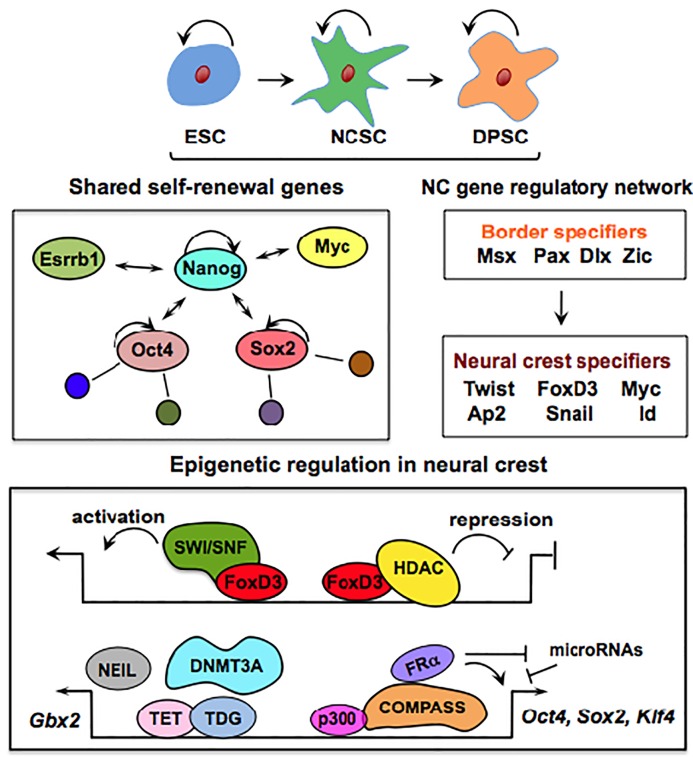
Figure 1
Figure 1
The self-renewal potential of embryonic stem cells (ESC), neural crest stem cells (NCSC) and dental pulp stem cells (DPSC) is dependent upon a shared gene regulatory network of self-renewal factors (left) and neural crest specifiers (right). The combinatorial activity of different epigenetic enzymes and chromatin remodeling complexes ultimately fine-turns the transcriptional output of cognate genes in neural crest in response to diverse signaling (bottom). FoxD3 binds to SWI/SNF complex to facilitate transcriptional activation, while interaction between FoxD3 and histone deacetylases (HDACs) attenuates the expression of occupied genes. The NEIL family of DNA glycosylases cooperates with thymine DNA glycosylase (TDG), TET dioxygenases, and DNA methyltransferases (DNMT) to control target genes. The expression of pluripoteny genes including Oct4, Sox2, and Klf4 can be regulated by microRNAs. FRα, folic acid receptor, can activate pluripotency genes via microRNA inhibition.
Figure 2
Figure 2
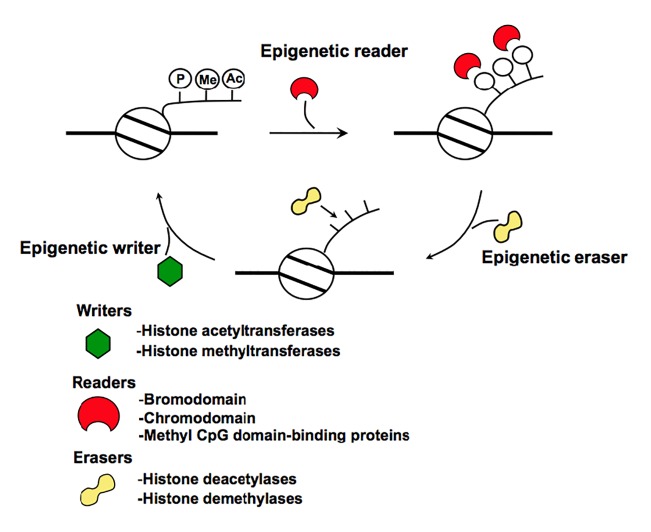
Epigenetic writers, readers and erasers maintain the epigenomic landscape of cells. Among epigenetic writers are histone acetyltransferases (HATs), histone methyltransferases (HMTs), and DNA methyltransferases (DNMTs) that transfer epigenetic marks to histone tails. The members of bromodomain, chromodomain and methyl-binding domain (MBD) protein families represent epigenetic readers that recognize different epigenetic modifications on nucleosomes and DNA. Epigenetic erasers such as histone deacetylases (HDACs), histone demethylases (HDMs) and members of the TET family of DNA hydroxylases remove epigenetic marks.
Figure 3
Figure 3
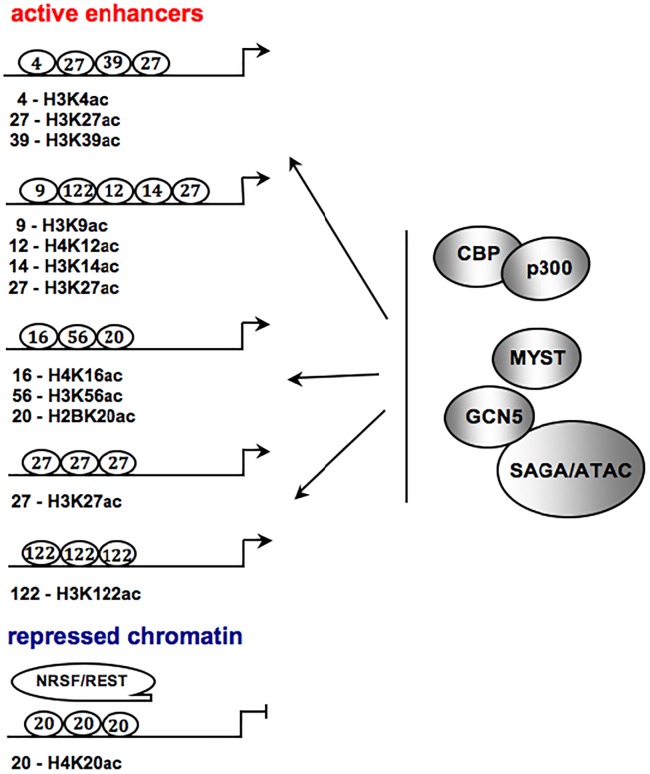
The combinatorial activity of different histone acetylation marks defines regulatory elements across the genome. Although nucleosome acetylation is a hallmark feature of chromatin accessibility and gene activity, in some discrete genomic regions the deposition of H4K20ac is sufficient to recruit NRSF/REST, a repressor of neuronal genes to initiate transcriptional silencing.
Figure 4
Figure 4
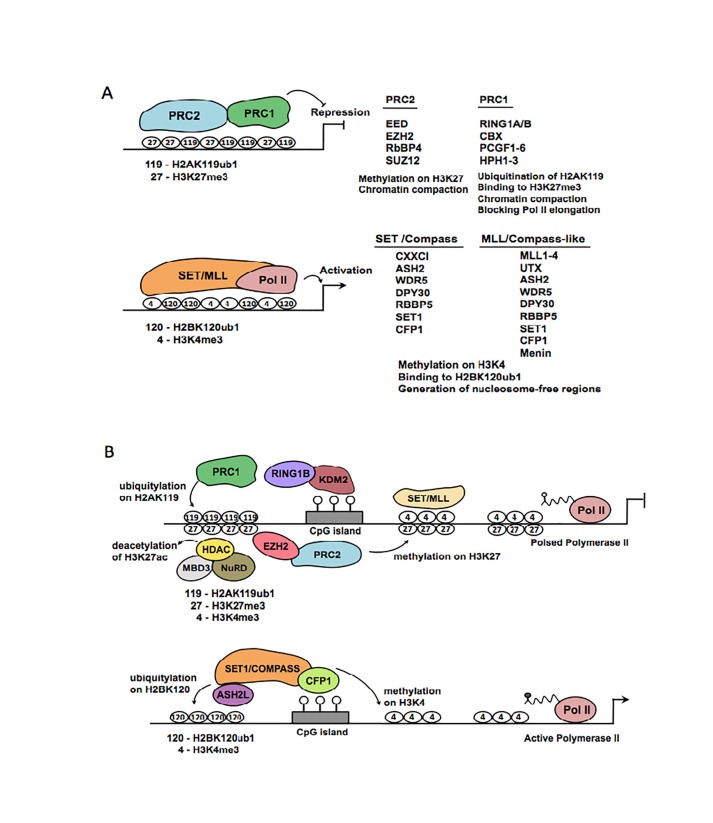
The composition and chromatin recognition of Polycomb (PcG) and Trithorax (TrxG) complexes in ESCs. A. PcG is composed of Polycomb Repressive Complexes PRC1 and PRC2, which are responsible for methylation on H3K27 and chromatin compaction. PRC2 contains four functional subunits EZH1/2, SUZ12, EED and RbBP4. PRC1 has six distinct PCGF subunits, H2A monoubiquitin ligases RING1A/B and a unique set of PRC1-associated proteins. The mammalian TrxG is composed of SET1/COMPASS and MLL/COMPASS-like complexes containing four members of MLL family, ASH2L, RbBP5, WDR5 and DPY30. RNF20 is a component of an E3 ubiquitin-protein ligase complex that mediates monoubiquitination of lysine 120 of histone H2B (H2BK120ub1). The SET1/COMPASS complex initiates a relaxed chromatin configuration by binding to H2BK120ub1. B. EZH2, an enzymatic subunit of PRC2, initiates trimethylation on H3K27 over the PRC2-bound regions, whereas PRC1 selectively binds to H2AK119ub1. PRC1-linked H2A monoubiquitylation is sufficient to recruit PRC2 to chromatin in vivo, suggesting a mechanism through which recognition of unmethylated CpG islands determines the localization of both PRC1 and PRC2 at the target sites. In the presence of PRC2, PRC1 retains the capacity to occupy the H3K27me3-enriched nucleosomes associated with poised RNA Polymerase II (Pol II), which is phosphorylated at serine 2. The TrxG-specific complex SET1/COMPASS exhibits a more robust H3K4 trimethylation activity than MLL/COMPASS-like complex. In pluripotent stem cells, CFP1 and MLL1/2 are implicated in targeting SET1/COMPASS to CpG islands, thus playing a critical role in H3K4me3 accumulation. ASH2L recognizes H2BK120ub1 to initiate the recruitment of SET1/COMPASS, which then binds activated Pol II, which is phosphorylated at serine 5, augmenting H3K4me3 domain co-transcriptionally.
Figure 5
Figure 5
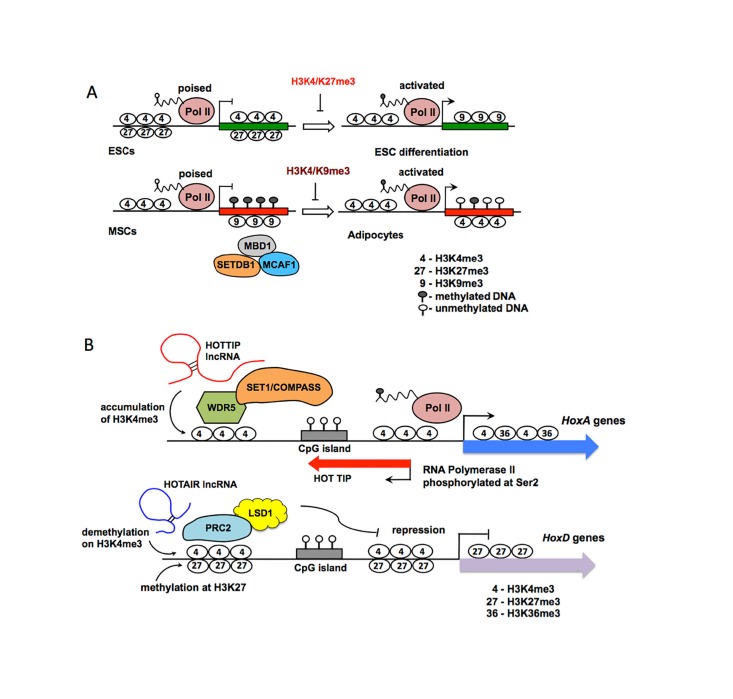
Bivalent chromatin and the role of non-coding RNAs in the regulation of gene expression. A. Two different forms of bivalent domain exist in ESCs and mesenchymal stem cells (MSCs). In pluripotent stem cells, H3K4/H3K27me3 bivalency pauses Pol II at promoters of developmental genes. In MSCs and preadipocytes, deposition of a repressive mark H3K9me3 by SETDB1 pauses Pol II at promoters. DNA methylation contributes to the formation of the H3K4/H3K9me3 bivalent domain by facilitating the recruitment of the repressive complex MDB1/MCAF1/SETDB1 over the gene bodies, thus restricting the differentiation potential of preadipocytes. Loss of H3K9me3 in adipocytes enables Pol II elongation at the developmental genes such as Cebpa and Pparg. B. Physical contact between lncRNAs and TrxG complex can promote transcriptional activation. WDR5, a subunit of the SET1/COMPASS complex, binds to the lncRNA HOTTIP transcribed from the HOXA locus. The interaction between WDR5 and HOTTIP elicits gene activation via MLL-mediated H3K4 trimethylation. As an epigenetic repressor, lncRNA HOTAIR ensures the recruitment of PRC2 and LSD1 at HOXD cluster to initiate accumulation of H3K27me3 and demethylation at H3K4me3, thereby enforcing a silent chromatin state.
Figure 6
Figure 6
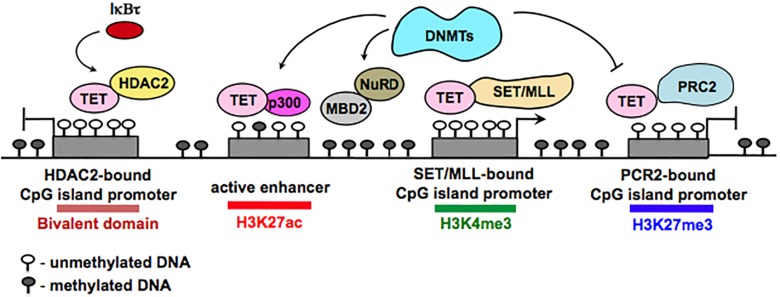
The close ties between DNA methylation and histone modification. Methylation of cytosine by DNA methyltransferases (DNMTs) establishes repressive chromatin, which is stabilized by PRC2 and NuRD complexes. However, in some cancer cells, DNA methylation ensures structural integrity of the H3K27ac-rich enhancers [199]. The TET-mediated DNA hypomethylation triggers the eviction of PRC2 and loss of H3K27me3 causing ectopic expression of cognate genes. Surprisingly, in innate myeloid cells, TET2 is able to recruit HDAC2 with the assistance of IκBτ factor to initiate the gene-specific transcriptional repression [206]. The TET-mediated DNA hydroxymethylation is critical for de novo establishment and maintenance of H3K4me3-rich active domains marking CGIs, while TET binding to PRC2 contributes to the establishment of H3K27me3-positive repressive chromatin. Methyl CpG-binding proteins (MBDs) control expression of pluripotency genes in ESCs by associating with the HDAC/NuRD repressive complex.
Figure 7
Figure 7
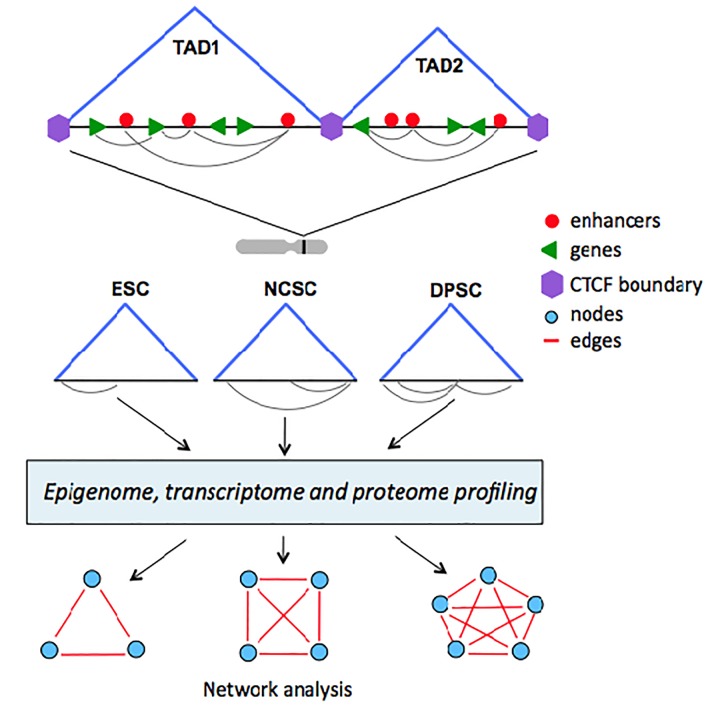
Long-range chromatin interactions, which are required for fine-tuning gene expression, occur predominantly inside of topologically associating domains (TADs), structural units of chromatin architecture. Insulators, the CTCF-bound genomic regions, separate TADs from each other within the 3D nuclear scaffold. Chromatin interactions are pre-determined by the epigenetic landscape and influence the unique signatures of transcriptomic and proteomic responses in living cells. The integration of network analysis and genome-wide datasets is a necessary step towards untangling the spatial and temporal dynamics of gene regulation of differentiating cells. Nodes (blue circles) represent functional units, either genes or proteins, in the network and edges (red line) represent interactions between units, whereas long-range interactions are depicted with gray curved lines.

References

    1. Zoghbi HY, Beaudet AL. Epigenetics and Human Disease. Cold Spring Harb Perspect Biol. 2016;8(2):a019497. - PMC - PubMed
    1. Hamidi T, Singh AK, Chen T. Genetic alterations of DNA methylation machinery in human diseases. Epigenomics. 2015;7(2):247–265. - PubMed
    1. Luo Z, Lin C. Enhancer, epigenetics, and human disease. Curr Opin Genet Dev. 2016;36:27–33. - PubMed
    1. Etchegaray JP, Mostoslavsky R. Interplay between Metabolism and Epigenetics: A Nuclear Adaptation to Environmental Changes. Mol Cell. 2016;62(5):695–711. - PMC - PubMed
    1. Duncan HF, Smith AJ, Fleming GJ. et al. Epigenetic modulation of dental pulp stem cells: implications for regenerative endodontics. Int Endod J. 2016;49(5):431–446. - PubMed

LinkOut - more resources