Review
. 2016 Dec 23;89(4):591-596.
eCollection 2016 Dec.

Receptor Signaling Directs Global Recruitment of Pre-existing Transcription Factors to Inducible Elements

Affiliations
Review

Receptor Signaling Directs Global Recruitment of Pre-existing Transcription Factors to Inducible Elements

Peter N Cockerill. Yale J Biol Med. .

Abstract

Gene expression programs are largely regulated by the tissue-specific expression of lineage-defining transcription factors or by the inducible expression of transcription factors in response to specific stimuli. Here I will review our own work over the last 20 years to show how specific activation signals also lead to the wide-spread re-distribution of pre-existing constitutive transcription factors to sites undergoing chromatin reorganization. I will summarize studies showing that activation of kinase signaling pathways creates open chromatin regions that recruit pre-existing factors which were previously unable to bind to closed chromatin. As models I will draw upon genes activated or primed by receptor signaling in memory T cells, and genes activated by cytokine receptor mutations in acute myeloid leukemia. I also summarize a hit-and-run model of stable epigenetic reprograming in memory T cells, mediated by transient Activator Protein 1 (AP-1) binding, which enables the accelerated activation of inducible enhancers.

Keywords: Transcription; epigenetics; immunological memory; leukemia.


Figures
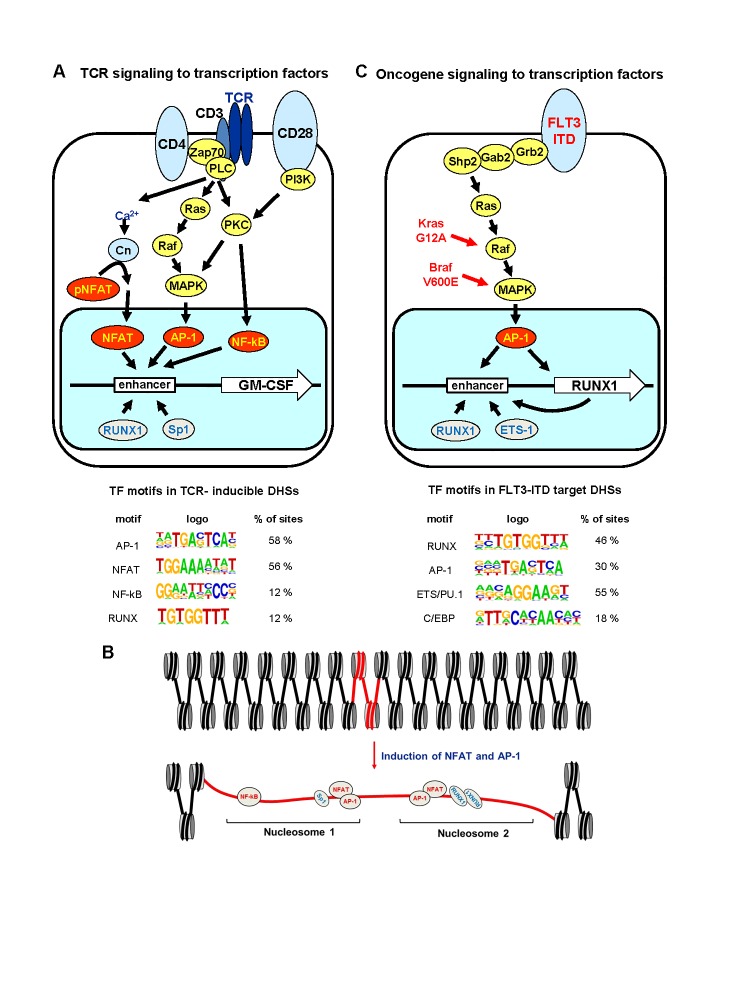
Figure 1
Figure 1
Global redistribution of TF binding in T cells and AML cells in response to activation of receptor signaling. A. TCR signaling pathways linked to the activation of inducible genes such as GM-CSF in T cells. Shown underneath are TF motifs that were found to be enriched in a population of ~1000 inducible DHSs identified in a global analysis of stimulated mouse T cells [1]; B. Scale model of the chromatin architecture and TF occupancy at the human GM-CSFenhancer in T cells before and after activation of TCR signaling; C. Gene regulatory network activated via MAPK signaling pathways by FLT3, Ras and Raf gene mutations in AML. Shown underneath are TF motifs that were found to be enriched in a population of ~1000 DHSs that are specifically enriched in AML carrying FLT-ITD mutations [2].
Figure 2
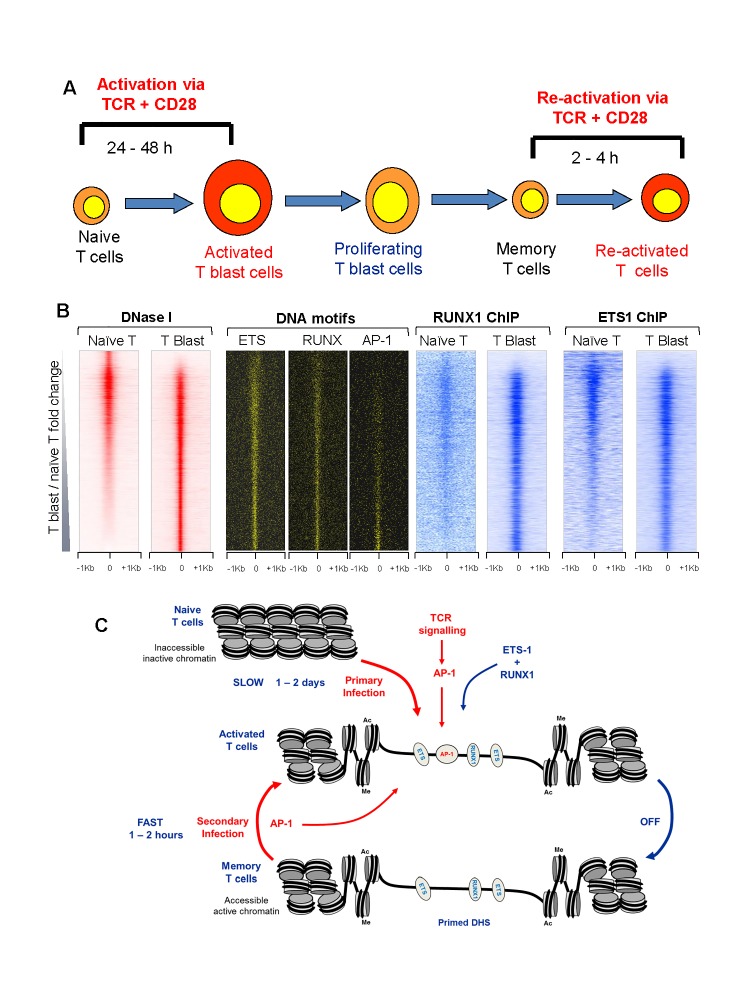
Figure 2
Mechanisms of establishing and maintaining immunological memory in T cells. A. Stages of T cell activation and differentiation; B. DNase-Seq and TF ChIP-Seq, plus motif locations, for 2 Kb segments of the mouse genome spanning the ~17,000 strongest DHSs in naïve CD4 T cells and CD4 T blast cells, ranked in order of increasing signal in T blast cells relative to naïve T cells [2]; C. Scale model depicting mechanisms of TF binding and epigenetic re-programming of activated and memory T cells.

References

    1. Bevington SL, Cauchy P, Piper J. et al. Inducible chromatin priming is associated with the establishment of immunological memory in T cells. EMBO J. 2016;35(5):515–535. - PMC - PubMed
    1. Cauchy P, James SR, Zacarias-Cabeza J. et al. Chronic FLT3-ITD Signaling in Acute Myeloid Leukemia Is Connected to a Specific Chromatin Signature. Cell Rep. 2015;12(5):821–836. - PMC - PubMed
    1. Cockerill PN. Structure and function of active chromatin and DNase I hypersensitive sites. FEBS J. 2011;278(13):2182–2210. - PubMed
    1. Johnson BV, Bert AG, Ryan GR. et al. GM-CSF enhancer activation requires cooperation between NFAT and AP-1 elements and is associated with extensive nucleosome reorganization. Mol Cell Biol. 2004;24(18):7914–7930. - PMC - PubMed
    1. Cairns BR. The logic of chromatin architecture and remodelling at promoters. Nature. 2009;461(7261):193–198. - PubMed

Publication types

Substances