


Slowly Adapting Sensory Units Have More Receptors in Large Airways than in Small Airways in Rabbits
- PMID: 28018231
- PMCID: PMC5145901
- DOI: 10.3389/fphys.2016.00588
Slowly Adapting Sensory Units Have More Receptors in Large Airways than in Small Airways in Rabbits
Abstract
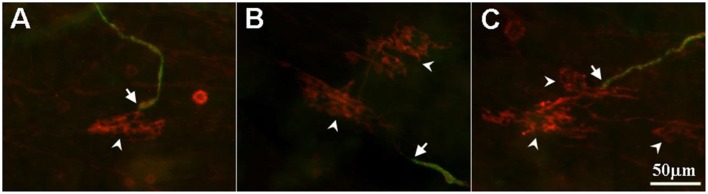
Sensory units of pulmonary slowly adapting receptors (SARs) are more active in large airways than in small airways. However, there is no explanation for this phenomenon. Although sensory structures in large airways resemble those in small airways, they are bigger and more complex. Possibly, a larger receptor provides greater surface area for depolarization, and thus has a lower activating threshold and/or a higher sensitivity to stretch, leading to more nerve electrical activities. Recently, a single sensory unit has been reported to contain multiple receptors. Therefore, sensory units in large airways may contain more SARs, which may contribute to high activities. To test this hypothesis, we used a double staining technique to identify sensory receptor sizes. We labeled the sensory structure with Na+/K+-ATPase antibodies and the myelin sheath with myelin basic protein (MBP) antibodies. A SAR can be defined as the end formation beyond MBP labeling. Thus, we are able to compare sizes of sensory structures and SARs in large (trachea and bronchi) vs. small (bronchioles <500 μm in diameter) airways in the rabbit. We found that even though the sensory structure was bigger in large airways than in small airways (3340 ± 223 vs. 1168 ± 103 μm2; P < 0.0001), there was no difference in receptor sizes (349 ± 14 vs. 326 ± 16 μm2; > 0.05). However, the sensory structure contains more SARs in large airways than in small airways (9.6 ± 0.6 vs. 3.6 ± 0.3; P < 0.0001). Thus, our data support the hypothesis that greater numbers of SARs in sensory units of large airways may contribute to higher activities.
Keywords: airway receptor; airway sensors; lung afferents; sensory receptor; sensory receptor cells; sensory unit; vagus nerve.
Figures



References
-
- Coleridge H. M., Coleridge J. C. G. (1986). Reflexes evoked from tracheobronchial tree and lungs, in Handbook of Physiology, eds Cherniack N. S., Widdicombe J. G. (Bethesda: American Physiological Society; ), 395–430.
-
- Farber J. P., Fisher J. T., Sant'Ambrogio G. (1983). Distribution and discharge properties of airway receptors in the opossum, Didelphis marsupialis. Am. J. Physiol. 245, R209–R214. - PubMed
Grants and funding
LinkOut - more resources
Full Text Sources
Other Literature Sources
Miscellaneous
