


Preventing Internalizing Problems in 6-8 Year Old Children: A Universal School-Based Program
- PMID: 28018267
- PMCID: PMC5156718
- DOI: 10.3389/fpsyg.2016.01928
Preventing Internalizing Problems in 6-8 Year Old Children: A Universal School-Based Program
Abstract
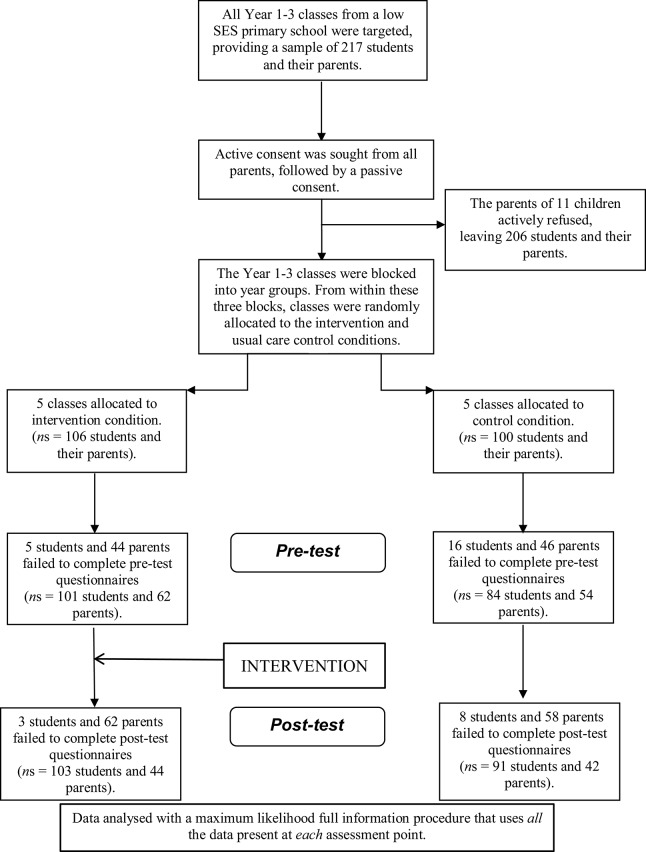
The Aussie Optimism Program: Feelings and Friends (AOP-FF) is a 10 week, universal mental health promotion program based on social/emotional and cognitive and behavioral strategies. The aim of the current study was to evaluate the efficacy of a universal Cognitive Behavioral Therapy based program in preventing and reducing internalizing problems in 6-8 year olds (Years 1-3 in Australia). Year 1-3 students from a low SES primary school (N = 206) were randomly assigned in classes to either an intervention or a control group and assessed at baseline and post-test. Results showed a significant (p = 0.009) and small to moderate (partial eta-squared = 0.034) pre-post decrease in parent-reported anxiety symptoms for the intervention group, in conjunction with a non-significant (p = 0.708) and negligible (partial eta-squared = 0.001) pre-post increase for the control group. A larger randomized controlled trial assessing longer term effects is needed. In addition the program needs to be simplified for year 1-2 students with a separate more developmentally appropriate program for year 3 students.
Keywords: anxiety; lower primary school children; prevention.
Figures
References
-
- Anliak S., Sahin D. (2010). An observational study for evaluating the effects of interpersonal problem-solving skills training on behavioural dimensions. Early Child Dev. Care 180, 995–1003. 10.1080/03004430802670819 - DOI
-
- Barlow D. H. (2002). Anxiety and Its Disorders: The Nature and Treatment of Anxiety and Panic, 2nd Edn. New York, NY: Guildford Press.
-
- Barrett P. M., Dadds M. R., Holland D. E. (1994). The Coping Koala: Prevention Manual. The University of Queensland, Queensland, Australia.
-
- Bryk A. S., Raudenbush W. (1987). Application of hierarchical linear models to assessing change. Psychol. Bull. 101, 147–158. 10.1037/0033-2909.101.1.147 - DOI
LinkOut - more resources
Full Text Sources
Other Literature Sources
