. 2016 Dec 19:13:52.
doi: 10.1186/s12983-016-0184-7. eCollection 2016.

Concordant morphological and molecular clines in a contact zone of the Common and Spined toad (Bufo bufo and B. spinosus) in the northwest of France

Affiliations

Concordant morphological and molecular clines in a contact zone of the Common and Spined toad (Bufo bufo and B. spinosus) in the northwest of France

Jan W Arntzen et al. Front Zool. .

Abstract

Background: Hybrid zones are regions where individuals of two species meet and produce hybrid progeny, and are often regarded as natural laboratories to understand the process of species formation. Two microevolutionary processes can take place in hybrid zones, with opposing effects on population differentiation. Hybridization tends to produce genetic homogenization, reducing species differences, whereas the presence of mechanisms of reproductive isolation result in barriers to gene flow, maintaining or increasing differences between taxa.

Results: Here we study a contact zone between two hybridizing toad species, Bufo bufo and B. spinosus, through a combination of molecular (12 polymorphic microsatellites, four nuclear and two mitochondrial SNP markers) and morphological data in a transect in the northwest of France. The results show largely concordant clines across markers, defining a narrow hybrid zone of ca. 30 km wide. Most hybrids in the centre of the contact zone are classified as F2 or backcrossed individuals, with no individuals assigned to the F1 hybrid class.

Conclusions: We discuss the implications of these results for our understanding of the evolutionary history of these species. We anticipate that the toad contact zone here described will become an important asset in the study of hybrid zone dynamics and evolutionary biology because of its easy access and the abundance of the species involved.

Keywords: Cline analysis; Hybridization; Microsatellites; Morphology; SNPs; mtDNA.


Figures
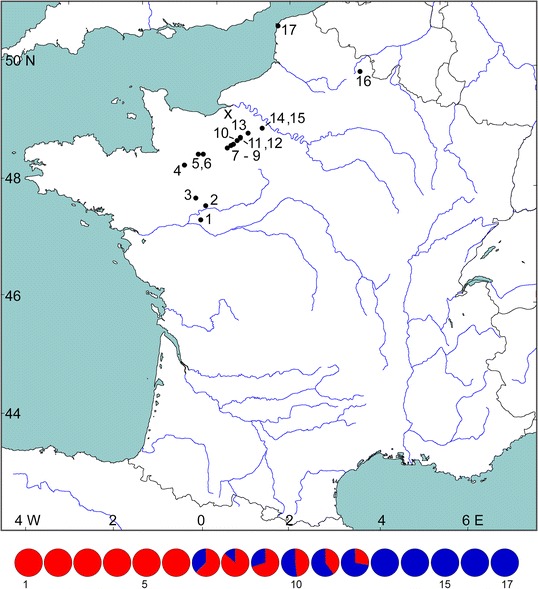
Fig. 1
Fig. 1
Location of 17 Bufo spinosus and B. bufo populations over a transect in northwestern France. The pie diagrams at the bottom show the observed mtDNA haplotype frequencies, with haplotypes typical for the species in red (B. spinosus) and blue (B. bufo). The B. bufoB. spinosus hybrid population reported by [18] is shown by an X
Fig. 2
Fig. 2
Species specific morphometric character states across a Bufo spinosus to B. bufo transect in the northwest of France. Data points shown are average values for males in 13 populations (see Table 1). a size and shape of the metatarsus tubercle and b positioning of the parotoids
Fig. 3
Fig. 3
Genotype profile over 12 microsatellite markers (a) and four nDNA SNPs (b) in Bufo spinosus and B. bufo over a transect in northwestern France. The classifications are with Structure (Q-score, horizontal axis) and with NewHybrids (pp, posterior probability of falling in the pooled hybrid class, vertical axis). Data points represent individuals (solid round symbols) or population means (open round symbols). For locality information see Table 1
Fig. 4
Fig. 4
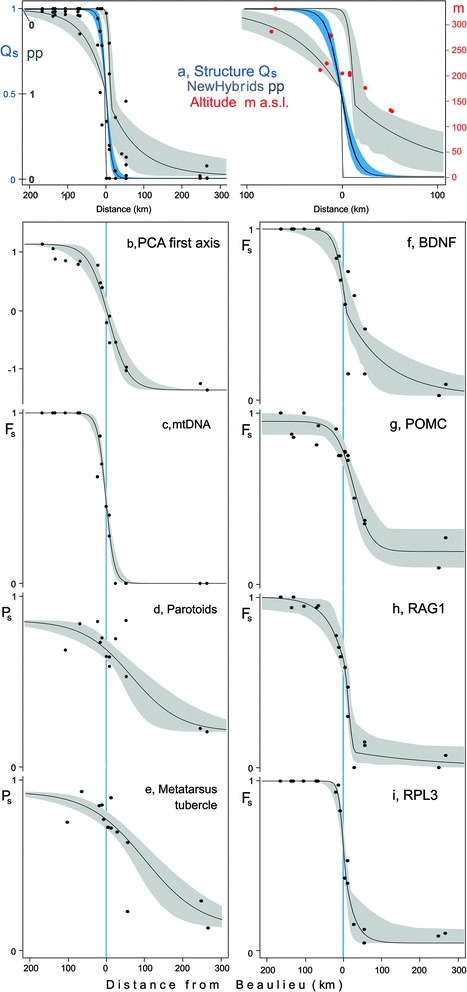
Geographical cline analysis for Bufo spinosus (left, with Qs-values close to unity at vertical axis) and B. bufo (right, with Qs-values close to zero at vertical axis) in a transect in northwestern France. Study populations are as in Table 1 and small solid dots are population averages. Clines were fitted to a) Structure Q-scores (with blue shading) and NewHybrids posterior probabilities for the species (grey shadings with the transition towards B. spinosus left and towards B. bufo right). Note that the graph to the right shows the central part of the transect in detail. Furthermore, b) the loading on the first PCA axis, based on the panel of 12 microsatellites, c) the B. spinosus frequency of the mtDNA marker, d, e) morphological identification probabilities (details see text) and f–i) the B. spinosus frequency of four SNP markers. The 95% credible cline regions are highlighted by grey shadings. The vertical blue line gives the position of population 10, at Beaulieu. Locality altitudes are plotted in red

References

    1. Seehausen O, Butlin RK, Keller I, Wagner CE, Boughman JW, Hohenlohe PA, Peichel CL, Saetre GP, Bank C, Brännström Å, Brelsford A. Genomics and the origin of species. Nat Rev Genet. 2014;15:176–192. doi: 10.1038/nrg3644. - DOI - PubMed
    1. Harrison RG, Larson EL. Hybridization, introgression, and the nature of species boundaries. J Hered. 2014;105:795–809. doi: 10.1093/jhered/esu033. - DOI - PubMed
    1. Hewitt GM. Hybrid zones: natural laboratories for evolutionary studies. Trends Ecol Evol. 1988;3:158–167. doi: 10.1016/0169-5347(88)90033-X. - DOI - PubMed
    1. Endler JA. Geographic variation, speciation and clines. New Jersey: Princeton University Press; 1977. - PubMed
    1. Barton NH, Hewitt GM. Analysis of hybrid zones. Annu Rev Ecol Evol Syst. 1985;16:113–148. doi: 10.1146/annurev.es.16.110185.000553. - DOI

LinkOut - more resources